
There is a kind of loss that doesn't announce itself.
No obituary, timestamp, or record. Their expertise ceased to matter, not due to falsification or being disproved, but because the systems that decide what matters to them, to the "real," moved on. Once those systems decide, they have historically seldom looked back.
What we have inherited is a view of knowledge as something stable, something that waits. Something like a library, where knowledge rests on the shelves. We know we will access it when we need it. This is a self-deceiving image we prefer over the uncomfortable truth. Knowledge has a half-life and becomes less useful with time.
The half-life is not determined by the accuracy of the knowledge. The half-life is determined by the visibility of the knowledge. Knowledge that is never seen can be as correct as the day is long, and yet, knowledge is rendered obsolete with time. Its obsolescence has more to do with the right systems looking the right way at the right time than where and when the knowledge is correct and useful.
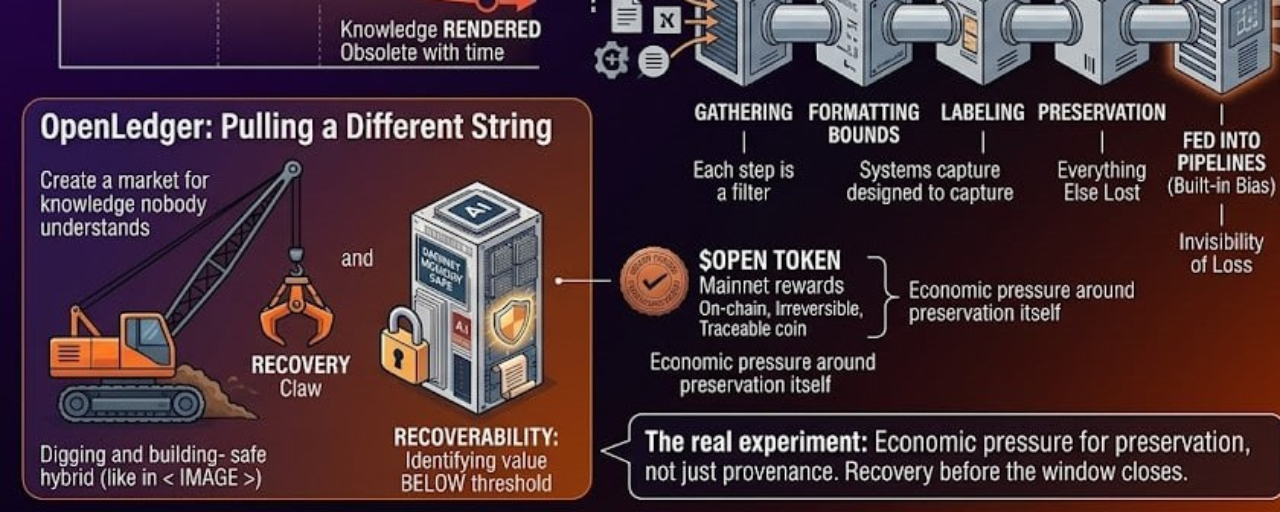
Consider the actual mechanics of how expertise is absorbed by AI systems today. This is very far from a neutral process. Data must be gathered, formatted within certain bounds, labeled, preserved, and fed into pipelines with builtin assumptions.
Each step is a filter and has bias. Systems capture what they were designed to capture. Everything else is lost.
That expertise existed. Fully. Completely. It shaped real decisions, real outcomes.
But it was never legible to the systems that now decide what counts as knowledge.
So from their perspective — it never existed at all.
That is what impedes me the most. It is not the loss itself, but the invisibility of the loss. The model is unaware it is incomplete. The ranking engine does not detect a missing piece. The attribution layer does not account for what it has not processed. The absence is becoming indistinguishable from the permanence of absence. The systems that come after have adapted, normalized, and built upon the absence. Challenging this has become as if one were disputing the ground.
This is where something like OpenLedger pulls on a different string than most infrastructure projects bother doing.
The obvious topic when discussing attribution systems is the compensation discussion - who gets compensated and how, as well as how their contributions are documented. These are important, but not the most concerning questions.
The far more concerning question is much earlier, and is even more upstream of attribution.
What decides whether something is ever even documented in the attribution system?
Attribution rewards only what the system chooses to observe. It distributes credit only within the scope of what survived. It does not look back where visibility ended. Anything that was counted does not account for what was filtered. Anything that does not make it through accumulates in a graveyard that no one is mapping.
That graveyard is massive. And it continues to grow.
The word that comes to mind is recoverability.
Not intelligence. Not computing power. Not even the raw volume of data. Recoverability — the ability to identify value that existed below the threshold long before the systems that value it ever considered looking in that direction.
It is a strange idea to create a market for this because markets spring up around the things that people already know are valuable. But how do you price knowledge that, by definition, nobody understands? How do you design a system to discover something that has successfully avoided discovery?
I do not have a clear answer. But it is important because the AI economy is going to an uncomfortable place if this is not addressed. We are designing more ways to draw signal from human knowledge, and at the same time, we are developing more powerful filters to determine the knowledge that will count as signal. The systems become smarter. The graveyard grows larger. The distance between them will eventually become structural.
The real experiment is not about whether a blockchain can track data provenance.
The real experiment is whether you can build economic pressure around preservation itself. Whether recovery can become worth paying for before the window closes, not after.
Most markets are built on top of what already survived.
A market built around what almost didn't — that's a different thing entirely.
Who owns the value that almost never got created? That question doesn't go away regardless of what any single project builds.
It just keeps getting more expensive to ignore.