
The message arrived at 2:13 a.m.
Not an exploit notification. Not a validator failure. Not a chain outage.
A wallet had approved something it shouldn't have.
The transaction itself was technically valid. Consensus worked exactly as designed. Blocks settled. Infrastructure remained healthy. Every dashboard stayed green.
And yet the room was full by sunrise.
Engineers reviewed logs. Auditors reconstructed approval paths. Compliance officers compared permissions against policy. The risk committee gathered around a screen displaying a sequence of signatures that, individually, looked harmless.
That is how most failures begin.
Not with broken technology.
With trusted technology used too broadly.
The blockchain industry still spends enormous energy chasing speed. New records. Lower latency. Higher throughput. Bigger numbers displayed on conference slides and marketing pages.
But speed rarely appears in postmortem reports.
Permissions do.
Key exposure does.
Authority without boundaries does.
Nobody wakes up to a crisis because a network processed a transaction three seconds slower. They wake up because a wallet had more power than it needed, for longer than it should have.
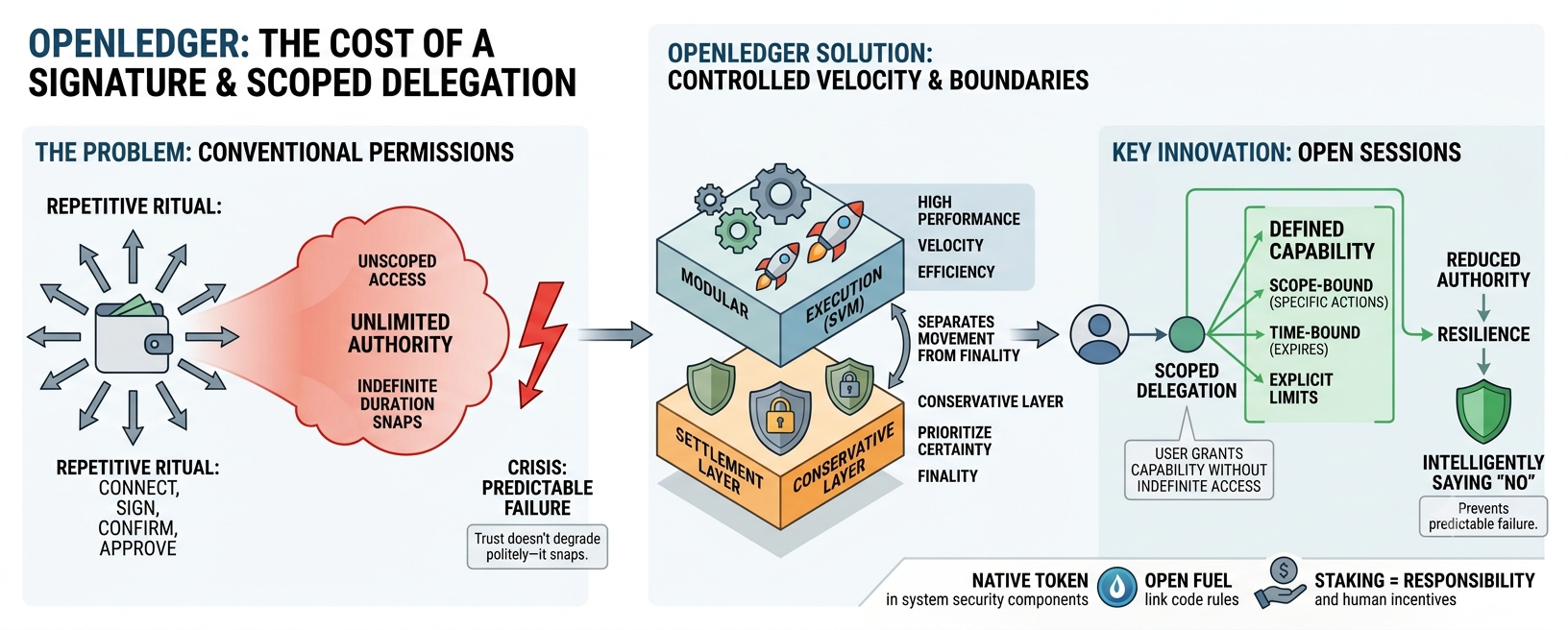
Trust doesn't degrade politely—it snaps.
That sentence appears in more internal reviews than most people would expect.
It is also why OpenLedger feels interesting.
OpenLedger is an SVM-based high-performance Layer 1, but reducing it to throughput misses the point entirely. Performance matters. It should. Systems handling data, models, agents, and liquidity cannot afford unnecessary friction.
But performance without control simply accelerates mistakes.
The more valuable question is whether a fast system can remain disciplined.
Whether it can move quickly while preserving limits.
Whether it can create velocity without surrendering accountability.
OpenLedger approaches that challenge through structure rather than optimism.
Execution remains modular, allowing activity to scale efficiently where speed is needed. Settlement sits underneath as a more conservative layer, designed to prioritize certainty over excitement. The architecture separates movement from finality instead of forcing them to compete.
That distinction sounds technical.
In practice, it is philosophical.
Every mature financial system eventually learns the same lesson: not every layer should be optimized for the same thing.
Some layers create opportunity.
Others create confidence.
Both are necessary.
The clearest example is OPEN Sessions.
For years, on-chain UX has relied on a repetitive ritual. Connect wallet. Sign. Confirm. Sign again. Approve. Reapprove. Hope nothing unexpected hides behind the next request.
Each signature becomes another decision.
Each decision becomes another opportunity for error.
OPEN Sessions replace that pattern with enforced delegation that is both scope-bound and time-bound. Authority is defined. Limits are explicit. Expiration is built in.
The user grants capability without creating indefinite access.
The permission exists for a purpose, and then it ends.
That may sound like a small design choice.
It isn't.
It is a security philosophy.
Scoped delegation + fewer signatures is the next wave of on-chain UX.
Not because users dislike clicking buttons.
Because reducing unnecessary authority is one of the most effective security controls ever created.
The safest permission is often the one that never exists.
The second safest is the one that expires.
This perspective extends to the network itself.
The native token, OPEN, functions as security fuel, while staking represents responsibility more than participation. The relationship matters because security is ultimately a human coordination problem disguised as a technical one.
Code enforces rules.
People enforce incentives.
Healthy systems require both.
Of course, none of this eliminates risk.
Bridge risk remains real.
Cross-chain assumptions remain real.
Operational mistakes remain real.
Audits help. Monitoring helps. Governance helps.
Yet every experienced team eventually discovers the same uncomfortable truth: no checklist is stronger than the permissions model underneath it.
A single exposed key can bypass months of careful planning.
A single excessive approval can invalidate layers of precaution.
This is why EVM compatibility should be viewed primarily as a practical decision. It reduces tooling friction. It helps developers build and migrate more easily. It lowers operational barriers.
Useful, yes.
Foundational, no.
Security lives elsewhere.
It lives inside boundaries.
Inside expiration dates.
Inside controls that prevent authority from expanding beyond its intended scope.
The older the industry becomes, the clearer the pattern gets.
The systems that survive are rarely the loudest.
They are rarely the fastest in every category.
They are the ones designed around the assumption that mistakes will happen and permissions will eventually be tested.
OpenLedger's most interesting feature may not be how quickly it moves.
It may be the fact that it was built with the expectation that speed alone is never enough.
Because in the end, resilience is not measured by how rapidly a network says "yes."
It is measured by how intelligently it says "no."
And a fast ledger that can say "no" prevents predictable failure.
