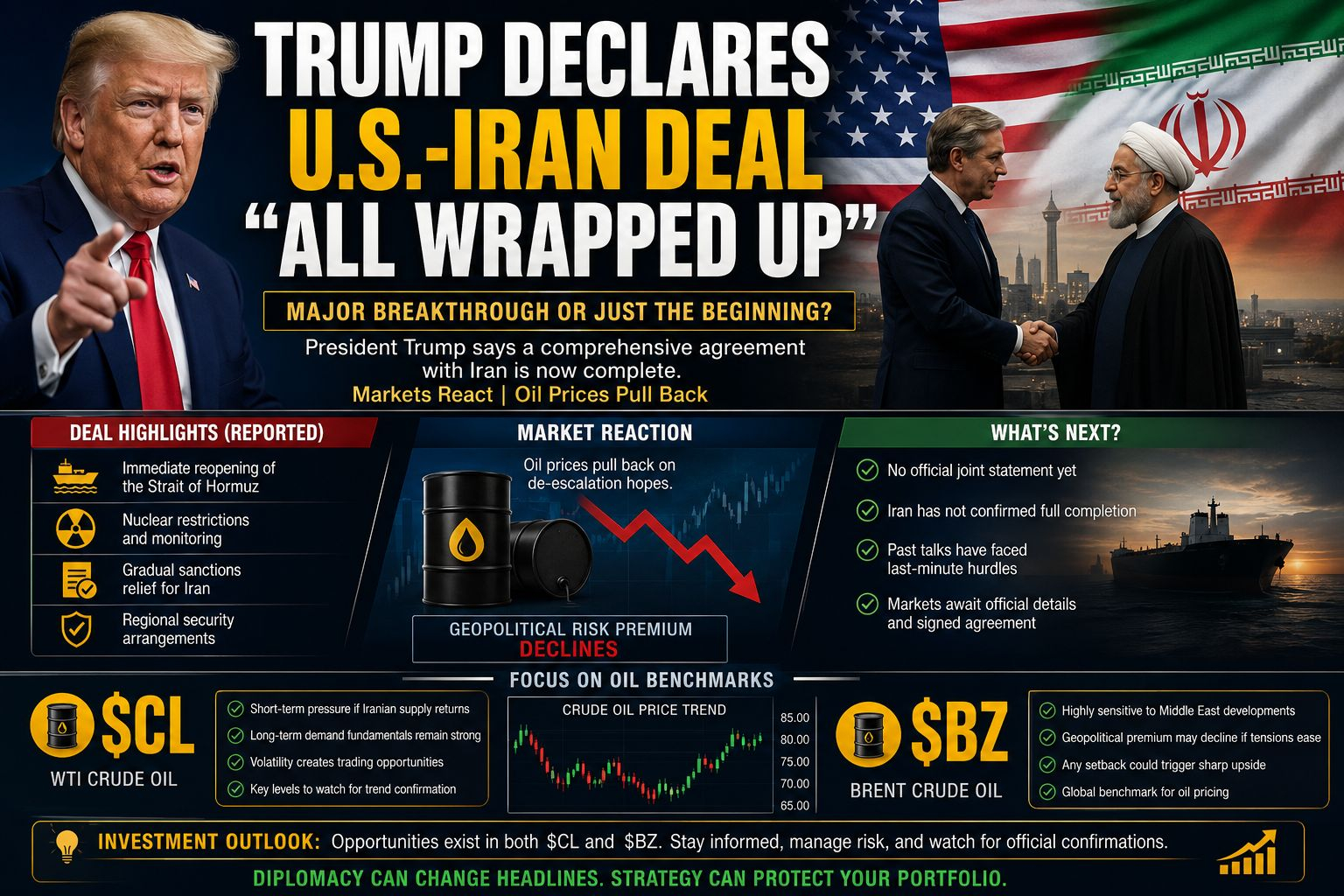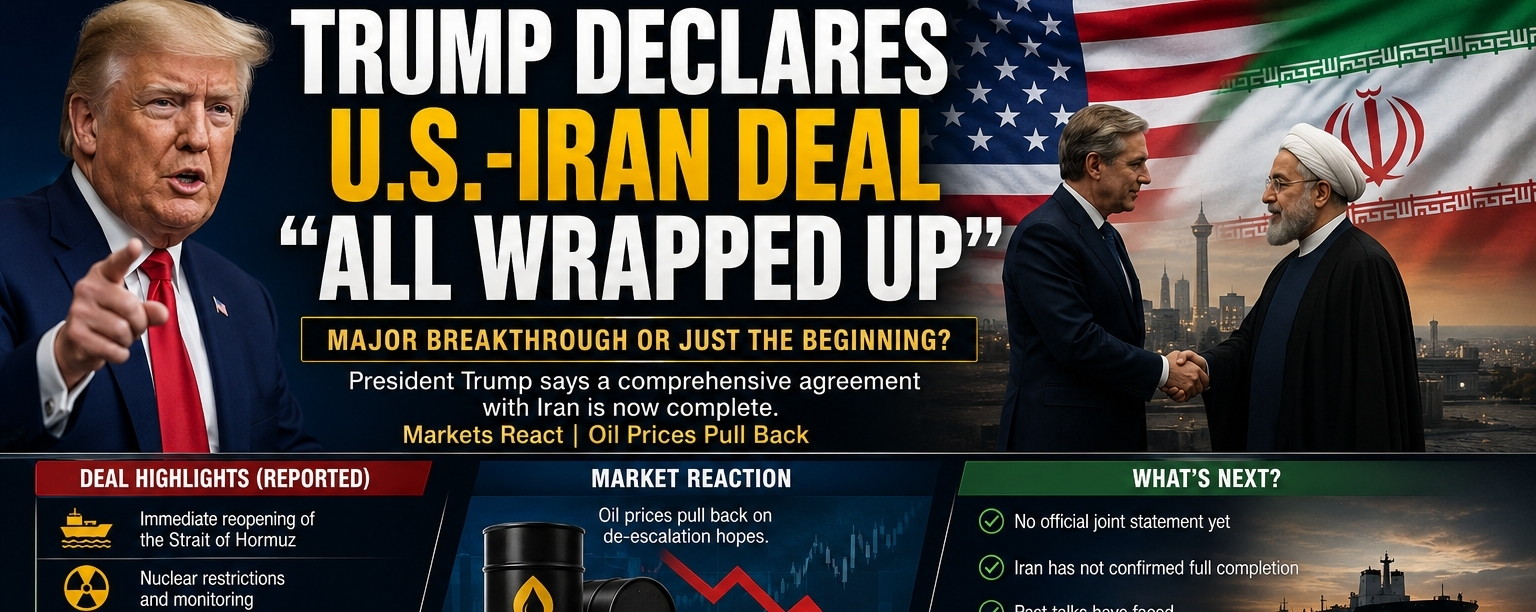
Global financial markets received a major geopolitical headline after U.S. President Donald Trump stated that a comprehensive agreement between the United States and Iran is now “all wrapped up.”
The statement marks the strongest and most confident language used by Trump so far regarding the ongoing negotiations. For weeks, officials had described the discussions as being in their “final phase” and nearing completion, but this latest declaration suggests Washington believes a breakthrough has effectively been achieved.
While investors welcomed the development, markets remain cautious because no official joint statement or signed agreement has yet been released by either side. Iranian authorities have also not publicly confirmed the same level of completion, leaving room for uncertainty until formal details emerge.
Why This Deal Matters to the World
The negotiations involve several highly sensitive issues that directly impact global energy markets and international stability.
Among the key topics reportedly discussed are:
• Reopening and securing the Strait of Hormuz for uninterrupted shipping. • Nuclear program restrictions and monitoring measures. • Gradual sanctions relief for Iran. • Long-term regional security arrangements.
The Strait of Hormuz remains one of the most strategically important waterways on Earth. A significant portion of global oil exports passes through this narrow corridor every day.
Whenever tensions rise in the region, oil traders immediately price in supply disruption risks. Conversely, when diplomatic progress appears likely, those risk premiums often disappear rapidly.
That is exactly what markets began pricing in following Trump's latest comments.
Oil Markets React Immediately
Following the headline, crude oil prices pulled back as traders anticipated a lower probability of military escalation in the Middle East.
For months, geopolitical tensions have supported oil prices through uncertainty and fear of supply disruptions. A successful agreement could reduce those concerns significantly.
However, experienced energy investors understand that headlines alone do not determine long-term trends.
The market still needs answers to several critical questions:
• Will the agreement be officially signed? • How quickly will sanctions be eased? • Can Iranian oil exports return to global markets at full scale? • Will regional stability actually improve?
Until those questions receive concrete answers, volatility is likely to remain elevated.
The Bigger Picture for Energy Investors
Even if a deal is finalized, global oil fundamentals remain complex.
Demand from major economies continues to fluctuate, while production policies from major oil-producing nations will still play a dominant role in determining future prices.
In addition, strategic petroleum reserves, shipping costs, inflation trends, central bank policy decisions, and economic growth expectations continue to influence the direction of crude oil.
This means investors should view the U.S.-Iran agreement as an important factor—but not the only factor—driving the market.
Why $CL Could Remain Attractive
$CL (Crude Oil Futures) remains one of the most closely watched instruments in the energy sector.
A finalized agreement could create short-term downside pressure if traders anticipate increased Iranian supply entering the market.
However, long-term investors understand that oil demand remains a fundamental component of the global economy.
If global growth stabilizes and energy consumption remains strong, temporary geopolitical selloffs may eventually become accumulation opportunities for strategic investors.
For traders, $CL may offer increased volatility and trading opportunities as new information emerges regarding the agreement's implementation.
Why Investors Are Watching $BZ Closely
$ BZ (Brent Crude) often reacts strongly to geopolitical developments involving the Middle East because Brent serves as the international benchmark for global oil pricing.
Should tensions continue to ease, Brent could experience short-term pressure from declining geopolitical premiums.
However, any delay, disagreement, or last-minute complication in negotiations could quickly reverse market sentiment and trigger renewed buying activity.
This creates an environment where disciplined investors are paying close attention to risk management while monitoring developments from both Washington and Tehran.
The Investment Perspective
History shows that geopolitical agreements often create immediate market reactions, but long-term trends are usually determined by actual implementation rather than political announcements.
Trump's statement has undoubtedly increased optimism that a diplomatic resolution may be near.
Yet seasoned investors know that the most important phase often begins after the headlines.
Markets will now focus on official confirmations, signed documents, sanctions timelines, and evidence that commitments are being honored by all parties involved.
For energy investors, the coming weeks could become one of the most important periods of the year.
Final Thoughts
President Trump's declaration that the U.S.-Iran deal is “all wrapped up” has injected fresh optimism into global markets and reduced fears of immediate escalation in the Middle East.
While oil prices initially softened on hopes of de-escalation, investors should remember that geopolitical negotiations rarely move in a straight line.
For those tracking $CL and $BZ , the situation presents both risks and opportunities. A successful agreement could reshape energy flows, alter supply expectations, and create significant trading opportunities across the oil market.
Until official confirmation arrives, investors should remain focused on facts, monitor developments closely, and maintain disciplined risk management.
The next chapter in the U.S.-Iran story may not only influence geopolitics—it could help determine the direction of global energy markets for months to come.