
THE CROSS-CHAIN PARADOX: WHY WEB3 STILL FEELS FRAGMENTED
“THE FUTURE OF CRYPTO WAS MEANT TO FEEL BORDERLESS.”
That promise defined the early vision of blockchain. 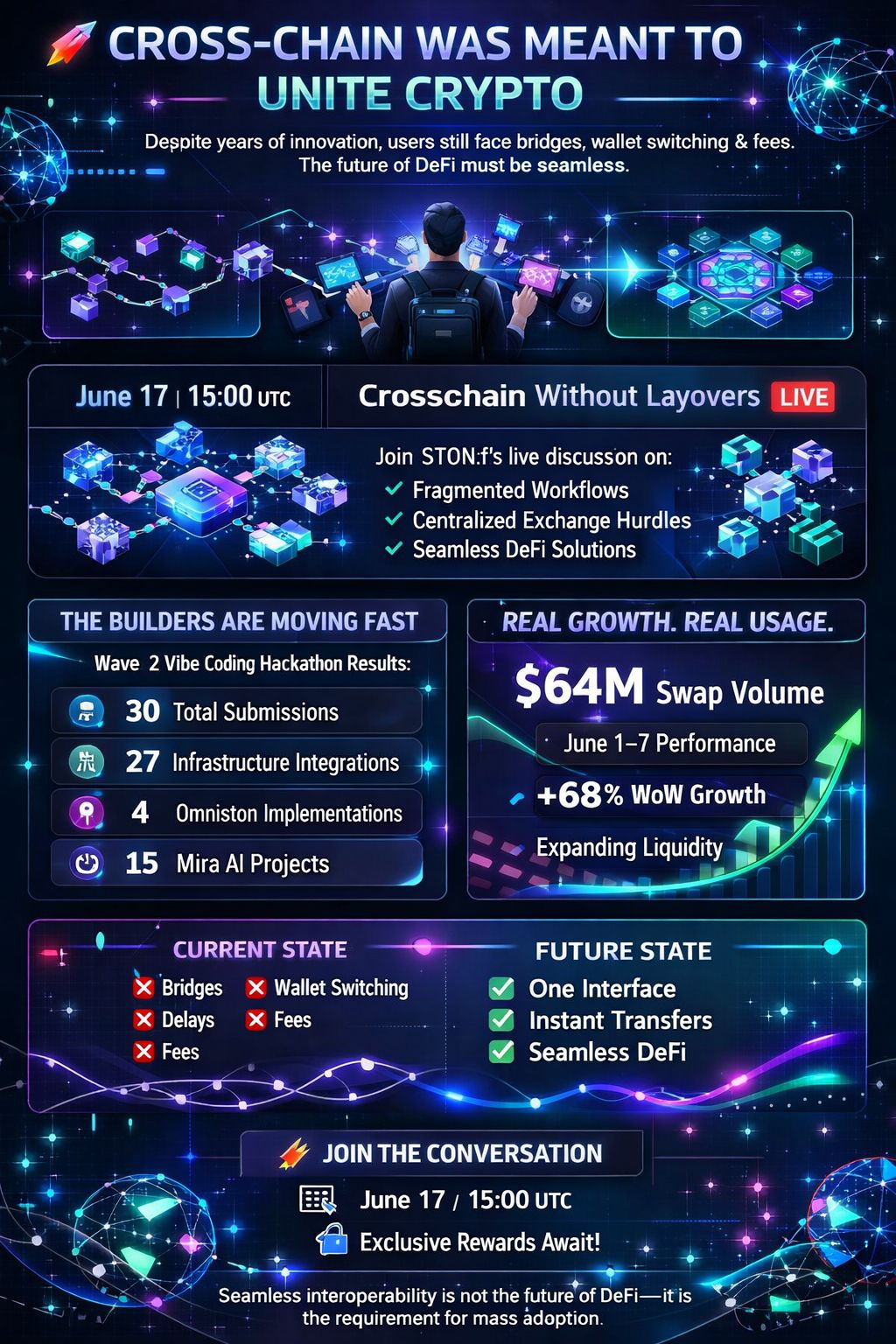
A world where value moves freely across networks, liquidity is always accessible, and users interact with decentralized systems without friction or technical barriers.
Years later, the infrastructure has advanced significantly—but the user experience has not kept pace.
Cross-chain activity today often still feels like a sequence of manual steps rather than a seamless flow: Bridge → Wait → Swap → Switch Wallets → Pay Fees → Hope Nothing Breaks
Despite the sophistication behind the scenes, this remains the default experience for many users. Somewhere along the way, complexity became normalized.
THE REAL PROBLEM IS NOT CONNECTIVITY—IT’S EXPERIENCE
Interoperability is no longer a theoretical concept. It is a working reality. The industry has built bridges, routing systems, liquidity networks, aggregators, and cross-chain messaging protocols. From a technical standpoint, ecosystems are more connected than ever before.
Yet from a user standpoint, fragmentation still dominates.
Common friction points include:
🔹 Multiple wallet approvals
🔹 Network switching between transactions
🔹 Unclear routing paths
🔹 Delays and failed transactions
🔹 Unpredictable fees
For experienced DeFi users, this may feel manageable. For new users, it is a significant barrier to entry. The core issue is no longer whether cross-chain systems function.
It is whether they feel seamless.
“SIMPLICITY IS WHAT USERS VALUE MOST—NOT THE UNDERLYING ARCHITECTURE.”
Despite the growth of decentralized finance, centralized exchanges remain the default solution for many cross-chain movements.
This is not because they are more decentralized or technologically advanced.
It is because they are simpler.
Users prefer predictable flows over complex interactions. They want outcomes, not processes. They care about speed, reliability, and clarity—not infrastructure diagrams.
For DeFi to compete at scale, it must match this level of simplicity without sacrificing decentralization.
BUILDERS ARE ALREADY SHAPING THE NEXT PHASE
Progress is not theoretical—it is already underway.
The STON.fi Vibe Coding Hackathon Wave 2 demonstrated strong momentum across the ecosystem, showcasing how builders are actively addressing real usability challenges in cross-chain finance.
Key highlights include:
🔹 30 valid project submissions
🔹 27 integrations with STON.fi infrastructure
🔹 4 projects using the Omniston cross-chain SDK
🔹 15 projects integrating the Mira AI agent
The range of projects reflects a shift in focus—from infrastructure expansion to user-centric design.
Solutions included cross-chain wallet analytics tools, payment systems, Telegram-native NFT experiences, and liquidity routing applications.
These are not just technical experiments. They are early signals of a more usable DeFi future.
GROWTH IS ACCELERATING
Beyond developer activity, ecosystem usage continues to expand.
@STONfi DEX recently processed approximately $64 million in weekly swap volume, representing around 68% growth week-over-week.
This level of activity reflects growing confidence, deeper liquidity, and increasing real-world usage of decentralized infrastructure.
Sustained growth of this nature suggests that demand for efficient, accessible DeFi systems is accelerating—not slowing down.
“THE FUTURE OF DEFI WILL NOT BE DEFINED BY MORE COMPLEXITY, BUT BY ITS DISAPPEARANCE.”
The next evolution of cross-chain finance will not be about adding more bridges, more layers, or more routing systems.
It will be about abstraction.
Users should not need to understand how value moves between chains. They should simply experience it moving.
The most successful products in Web3 will not be the ones that expose the most infrastructure.
They will be the ones that hide it entirely.
Because the real milestone for interoperability is not connectivity.
It is invisibility.