
Interoperability has always been one of the biggest goals in blockchain.
Different networks brought innovation.
But they also created separation.
Users often had to manage multiple wallets.
Navigate bridges.
Track different networks.
Understand different transaction requirements.
The result was a fragmented experience.
Now, STON.fi is taking a step toward changing that.
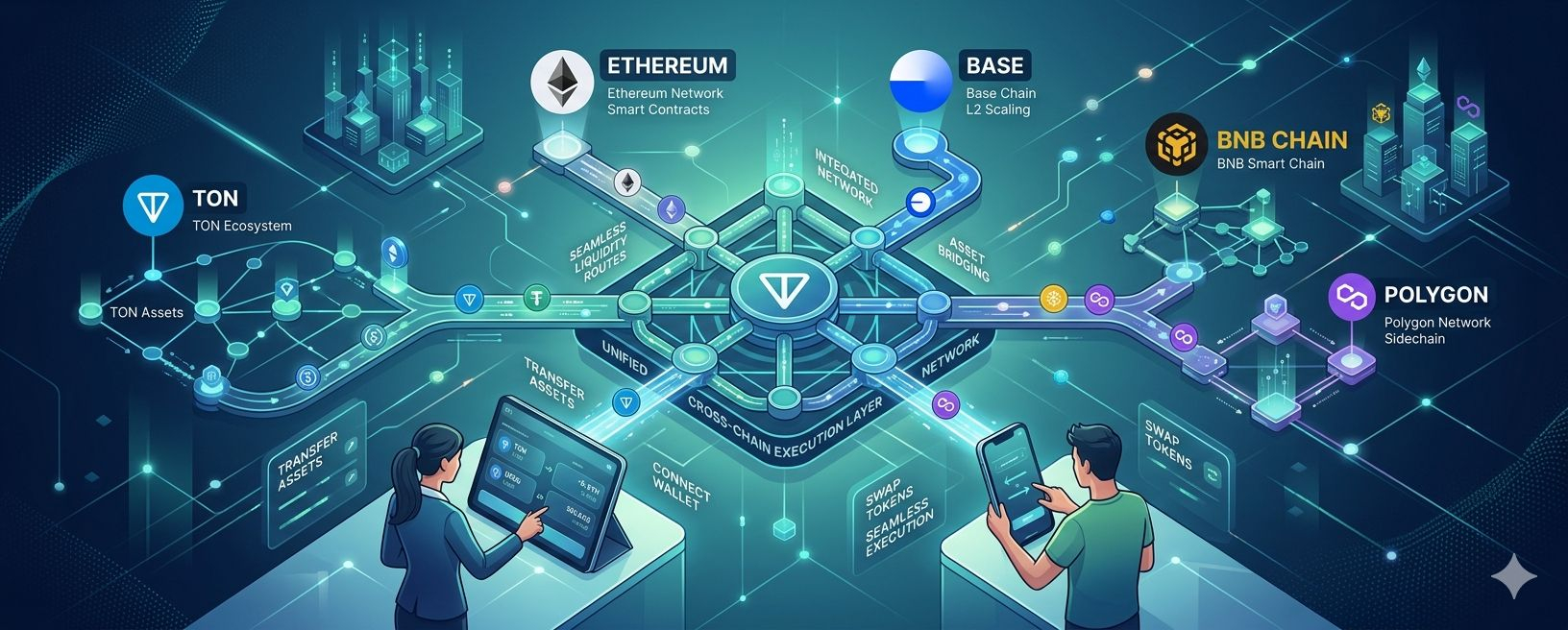
TON <> EVM swaps are now live directly inside the STON.fi dApp.
From Single-Network Liquidity to Multi-Chain Execution
The launch expands the STON.fi experience beyond TON-native swaps.
Users can now access cross-chain swaps between TON and major EVM ecosystems including:
➤ Ethereum
➤ Base
➤ BNB Chain
➤ Polygon
All through one interface.
No separate bridge workflow.
No additional platforms.
No unnecessary switching between applications.
The goal is simple:
Make moving value across ecosystems feel more natural.
Supported Assets at Launch
The initial release focuses on major stablecoins across connected networks.
Supported assets include:
➤ USDT on TON
➤ USDT and USDC on Base
➤ USDT and USDC on Ethereum
➤ USDC and pUSD on Polygon
This creates practical routes for users who need to move stable liquidity between ecosystems.
For example:
A user can swap USDC on Base into USDT on Ethereum directly inside the application.
The complexity remains behind the scenes.
The user experience stays simple.
The Infrastructure Behind the Experience
The technology enabling this expansion is Omniston.
Originally designed as a liquidity aggregation layer for TON, Omniston is evolving into a broader execution framework.
Its role is not just finding liquidity.
It coordinates execution across multiple environments.
Behind every cross-chain swap are complex processes:
➤ Route discovery
➤ Liquidity optimization
➤ Execution coordination
➤ Settlement tracking
Omniston brings these pieces together into one execution flow.
Reducing Cross-Chain Friction
One of the biggest challenges in DeFi is not access.
It is usability.
A system can be technically powerful and still feel difficult if users must understand every underlying mechanism.
The future of decentralized finance likely depends on abstraction.
Users should focus on:
➤ What asset they want
➤ Where they want it
➤ What action they want to complete
The infrastructure should handle the complexity.
Predictability Matters
Cross-chain systems introduce additional variables.
Different networks.
Different execution environments.
Different settlement processes.
That makes reliability important.
With Omniston, users receive the exact amount displayed in the interface.
If the execution conditions cannot be met, the swap does not complete and funds are returned.
This creates a clearer expectation between user intent and final execution.
Early Stage, Bigger Direction
At launch, cross-chain swap volume is temporarily limited to:
➤ $1,000 per transaction
But the importance of the update goes beyond the current limit.
It represents a broader shift.
TON is becoming more connected with the wider blockchain landscape.
DeFi is moving from isolated ecosystems toward interconnected networks.
Closing Reflection
The next phase of blockchain adoption will not only depend on faster chains or more applications.
It will depend on removing barriers between them.
Cross-chain infrastructure is becoming less about moving assets.
And more about making different networks feel like one connected system.
STON.fi’s expansion with Omniston is another step toward that future.
👉 Explore TON <> EVM swaps on STON.fi and experience a more connected DeFi ecosystem.