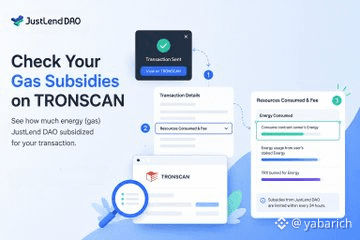
🚀 THE TRANSACTION IS ONLY THE RESULT — THE REAL STORY IS THE INFRASTRUCTURE BEHIND IT
Most blockchain users focus on a single outcome:
Did the transaction succeed?
If the answer is yes, they move on.
The transfer was completed.
The swap executed.
The funds arrived.
Mission accomplished.
But beneath every successful transaction lies an entire layer of infrastructure that most users never see.
And understanding that infrastructure provides valuable insight into how blockchain networks actually work.
Especially on TRON, where resource management plays a unique role in enabling efficient transactions.
1️⃣ EVERY TRANSACTION CONSUMES RESOURCES
On traditional payment networks, users rarely think about what happens behind the scenes.
The same principle applies to blockchain.
Every successful transaction requires resources.
On TRON, these resources primarily include:
⚡ Energy
🌐 Bandwidth
🖥 Network validation
🔗 Smart contract execution
While users often focus on the outcome, the network focuses on the process.
The transaction itself is simply the final result.
2️⃣ ENERGY IS THE FUEL OF SMART CONTRACTS
One of the most misunderstood concepts on TRON is Energy.
Energy is not a token.
It is not a cryptocurrency.
It is a network resource used to execute smart contracts.
Whenever users:
🔹 Transfer certain assets
🔹 Interact with DeFi protocols
🔹 Execute contract functions
🔹 Participate in lending markets
🔹 Perform on-chain operations
Energy helps power those interactions.
Without it, smart contracts cannot operate efficiently.
3️⃣ MOST USERS NEVER SEE WHAT HAPPENS UNDER THE HOOD
This is actually a sign of good infrastructure.
The best systems are often invisible.
People use websites without thinking about servers.
They stream videos without thinking about data centers.
They send messages without thinking about network routing.
Similarly, most users complete transactions without examining how resources were consumed.
But for those interested in blockchain mechanics, resource utilization reveals a fascinating layer of network activity.
4️⃣ RESOURCE DATA PROVIDES INSIGHT INTO NETWORK EFFICIENCY
Looking beyond transaction success can help users better understand:
📊 Resource consumption
📊 Contract efficiency
📊 Network optimization
📊 Operational costs
📊 Ecosystem activity
This information is especially valuable for active DeFi participants who interact with smart contracts frequently.
Understanding resource usage can help improve both efficiency and strategy.
5️⃣ WHY ENERGY MATTERS TO DEFI
Protocols across the TRON ecosystem depend heavily on smart contract execution.
Including:
🏦 Lending
🏦 Borrowing
🏦 Yield farming
🏦 Stablecoin transfers
🏦 Liquidity management
Every interaction requires underlying network resources.
This means Energy plays an important role in supporting the broader DeFi economy.
The smoother resource management becomes, the more seamless the user experience becomes.
6️⃣ JUSTLENDDAO PLAYS A KEY ROLE IN THE RESOURCE ECONOMY
One interesting aspect of the TRON ecosystem is how resource markets themselves create economic activity.
Through mechanisms such as:
⚡ Energy generation
⚡ Resource allocation
⚡ Lending participation
⚡ Capital deployment
⚡ Network utilization
users gain exposure to a unique blockchain economic model.
Understanding resource usage helps reveal how these systems interact beneath the surface.
7️⃣ THE FUTURE OF BLOCKCHAIN UX IS INVISIBLE COMPLEXITY
Most users do not want to manage technical details.
And eventually, they probably won't need to.
The future of blockchain adoption will likely involve:
🚀 Automated resource management
🚀 Simplified transactions
🚀 Gas abstraction
🚀 Seamless user experiences
🚀 Invisible infrastructure
The goal is not to expose more complexity.
The goal is to hide complexity while maintaining transparency for those who want to explore it.
8️⃣ THE MOST INTERESTING PART HAPPENS BEFORE THE CONFIRMATION
A successful transaction is only the final chapter.
Behind every confirmation lies:
🔍 Resource allocation
🔍 Smart contract execution
🔍 Network validation
🔍 Economic incentives
🔍 Infrastructure coordination
For casual users, the confirmation message is enough.
For curious users, understanding what happened behind the scenes provides a much deeper appreciation of how decentralized networks operate.
Because blockchain is not just about moving assets.
It is about coordinating resources across a global network.
And sometimes the most interesting part isn't whether a transaction succeeded.
It's understanding how the network made that success possible.
@justinsuntron
#TRONEcoStar