
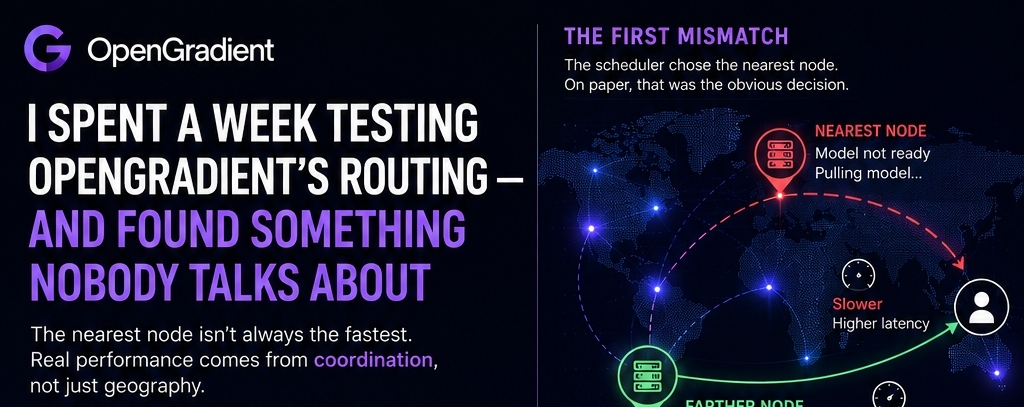
I was testing a routing scenario for OpenGradient the other day when one request kept missing its latency target.
The scheduler chose the nearest inference node. On paper, that was the obvious decision. Except the node didn't have the requested model ready. It started pulling the model while another node, slightly farther away, was already warm and mostly idle. The shorter network path became the slower execution path.
That was the first mismatch.
I had been treating node placement like a geography problem. It's closer to a coordination problem with geography inside it. Distance matters, but so do GPU capacity, queue pressure, model state, and whether the backup node actually fails differently from the primary.
The map looked distributed. The dependency graph did not.
Two nodes in separate cities can still share one cloud provider, one operator, or one regional network failure. And the full nodes shouldn't necessarily follow the same map as inference nodes. They're optimizing proof propagation and failure independence, not just user response time. Data nodes introduce another direction entirely because proximity to the source may matter more than proximity to the user.
OpenGradient's architecture handles this through something called the Hybrid AI Compute Architecture (HACA). Instead of making every validator re-execute every inference — which doesn't scale for AI workloads — the network splits into specialized roles:
· Inference nodes run the models
· Full nodes verify proofs and maintain the ledger
· Data nodes fetch external data in isolated environments
No single node type does everything. They coordinate.
The network has already processed over 2 million verifiable AI inferences and generated more than 500,000 zkML proofs and TEE attestations. Over 4,400 models are now deployed. That's not testnet numbers anymore — that's real usage.
But I'm less certain about the incentive layer. Facility-location models help make those tradeoffs visible, but will operators actually distribute themselves optimally? Or will they cluster where rewards are easiest to earn?
The real test is where the next nodes appear — and whether they reduce the delays and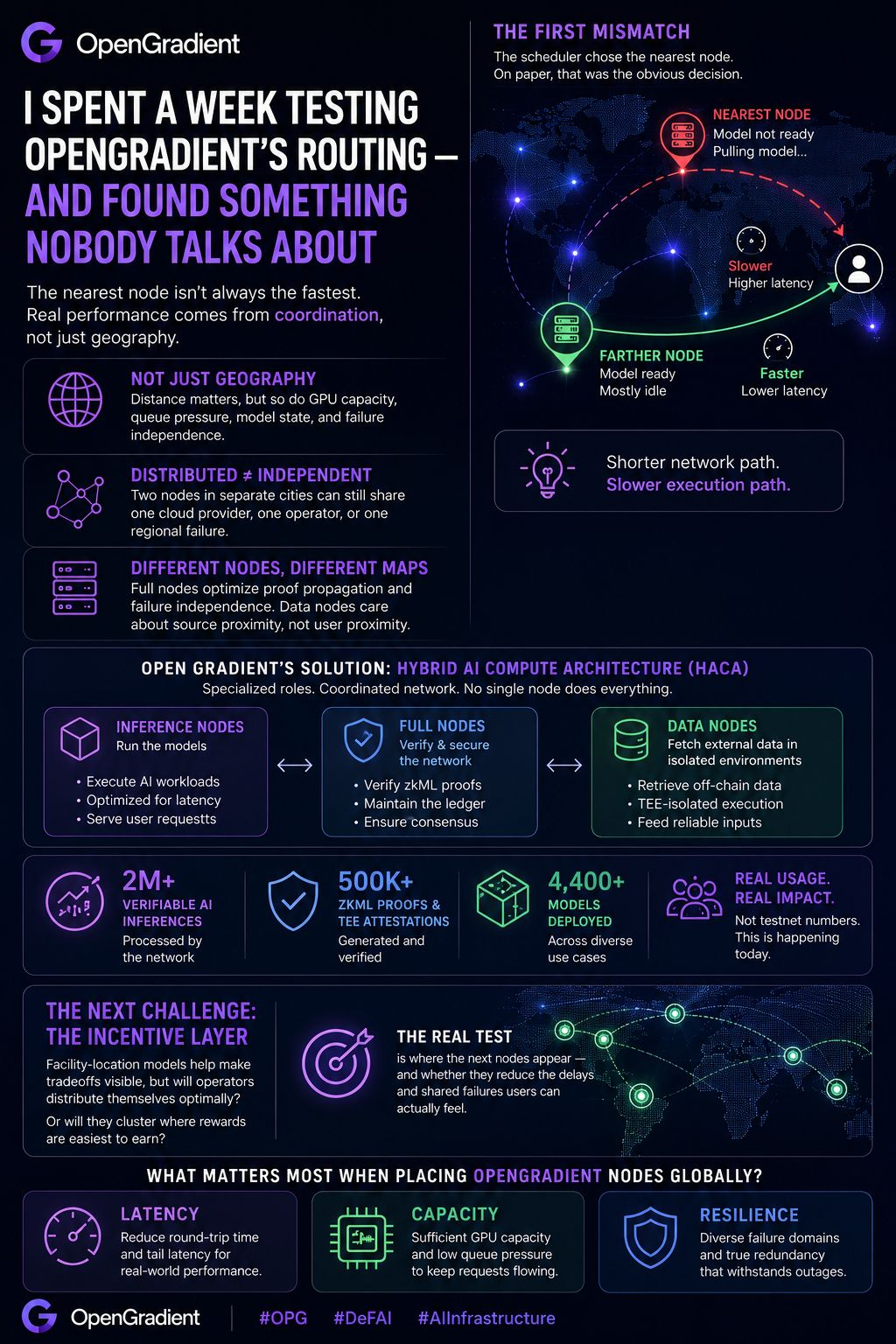
 shared failures users can actually feel.$OPG
What matters most when placing OpenGradient nodes globally?
· Latency
· Capacity
· Resilience
#OPG @OpenGradient #DeFAI #AIInfrastructure