

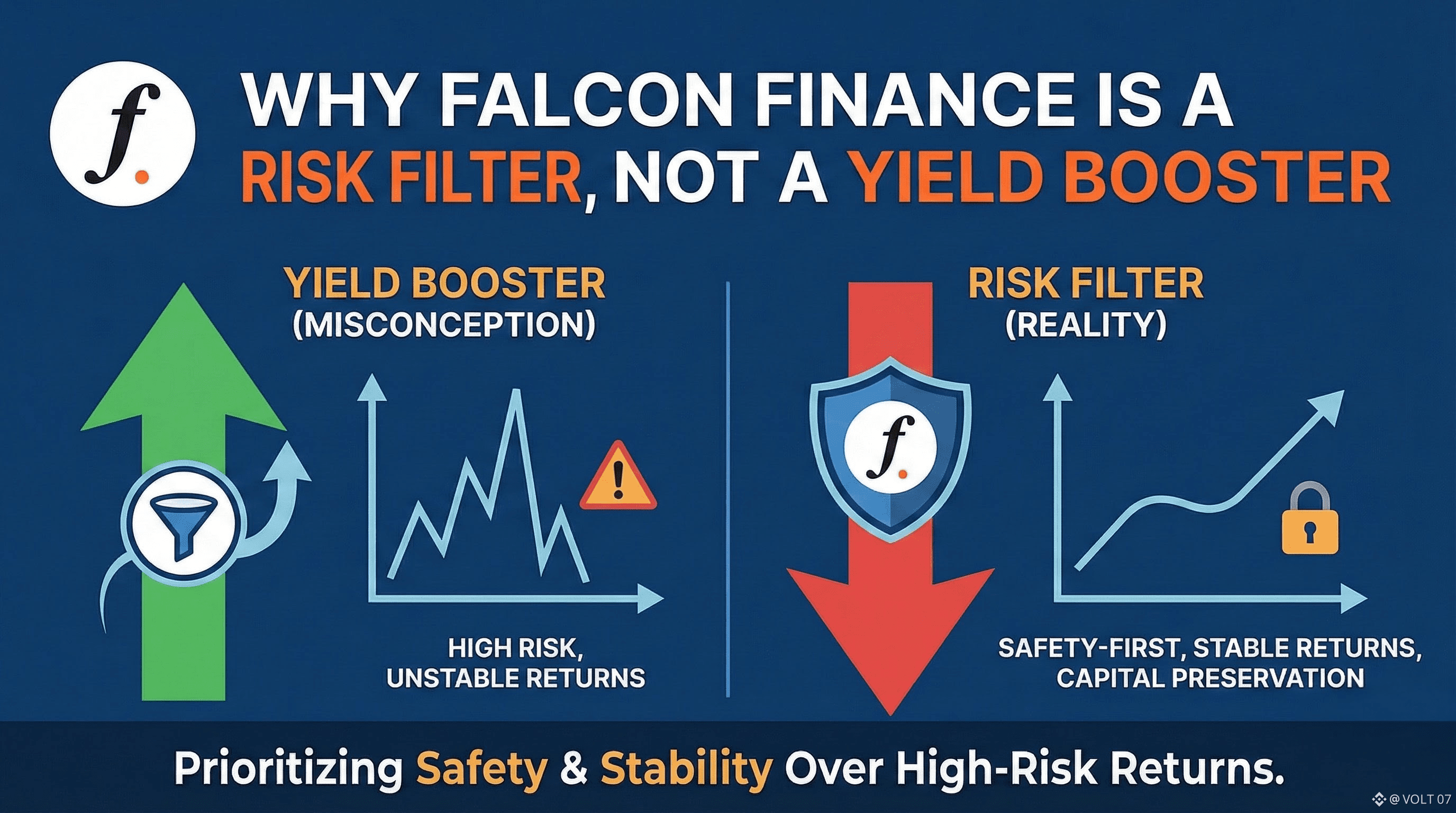
 There’s a quiet misunderstanding that follows almost every yield protocol in crypto. People assume it exists to push returns higher, to squeeze more performance out of capital, to turn patience into profit as fast as possible. That assumption doesn’t quite fit Falcon Finance. If you watch how it’s actually being used, a different picture emerges. Falcon Finance isn’t being pulled into portfolios to amplify upside. It’s being used to shape risk.
Yield boosters attract attention through numbers. Higher APRs, aggressive incentives, constant optimization. Risk filters do the opposite. They’re quiet. They don’t promise excitement. They promise restraint. Falcon Finance sits much closer to that second category. The capital flowing into it doesn’t behave like capital chasing yield at all. It behaves like capital looking for a place to slow down.
This makes sense when you look at where many crypto portfolios struggle. The problem usually isn’t a lack of opportunity. It’s excess exposure to the same kind of risk. Too many positions move together. Too much dependence on sentiment. Too little insulation when markets turn sharp. In that context, Falcon Finance becomes useful not because it offers the best returns, but because it behaves differently when conditions change.
Using Falcon Finance as a risk filter means treating it as a stabilizing layer rather than a performance engine. Returns come from participation and continuity, not from market acceleration. That distinction matters. When volatility rises, assets designed to boost yield often amplify stress. Positions require constant attention. Liquidity becomes reactive. Small shocks ripple outward. Falcon Finance tends to absorb rather than magnify those moments, which is exactly what a risk-aware portfolio needs.
There’s also a behavioral aspect that’s hard to quantify but easy to feel. Yield boosters demand action. They pull users into cycles of reallocation, optimization, and constant evaluation. Risk filters reduce decision pressure. Capital placed in Falcon Finance doesn’t beg to be moved every week. That calmness changes how people behave during uncertainty. And behavior, more than math, is what usually determines portfolio outcomes over time.
Another reason Falcon Finance is being used this way is expectation management. People entering purely for yield tend to leave the moment returns compress or alternatives appear. People entering for structure tend to stay longer. The participation patterns around Falcon Finance suggest the second group is growing. Users seem less focused on maximizing short-term output and more focused on maintaining exposure without compounding risk elsewhere.
This doesn’t mean Falcon Finance avoids risk entirely. No protocol does. Smart contract exposure, liquidity shifts, and market-wide stress still apply. But as part of a broader allocation, it changes the texture of risk. It adds a layer that doesn’t depend on constant optimism to function. And in crypto, that’s rare.
The most telling sign is how Falcon Finance fits into conversations about portfolios. It’s not discussed as the place where returns explode. It’s discussed as the place where portfolios breathe. Where exposure exists without demanding constant justification. Where capital can remain productive without becoming fragile.
In a market that often mistakes aggression for intelligence, this role is easy to overlook. But as more participants move toward disciplined portfolio construction, tools that filter risk become more valuable than tools that chase yield. Falcon Finance fits naturally into that evolution.
It isn’t there to make portfolios louder. It’s there to make them more resilient. And in the long run, resilience tends to matter far more than excitement ever does.

