

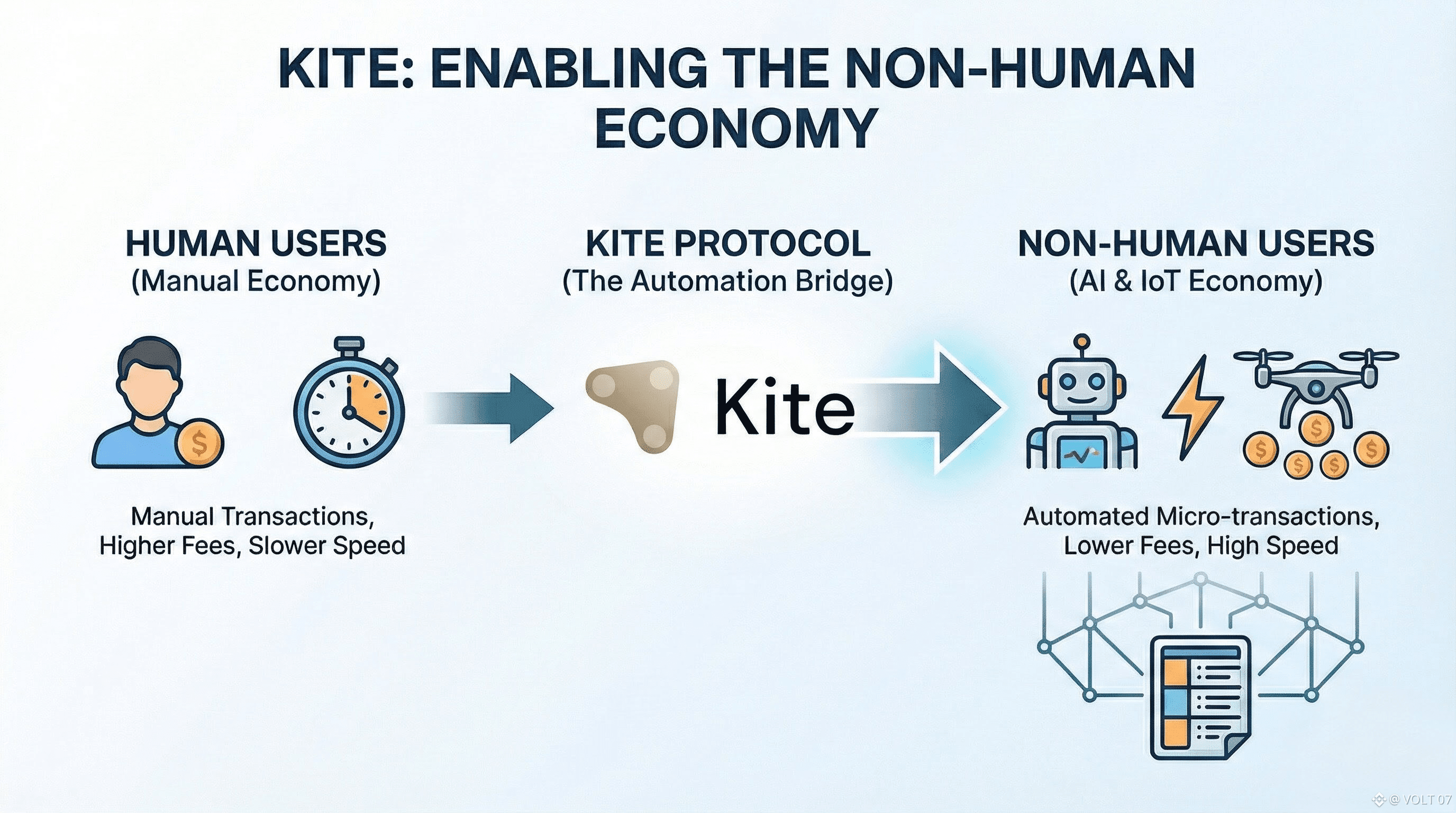
 Blockchain economics has always assumed a human at the keyboard KITE is built for a future where that assumption no longer holds.
Most blockchains, including today’s most successful ones, are designed around human behavior: wallets controlled by individuals, transactions triggered manually, and economic activity shaped by psychology, incentives, and narrative cycles.
KITE is a categorical departure from this model. It's designed for non-human users: autonomous AI agents, machine services, and algorithmic entities that act on-chain continuously, rationally, and without fatigue. This change in premise alters the very way on-chain economics must be designed.
Non-human users behave nothing like humans - and markets must adjust.
Human-driven economies are noisy. They overreact and underreact, and they respond to incentives emotionally. The behavior of non-human users is different:
they operate continuously, not episodically
they optimise over constraints, not narratives
they value predictability over optionality
they execute at machine cadence, not human pace
They respond to policy, not persuasion.
This is the reality KITE'S economic model starts with. It does not attempt to accommodate human irrationality; it assumes machine rationality.
First, the economic requirement that non-human users have from the system is deterministic cost.
AI agents will not work in environments where transaction costs fluctuate wildly or execution outcomes become probabilistic.
KITE addresses this in identifying the following priorities:
predictable fee structures
low volatility in the cost of execution.
deterministic settlement guarantees
Minimum variance under load
This allows agents to model costs accurately-a prerequisite for any autonomous system that is supposed to operate profitably for extended periods of time.
Non-human users need programmable capital, not discretionary approval.
Capital movement in human-centered DeFi is gated by signatures, confirmations, and ultimate manual oversight.
KITE replaces this with policy-driven finance, whereby agents act within defined economic bounds:
spending caps
permissions based on the given roles
whitelisted counterparties
time-bound budgets
emergency shutdown conditions
This enables capital management by machines themselves in a safe, auditable, and constrained manner-an economic requirement that native blockchains cannot enforce.
Earning becomes the predominant economic loop rather than mere speculation.
Human users normally speculate over blockchains.
Non-human users interact to create value.
On KITE, agents can:
sell computation
provide information
perform tasks
Do an analysis coordinate workflows
arbitrate information
This naturally takes humanity to an economy where demand is based on utility, not sentiment. A payment is made because the job is done, not because tokens have been moved around.
Continuous micro-transactions reshape token velocity.
Human-driven systems generate bursty, irregular transaction patterns.
Machine-driven systems generate steady, granular flow:
frequent small payments
constant settlement cycles
high transaction counts with low variance
persistent demand for blockspace
KITE’s economic model anticipates this by treating throughput and reliability as economic primitives, not scaling afterthoughts.
Non-human economies demand native coordination, not ad-hoc markets.
Machines do not browse marketplaces. They follow instructions.
KITE’s instruction layer enables:
machine-readable task definitions
conditional execution logic
verifiable completion proofs
automatic settlement
This turns the blockchain from a passive ledger into an active coordination layer, where economic activity is orchestrated rather than discovered.
Trust in non-human economies is enforced by rules, not reputation.
Human markets require social trust, brands, and reputation.
Machine markets depend on hard constraints:
deterministic execution
traces of auditable behavior
enforceable policies
"Transparent Settlement"
KITE incorporates these guarantees into the protocol itself and does so in a manner that ensures that trust is a designed architectural function and not a so-called emergent form of social trust.
The token demand will become infrastructural instead of speculative.
In retail-driven systems, tokens derive demand from expectation.
In non-human systems, tokens derive demand from necessity:
agents need tokens to pay
workflows require settlement
services require compensation
coordination requires economic signaling
This shifts the token’s role from a store of belief to a unit of economic bandwidth a profound change in how value accrues.
The compounding effect of non-human participation.
Human adoption scales linearly.
Non-human participation scales exponentially.
As more agents deploy on KITE:
economic activity increases autonomously
transaction volume becomes sentiment-independent
demand stabilizes across market cycles
system usage compounds quietly
This is why non-human users are not just another segment they are an entirely new economic class.
Why KITE’s model signals the next phase of blockchain economics.
Most blockchains are optimizing for users.
KITE is optimizing for systems that use blockchains.
This puts it at a forefront position among a structural change that is already in progress, namely the shift from human-driven finance towards economic activity that is machine-native.
Conclusion: non-human users will define the next decade of on-chain growth.
As AI systems become autonomous economic actors, blockchains must evolve beyond interfaces and incentives. They must offer:
deterministic economics
programmable capital
continuous settlement
system-level coordination
KITE is one of the first networks designed explicitly for this reality.
The future of blockchain economics will not be shaped by who trades the most but by what transacts the most.
And increasingly, that “what” will not be human.
Markets evolve when participants change. When machines become economic actors, finance must be rebuilt around certainty, not emotion.

