
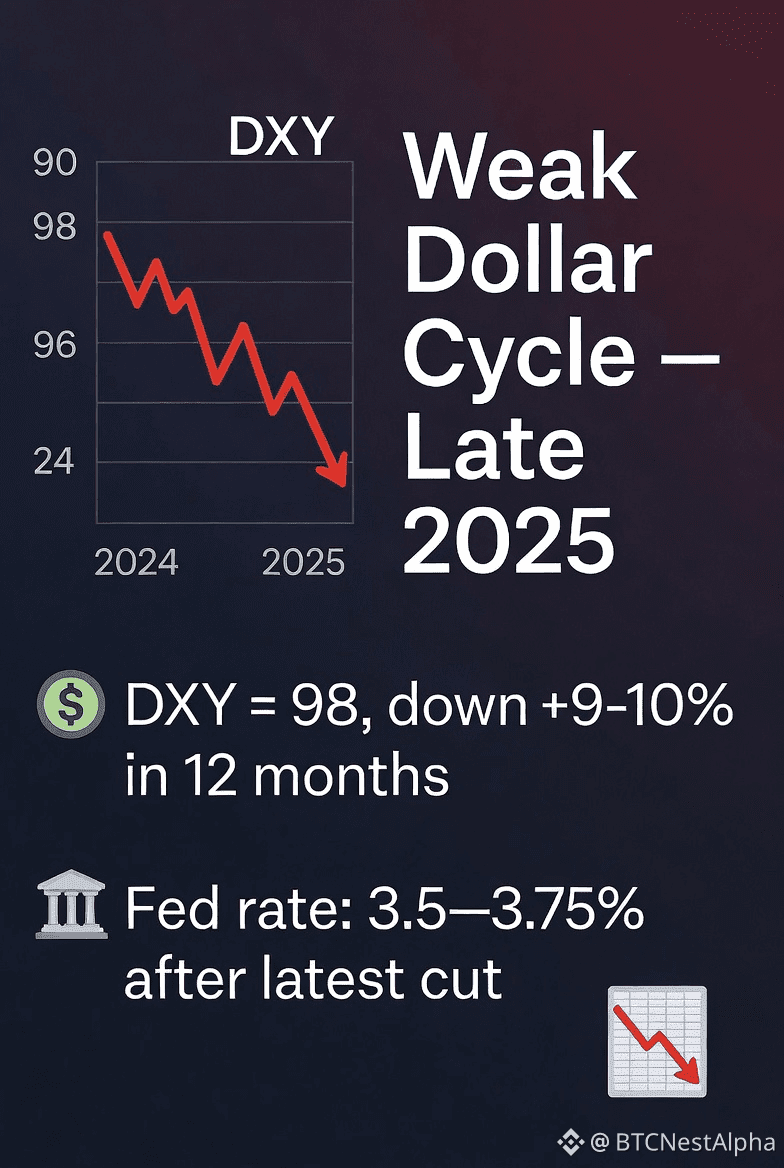
As we wrap up December 25, 2025 (Christmas Day), global markets are in holiday mode with thin trading volume. The US Dollar Index (DXY) is hovering near 98, down roughly 9–10% over the last 12 months, making 2025 one of the weakest dollar years in recent history. USD/CNY around 7.02 reflects ongoing dollar pressure after the Fed’s latest 25 bps cut, which brought the federal funds rate down to a 3.5–3.75% target range.
For investors in crypto, US equities, and emerging markets, the key question heading into 2026 is simple: soft landing or recession? This macro outcome will decide where capital rotates next and which assets outperform. Emerging markets remain a sensitive barometer of global risk appetite because they react quickly to shifts in growth, liquidity, and the dollar.
Three Rules in Weak Dollar PhasesCapital leaves USD assets: Weaker dollar environments often push money toward higher‑return opportunities such as US stocks, crypto, and select emerging markets with strong carry and growth stories.
Expect early‑stage chaos: Volatility and sharp rotations are common until the full impact of policy shifts and rate cuts becomes clearer.Quality outperforms: Assets with solid balance sheets, real cash flows, or clear use‑cases tend to lead, while speculative or weak projects lag or get wiped out.
Right now, the Fed appears to have wrapped its 2025 easing cycle, but markets remain split on how many cuts might come in 2026, especially with growth data still surprisingly resilient. Institutional flows into crypto are slowly increasing, and emerging markets are seeing cautious inflows, yet there is no dominant risk‑on trend – making patience and position sizing crucial.
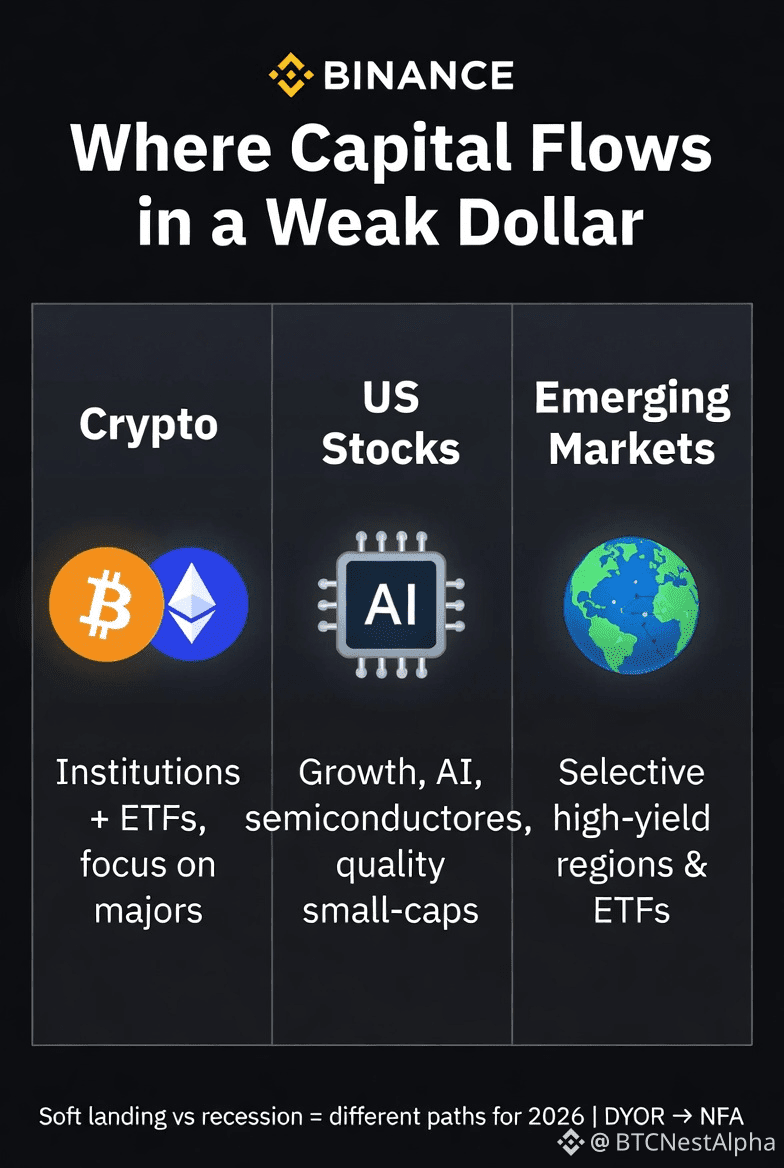
Scenario 1: Soft Landing (More Likely) – Risk Assets Win in 2026If rate cuts support growth without triggering a deep downturn, risk assets usually benefit. Capital tends to chase higher‑beta opportunities once investors gain confidence that inflation and policy are under control.
Crypto: Bitcoin leads with continued institutional and spot ETF demand, while fundamentally strong altcoins recover and weaker memes fade. Volatility remains elevated but manageable compared to earlier cycles.
US Stocks: Growth themes such as tech, AI, semiconductors, and quality small‑caps push indices to new highs; deeply cyclical sectors remain more mixed.
Emerging Markets: Countries with relatively stable fiscal policy and attractive yields – for example parts of Southeast Asia and other disciplined regions – can see stronger inflows, lifting both local equities and currencies.
Scenario 2: Hard Recession (Less Likely) – Safe Havens Take Control
If growth rolls over sharply and a full‑blown recession hits, the playbook flips towards safety and liquidity. Flight‑to‑quality flows dominate, especially in the early phase of the downturn.
Crypto: The initial leg usually brings a sharp sell‑off; Bitcoin tends to hold up better and recover first, while high‑beta altcoins face heavy drawdowns.
US Stocks: Expensive growth and tech names lead the downside, but defensives such as consumer staples and healthcare hold relatively better.
Emerging Markets: Broad outflows pressure both stocks and FX; only true safe‑haven markets (for example some strong‑balance‑sheet economies or key commodity exporters) stay comparatively resilient.
Practical Positioning Ideas for 2026
Keep a cash buffer to add during clearer trends instead of going all‑in at once.
Crypto: Focus mainly on majors like BTC and ETH; keep total altcoin exposure modest (for example, under 20% of the crypto allocation).
US Stocks: Tilt toward quality growth and tech while using hedges or partial defensives to manage drawdowns.
Emerging Markets: Prefer diversified regional or factor‑based ETFs over single, illiquid names.
For additional protection, some allocation to gold still makes sense, with prices recently hitting an all‑time high around $4,490 per ounce on strong safe‑haven demand and central‑bank buying. The weak‑dollar trend looks set to persist into 2026 according to many macro models, but real gains will depend on discipline – build positions gradually, prioritize quality, and ignore short‑term hype.
DYOR | NFA 🚨

