
1. Current Status (as of 2025)
Kyrgyzstan does not yet have a fully operational, widely adopted official stablecoin linked directly to the Kyrgyz som (KGS).
However, there are two closely related developments that matter:
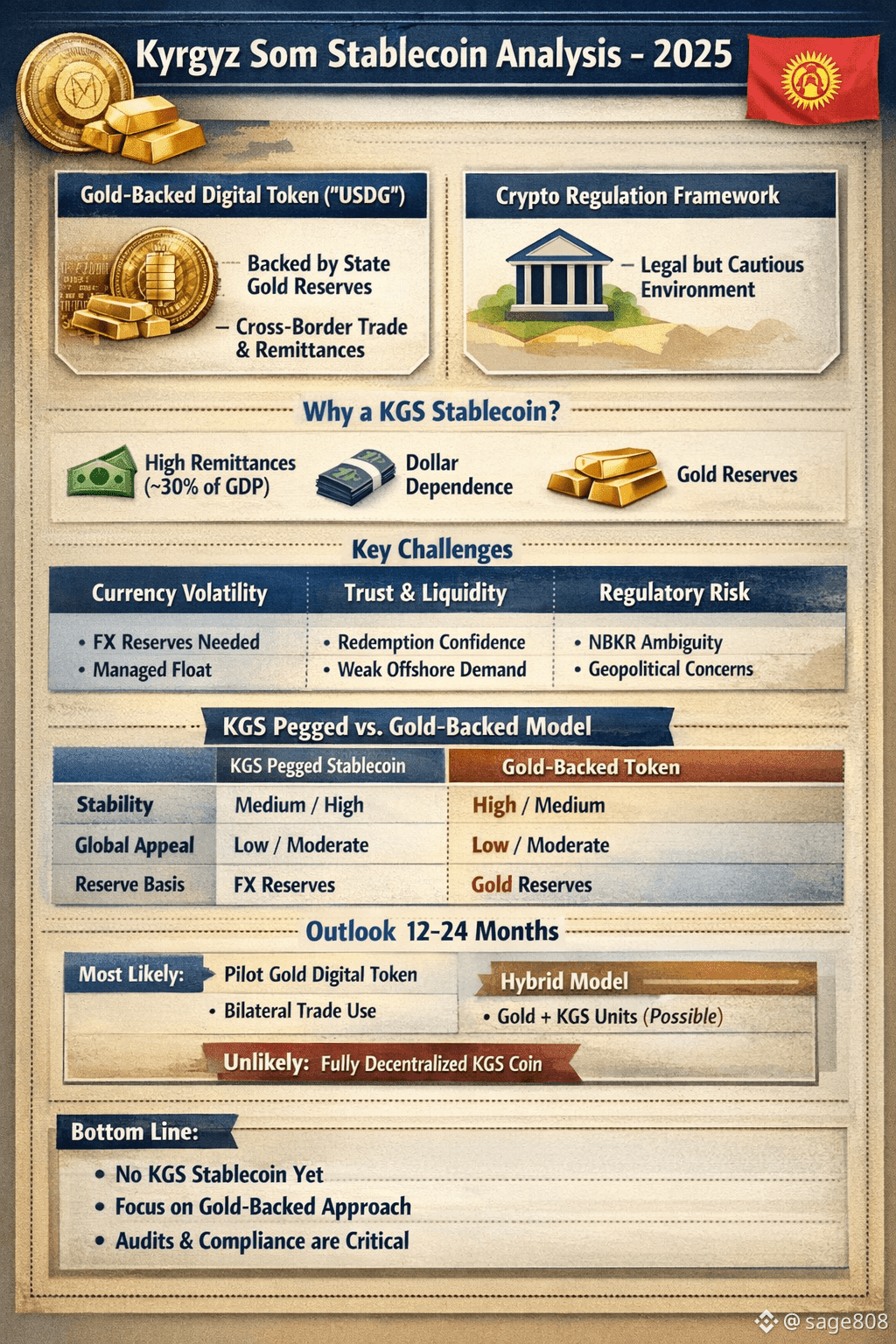
A. Gold-Backed Digital Currency Initiative (Often referred to as “USDG” in media)
Announced by Kyrgyz authorities and partners as a gold-backed digital token, not strictly a KGS-pegged stablecoin.
Intended backing: physical gold reserves held by the state.
Target use cases:
Cross-border trade settlement
Remittances
Alternative to USD-centric settlement systems
Positioning: state-aligned but not yet a fully launched Central Bank Digital Currency (CBDC).
B. Regulatory Framework for Digital Assets
Kyrgyzstan has actively legalized and regulated crypto mining and digital assets.
The National Bank of the Kyrgyz Republic (NBKR) has:
Not banned stablecoins
Not officially endorsed a KGS stablecoin either
This creates a permissive but cautious environment.
2. Why a KGS Stablecoin Is Strategically Attractive
From a macroeconomic and regional perspective:
Key Motivations
High remittance inflows
Remittances account for ~30% of GDP.
Stablecoins reduce cost and settlement time.
Dollar dependence
Economy heavily USD-influenced.
Stablecoin initiatives aim to diversify away from USD rails.
Gold reserves
Kyrgyzstan has meaningful gold production (Kumtor mine legacy).
Gold backing provides stronger credibility than fiat-only pegs.
3. Structural Challenges for a Kyrgyz Som Stablecoin
A. Currency Volatility
KGS is a managed float, not a hard peg.
A KGS-pegged stablecoin would require:
Large FX reserves
Active market operations
This is expensive and operationally complex.
B. Trust & Convertibility
Stablecoins succeed on instant redemption confidence.
For KGS:
International liquidity is limited
Offshore demand is weak
This reduces global utility compared to USD-backed stablecoins.
C. Regulatory Signaling Risk
Any ambiguity from the NBKR can:
Freeze institutional adoption
Scare off foreign partners
4. Gold-Backed Model vs KGS-Pegged Model
Factor
KGS-Pegged Stablecoin
Gold-Backed Token
Stability
Medium
High (relative)
Global appeal
Low
Moderate
Reserve transparency
FX-dependent
Audit-dependent
De-dollarization impact
Limited
Stronger
Implementation risk
High
Medium
Conclusion:
Kyrgyzstan’s choice to explore gold backing instead of a pure KGS peg is strategically rational.
5. Key Risks to Monitor
1. Transparency Risk
Independent audits of gold reserves are non-negotiable.
Any opacity will kill credibility instantly.
2. Sanctions & Geopolitical Scrutiny
Gold-backed digital assets attract Western regulatory attention.
AML / CFT compliance must be airtight.
3. Technology Governance
Permissioned vs public blockchain decision matters.
Over-centralization reduces adoption.
Over-decentralization scares regulators.
6. Outlook (12–24 Months)
Most Likely Scenario
Pilot-scale deployment of a gold-backed digital token
Limited use in:
Bilateral trade
Government-approved corridors
No retail-scale KGS stablecoin yet
Less Likely (but possible)
Hybrid model:
Gold-backed reserve
KGS-denominated transactional unit
Unlikely
Fully decentralized, permissionless KGS stablecoin with global liquidity
7. Bottom Line
There is no mature Kyrgyz som stablecoin today.
Kyrgyzstan is positioning itself as a regional digital-asset innovator, not a first-mover.
The gold-backed approach is more credible than a pure KGS peg.
Success depends on audit transparency, redemption guarantees, and regulatory clarity.

#USGDPUpdate #USCryptoStakingTaxReview #USJobsData #BTCVSGOLD #BinanceAlphaAlert