
Imagine you own a piece of a high-rise in Tokyo or a handful of US Treasury bills. Traditionally, these are "slow" assets. If you need cash, you usually have to sell them—a process buried in paperwork, taxes, and waiting periods. But what if those assets could breathe? What if they could stay in your portfolio while simultaneously providing you with instant, usable liquidity on-chain?
This isn't a futuristic "maybe." It is the core mission of Falcon Finance, a protocol redefining the very definition of collateral. By bridging Real-World Assets (RWAs) with the high-velocity world of DeFi, Falcon is building what they call Universal Collateralization Infrastructure.
The Liquidity Gap: Why RWAs Matter Now
For years, DeFi was a "closed loop." You used ETH to borrow USDC to buy more ETH. It worked, but it was volatile and isolated from the multi-trillion dollar global economy.
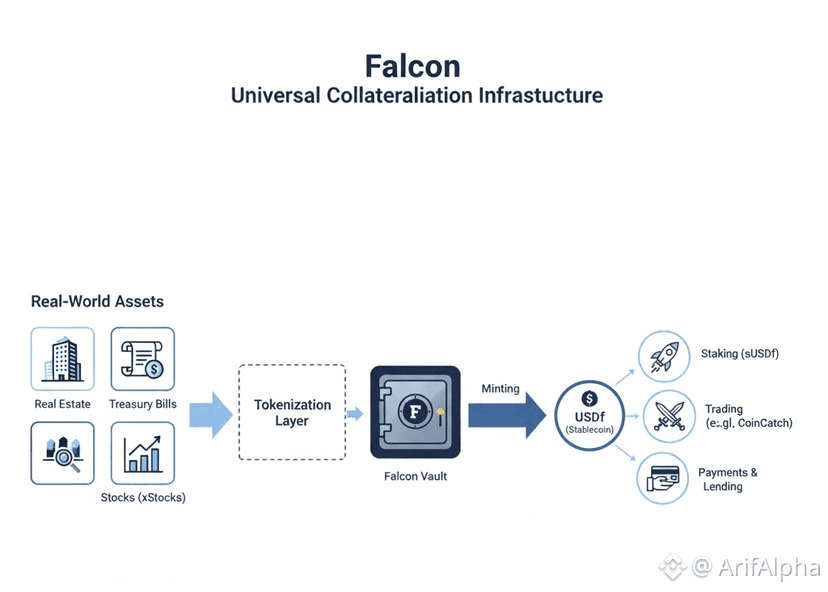
Falcon Finance changes the game by expanding the "menu" of what counts as money. Through their ecosystem, you can deposit tokenized stocks (xStocks), bonds, or even private credit and mint USDf—an overcollateralized synthetic dollar.
The "Holding" Revolution: > Think of it like a smart mortgage on your entire wealth. You don’t sell your Tesla stock or your gold-backed tokens to pay for a new investment. You deposit them into Falcon’s secure vaults, mint USDf, and put that capital to work. You keep the upside of your original asset while gaining the agility of a DeFi native.
Key Features: The Falcon Engine
Falcon isn't just another lending app; it’s a liquidity layer designed for stability and trust. Here’s how they are doing it:
• USDf & sUSDf (The Dual-Token Power): Mint USDf to spend or trade. If you want to grow your wealth passively, you stake it into sUSDf, which earns real yield (often around 8–10% APY) generated from market-neutral strategies and the underlying RWA returns.
• Institutional-Grade Security: With $1.6B+ in reserves and partnerships with custodians like Fireblocks, Falcon prioritizes "boredom over brilliance." They focus on steady, verifiable backing rather than high-risk "degen" yields.
• Transparency First: Supported by Chainlink’s Proof of Reserve, anyone can verify that the assets backing the system actually exist. No black boxes.
A Real-Life Scenario: The "One Balance Sheet" Strategy
Meet Sarah. She has a diversified portfolio: some Bitcoin, some tokenized Mexican sovereign bonds, and a few shares of tokenized Nvidia (xStocks).
1. The Old Way: Sarah sees a new opportunity on CoinCatch. To participate, she has to sell her bonds, wait for the settlement, and transfer the cash. She loses her yield on the bonds and pays capital gains tax.
2. The Falcon Way: Sarah deposits her bonds and xStocks into Falcon. She mints USDf instantly. She uses that USDf to trade on CoinCatch or provide liquidity in a DEX. Her bonds continue to earn interest in the background. She has effectively created a single, programmable balance sheet where every asset is productive.
Visualizing the Flow: From Real World to DeFi
Building the Future of Finance
Falcon Finance is positioning itself as the "backbone" of the 2026 financial landscape. By filtering out "impatient capital" and focusing on sustainable, RWA-backed growth, they are proving that DeFi can be professional, reliable, and deeply integrated with the real world.
The goal isn't just to be a crypto project; it’s to be the universal engine that makes every asset you own—no matter where it sits—instantly liquid and infinitely useful.
If you could tokenize and use any one of your "real-world" assets as collateral tomorrow without selling it, which one would it be and why?
@Falcon Finance #FalconFinance $FF

