
In crypto conversations, privacy is often framed emotionally. It’s discussed as resistance, as ideology, or as a moral stance against surveillance. Those debates may matter socially, but they miss how privacy actually functions inside financial systems.
Finance doesn’t use privacy to make statements.
It uses privacy to operate.
This is the starting point for how Dusk Foundation approaches privacy. Not as a banner to wave, but as an operational requirement that determines whether a system can be used at all.
That framing changes the entire architecture.
Why Financial Privacy Is Boring on Purpose
In traditional finance, privacy is deliberately uninteresting. It’s not advertised. It’s not debated daily. It’s assumed.
Positions aren’t public.
Strategies aren’t broadcast.
Counterparties aren’t exposed.
Not because institutions are hiding something, but because markets stop functioning when every move becomes visible. Information asymmetry isn’t a bug in finance. It’s part of how liquidity, pricing, and competition remain stable.
Public-by-default blockchains invert this model completely. Everything is visible, permanent, and globally accessible. Early on, that felt revolutionary. At scale, it becomes destabilizing.
Dusk’s design quietly restores a financial norm that crypto temporarily forgot: privacy is infrastructure.
Exposure Creates Risk Before It Creates Trust
Crypto often assumes that exposure equals trust. If everyone can see everything, manipulation should be harder.
In real markets, the opposite often happens.
Public exposure allows:
real-time strategy tracking
front-running and behavioral exploitation
identification of large positions
targeting of counterparties
These aren’t theoretical risks. They’re structural ones.
Institutions understand this instinctively, which is why many simply refuse to operate on fully transparent ledgers for sensitive activity. No amount of decentralization rhetoric offsets that exposure.
Dusk doesn’t try to convince institutions to accept this risk. It removes the risk at the protocol level.
Confidential by Default Doesn’t Mean Unaccountable
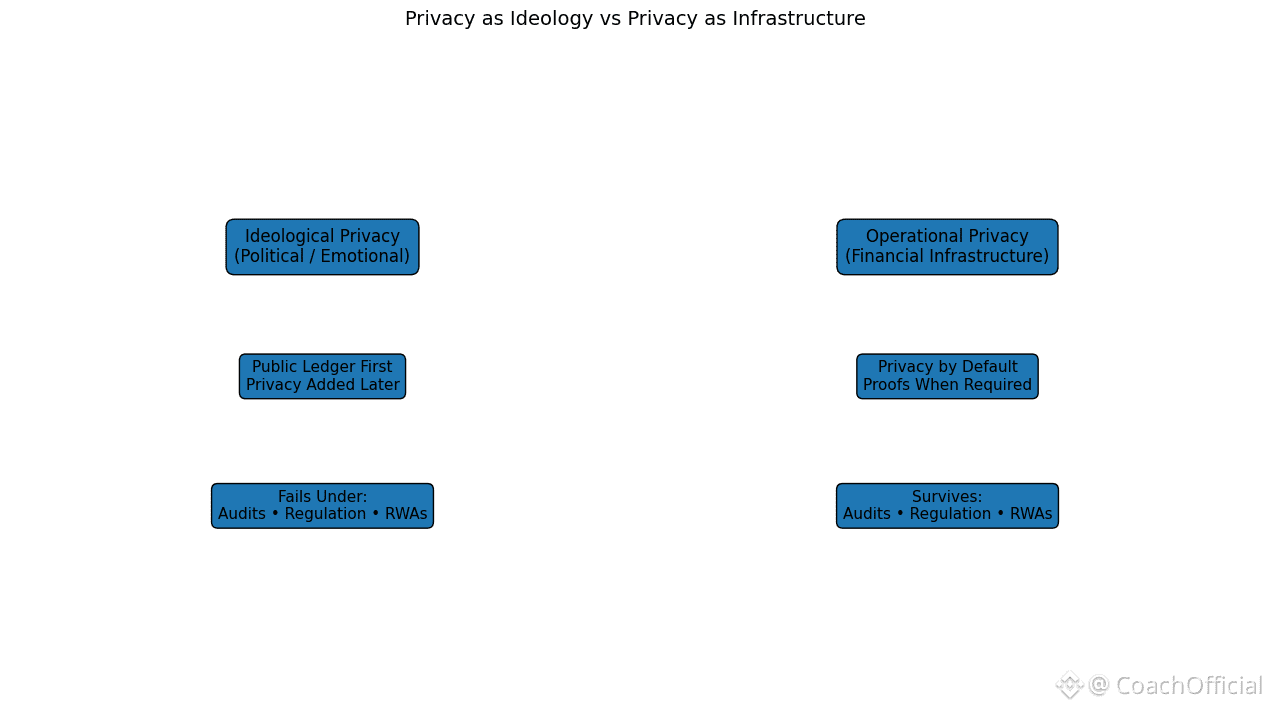
One of the biggest misunderstandings about Dusk is the assumption that confidentiality implies opacity. In practice, Dusk separates who can see from what can be proven.
Transactions can remain confidential during normal operation, protecting market behavior from unnecessary exposure. At the same time, cryptographic proofs allow validity, compliance, or ownership to be demonstrated when required.
This distinction matters.
Visibility is not the same as verifiability.
Opacity is not the same as privacy.
Dusk builds around verifiability first, visibility second.
That ordering is crucial for regulated environments.
Why “Privacy Later” Is Not an Option
Many blockchains treat privacy as an upgrade path. Launch openly, gain traction, then add confidentiality features once institutions arrive.
This approach fails for one simple reason: history cannot be redacted.
If transaction flows were public, they remain public.
If positions were exposed, the damage is already done.
If counterparties were revealed, privacy cannot be retroactively restored.
Dusk avoids this trap by starting with privacy boundaries in place. It doesn’t assume future fixes will undo early exposure. It assumes early exposure becomes permanent risk.
That’s a conservative assumption — and a realistic one.
Privacy as a Precondition for Compliance
There’s a persistent myth that privacy and compliance are opposites. In reality, compliance without privacy is often impossible.
Regulated entities are required to:
protect client data
prevent market manipulation
control disclosure of sensitive information
A system that exposes everything publicly forces institutions into constant violation risk. That’s not compliance-friendly. It’s compliance-hostile.
Dusk’s model allows institutions to meet disclosure obligations without over-disclosing. Regulators can audit without markets spying. Auditors can verify without competitors watching.
This isn’t about avoiding oversight. It’s about making oversight functional.
The Human Layer Most Protocols Ignore
One reason privacy matters operationally is human behavior.
People change roles.
Employees leave.
Companies merge.
Regulations evolve.
A transaction that felt harmless when executed might be sensitive years later. Public blockchains assume perfect foresight. Finance assumes the opposite.
Dusk’s confidentiality model accepts that context changes. By minimizing unnecessary exposure, it reduces the chance that today’s normal activity becomes tomorrow’s liability.
That’s not paranoia. That’s experience.
Real-World Assets Force Privacy Discipline
Tokenized real-world assets don’t tolerate sloppy privacy assumptions.
Issuers must control disclosures.
Custodians must protect client information.
Jurisdictions impose strict data rules.
A blockchain that leaks information by default disqualifies itself immediately from serious asset issuance.
Dusk’s architecture aligns naturally with these requirements. Privacy isn’t an add-on for tokenization. It’s a prerequisite.
That’s why Dusk doesn’t frame real-world assets as a future goal. Its design already assumes they exist.
Why This Approach Feels Unfashionable
Crypto trends reward maximal transparency. Dashboards, explorers, analytics, everything visible.
Dusk resists that instinct. Not because transparency is bad, but because indiscriminate transparency is lazy.
Financial systems require intentional disclosure. Deciding what not to expose is just as important as deciding what to reveal.
That kind of restraint doesn’t trend well. But restraint is what keeps systems usable when stakes rise.
Privacy That Scales Under Scrutiny
The true test of any privacy system is what happens under pressure.
When auditors ask questions.
When regulators intervene.
When disputes arise.
Dusk’s approach doesn’t collapse under scrutiny because it was designed with scrutiny in mind. Privacy exists alongside proof. Confidentiality exists alongside accountability.
Nothing relies on trust. Everything relies on cryptography and defined process.
Closing Thought
In crypto, privacy is often treated as a value.
In finance, privacy is treated as a condition.
Dusk understands the difference.
By building privacy as an operational requirement rather than a political statement, it positions itself for environments where systems are judged not by intention, but by outcome.
And in regulated finance, outcomes are what matter.
@Dusk $DUSK #Dusk
