
One of the quiet assumptions baked into much of crypto is that regulation is transitional. Something messy, inconvenient, and temporary. The thinking goes like this: once the technology matures, once adoption grows, once regulators “understand,” the friction will ease and systems can operate more freely.
That assumption has aged poorly.
Regulation hasn’t softened. It has clarified. And clarity hasn’t reduced pressure — it has focused it.
This is why Dusk Foundation feels unusually aligned with where the industry is heading now. Dusk never treated regulation as a phase to survive. It treated it as a permanent condition to design around.
That mindset difference is subtle, but it reshapes everything.
Regulation Doesn’t Go Away When Technology Improves
In traditional finance, better technology doesn’t reduce regulation. It usually increases it.
New tools create new risks.
New efficiencies create new oversight requirements.
New markets create new reporting obligations.
Blockchain is following the same pattern.
As on-chain systems become capable of handling real value — securities, funds, ownership rights — the expectation of accountability grows alongside them. The idea that regulation would fade once blockchain “proved itself” misunderstood how financial systems actually evolve.
Dusk didn’t make that mistake.
From the start, it assumed that any system serious enough to matter would eventually operate under clear regulatory expectations. The question wasn’t if regulation would apply, but how it could coexist with decentralization and privacy.
The Cost of Designing for Regulatory Absence
Many blockchains were designed during a period of uncertainty. Regulations were unclear, enforcement was inconsistent, and experimentation felt relatively unconstrained.
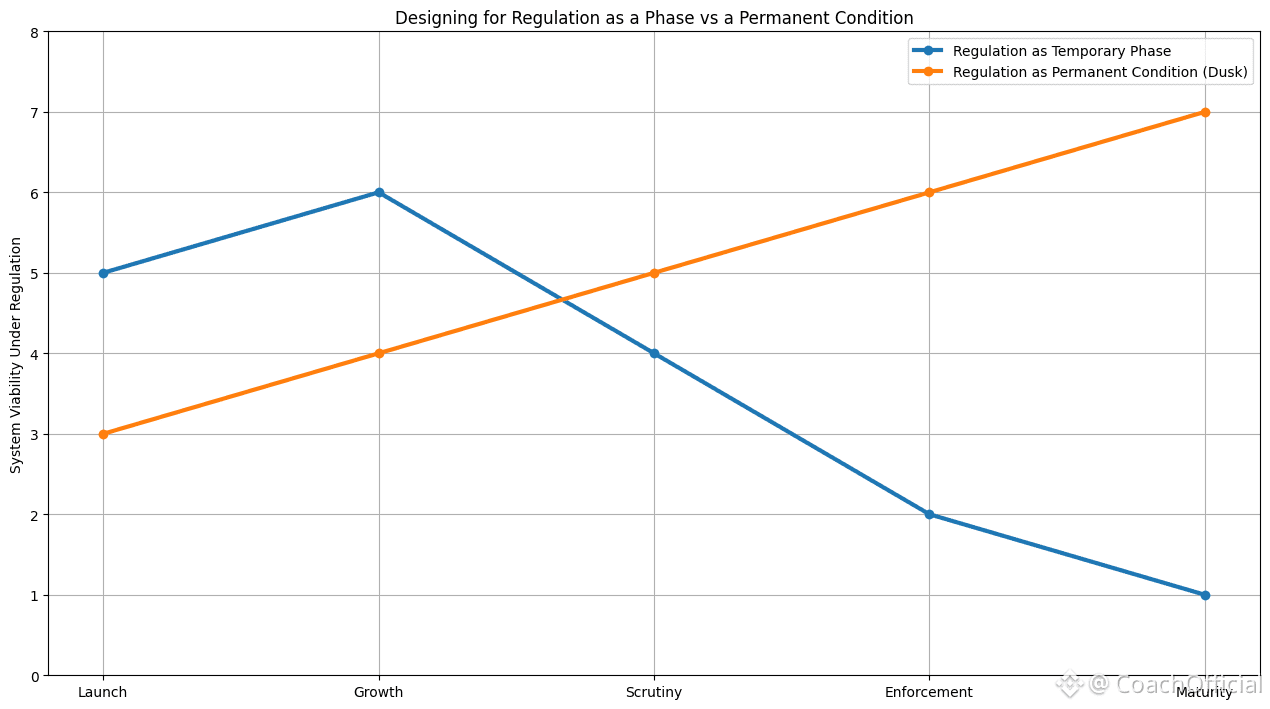
That freedom shaped architecture in lasting ways:
public-by-default data models
weak disclosure boundaries
reliance on off-chain interpretation
governance structures optimized for speed over defensibility
Those choices made sense in context. But architecture doesn’t reset when context changes.
As regulation solidifies, systems designed for regulatory absence are forced into awkward retrofits. Privacy features are bolted on. Compliance logic is layered awkwardly at the application level. Governance is reinterpreted under pressure.
These fixes are costly — technically, legally, and reputationally.
Dusk avoids this trap by never assuming regulatory absence in the first place.
Regulation as a Design Constraint, Not an Obstacle
There’s a difference between avoiding regulation and designing within it.
Avoidance leads to fragility.
Design leads to resilience.
Dusk treats regulation the way engineers treat physics. You don’t argue with it. You don’t wait for it to disappear. You design systems that work because the constraint exists.
This is why privacy, auditability, and selective disclosure are embedded at the protocol level rather than delegated to apps or governance promises. The base layer itself acknowledges that oversight exists and must be supported without breaking the system.
That approach doesn’t make Dusk less decentralized. It makes decentralization usable in environments where rules apply.
Why Compliance Needs Privacy to Function
One of the more counterintuitive truths in finance is that compliance often depends on privacy.
Regulated entities are required to disclose specific information to specific parties — not everything to everyone. Public-by-default systems make this difficult. They force over-disclosure, which creates new risks and, ironically, new compliance violations.
Dusk’s architecture supports a more realistic compliance model:
confidentiality during normal operation
verifiable disclosure when legally required
controlled access rather than blanket exposure
This aligns with how regulators actually operate. Oversight is targeted, procedural, and contextual — not constant surveillance.
By supporting this model natively, Dusk turns regulation from a blocker into a supported workflow.
Institutions Don’t Adopt Systems That Might Become Illegal
One reason institutions hesitate to adopt many blockchain systems isn’t ideological. It’s practical.
They ask:
Will this still be acceptable under future regulation?
Can this system adapt without exposing us to retroactive risk?
Are we betting on an architecture that regulators might later reject entirely?
Uncertainty here is expensive.
Dusk reduces that uncertainty by aligning its design with regulatory expectations that are unlikely to reverse: data protection, auditability, accountability, and controlled disclosure.
Institutions don’t need guarantees. They need credible alignment.
That’s what Dusk offers.
Why Real-World Assets Make Regulatory Design Non-Negotiable
Tokenized real-world assets collapse the distance between blockchain and law.
Once assets represent legal claims, there is no neutral ground. Ownership must be defensible. Transfers must comply with jurisdictional rules. Records must withstand audits and disputes.
A blockchain that treats regulation as optional simply cannot support these assets at scale.
Dusk’s architecture assumes that assets will be questioned, reviewed, and regulated. This assumption forces discipline early, before shortcuts become liabilities.
It’s the difference between building a demo and building infrastructure.
Regulation Shapes Time Horizons
Systems designed to “move fast and adapt later” optimize for short time horizons. They work well until pressure arrives.
Systems designed with regulation in mind optimize for long horizons. They move slower early, but they avoid existential redesigns later.
Dusk clearly chooses the second path.
It sacrifices some early flexibility to gain long-term coherence. That trade-off isn’t exciting in a fast-moving industry, but it’s exactly how financial infrastructure survives.
Decentralization That Doesn’t Rely on Regulatory Blindness
Some crypto narratives quietly depend on regulators not looking too closely. That’s not a strategy — it’s a countdown.
Dusk doesn’t rely on blindness. It relies on compatibility.
By making privacy verifiable, disclosure controlled, and governance structured, it creates a system that can withstand attention rather than avoid it.
That’s a more mature form of decentralization — one that accepts responsibility instead of outsourcing it to ambiguity.
Why This Matters Right Now
We’re entering a phase where regulatory expectations are no longer hypothetical. They’re written, enforced, and increasingly consistent across jurisdictions.
In this environment, the gap between systems designed with regulation and systems designed despite regulation will widen quickly.
Dusk is positioned on the right side of that divide — not because it predicted every rule, but because it predicted the existence of rules.
Closing Thought
The most dangerous assumption in blockchain was never technical. It was temporal.
The belief that regulation was something to outgrow.
Dusk never believed that.
It built as if regulation would always be there.
As blockchain moves from experiment to infrastructure, that assumption looks less conservative and more accurate.
@Dusk $DUSK #Dusk
