In crypto, speed is power — but precision is survival.
Every day, even experienced traders accidentally send assets through the wrong blockchain network. One wrong click between ERC-20 and BEP-20, and suddenly panic kicks in. The transaction is confirmed. The balance is gone. Fear spreads fast.
But here’s the truth most people don’t tell you:
👉 In many cases, the funds are not lost at all.
👉 They’re simply sitting on the wrong blockchain.
Understanding how to recover these assets isn’t just damage control — it’s a skill that separates retail mistakes from professional confidence.
Why Network Selection Is a Big Deal in Crypto Transfers
When withdrawing from Binance, you’re always asked to choose a network. That choice determines which blockchain your assets travel on.
The most common (and dangerous) confusion happens here:
Ethereum (ERC-20)
BNB Smart Chain (BEP-20)
They look identical.
They use the same wallet address format.
But they are entirely different blockchains.
Choosing the wrong one doesn’t burn your funds — it relocates them.
And if you understand how blockchains share private keys across networks, recovery becomes possible.
What Really Happens When You Send Crypto on the Wrong Network
Here’s the key insight most users miss:
Your crypto doesn’t disappear. It arrives on the blockchain you selected.
Ethereum and BNB Smart Chain use the same cryptographic address system. That means:
ERC-20 tokens sent via BEP-20 arrive on BNB Smart Chain
BEP-20 tokens sent via ERC-20 arrive on Ethereum
For example:
$ETH sent via BNB Smart Chain becomes pegged ETH on BSC
You can verify this instantly via BscScan or Etherscan
This is why recovery is often possible — if you control the wallet.
Best-Case Scenario: Wallet Supports Multiple Networks
If your wallet supports both Ethereum and $BNB Smart Chain, you’re already ahead.
Popular wallets like MetaMask, Trust Wallet, and SafePal allow you to:
Switch networks
Manually add token contracts
Reveal “missing” balances instantly
Once the asset appears, you have two smart recovery options:
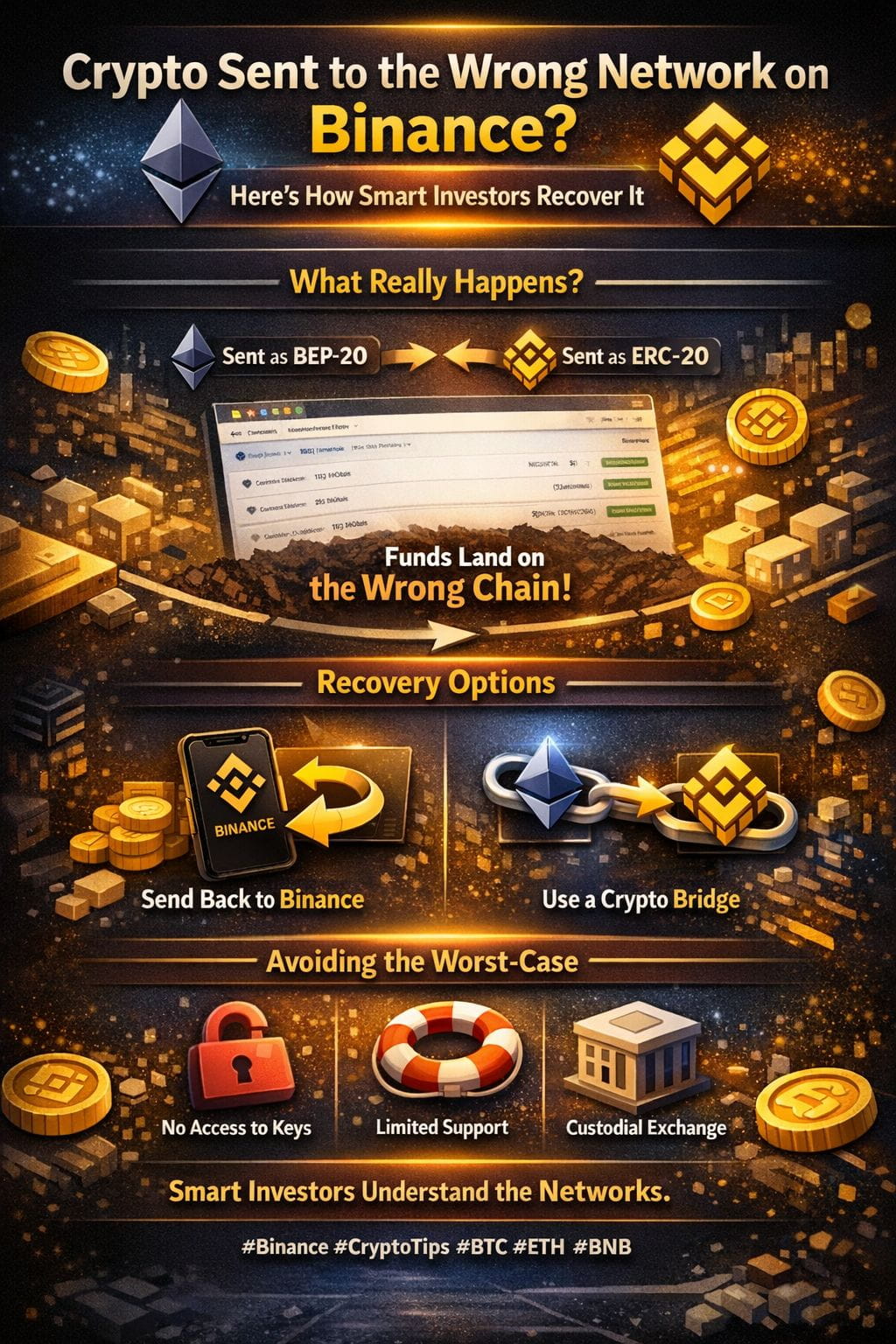
Option 1: Send Back to Binance
Use the same network the token currently lives on
Deposit to Binance
Withdraw again using the correct network
⚠️ Network mismatch here can permanently lock funds.
Option 2: Bridge the Asset
Use a supported bridge
Convert ERC-20 ↔ BEP-20
Then transfer normally
This flexibility is exactly why multi-chain wallets are becoming essential infrastructure in crypto.
Wallet Supports Only One Network? There’s Still a Way
If your wallet only supports Ethereum or only BNB Smart Chain, recovery is still possible — but only if it’s non-custodial.
Here’s how professionals handle it:
Import the wallet’s private key or seed phrase into a multi-chain wallet
Add the missing network manually
Add the token contract
The balance appears instantly
Important clarification:
Importing a private key does not move your funds.
It simply unlocks visibility across networks.
From there, you can safely return funds to Binance or bridge them properly.
Worst-Case Scenario: Sent to an Exchange or Custodial Wallet
This is where recovery becomes uncertain.
If you sent funds to:
Another exchange
A custodial wallet
Or deposited into Binance using the wrong network
Then recovery depends entirely on the platform’s support policy.
Most exchanges:
Do not provide private keys
Offer limited or paid recovery, if any
Cannot guarantee success
This is why self-custody and network awareness are critical investor skills in 2026 and beyond.
Final Thoughts: Mistakes Happen — Knowledge Is the Edge
Sending crypto on the wrong network is one of the easiest mistakes to make — and one of the most misunderstood.
But here’s the bullish takeaway:
✅ If you control your private keys, your funds are usually recoverable
✅ Multi-chain infrastructure is improving rapidly
✅ Crypto is evolving toward user resilience, not fragility
Every mistake becomes cheaper when you understand the system.
And every investor who learns this once, moves forward with far more confidence.
Smart money doesn’t panic.
Smart money understands the network.