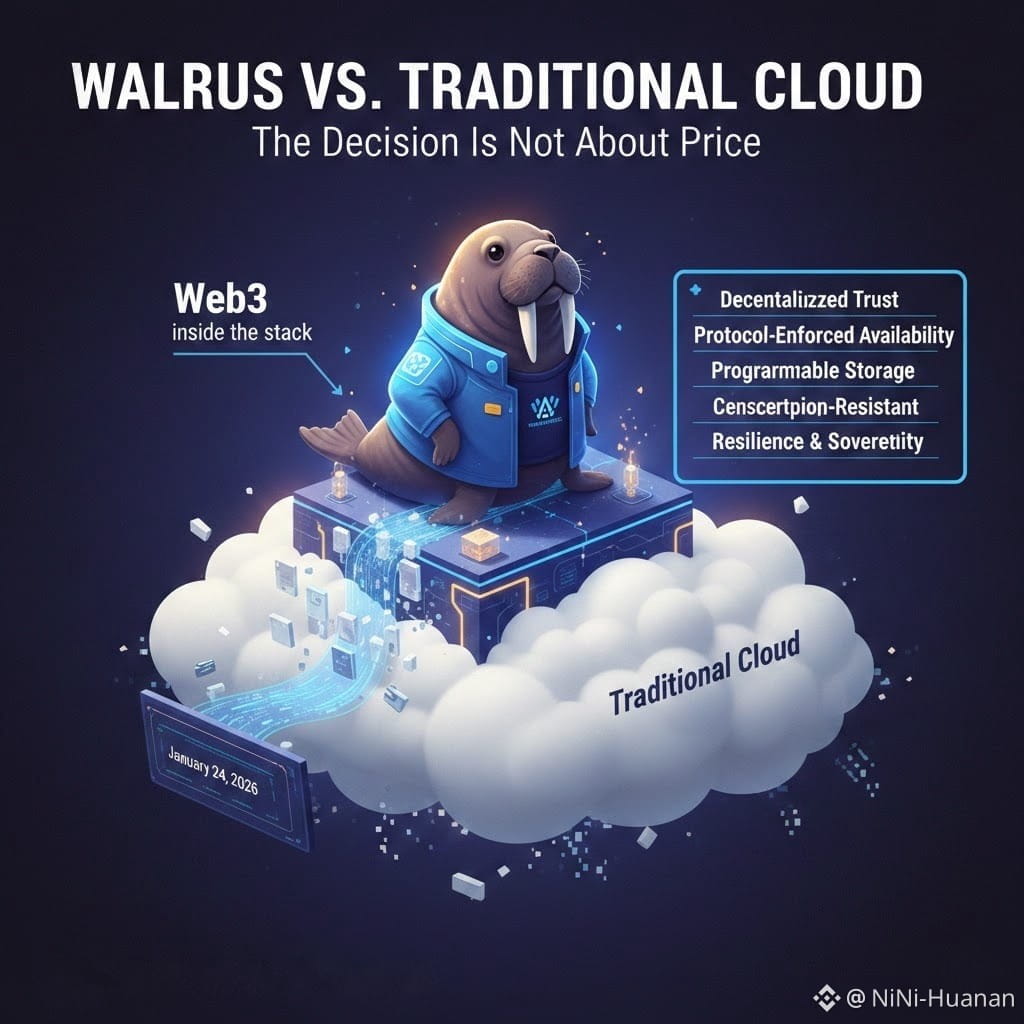
Comparing Walrus with traditional cloud providers purely on price misses the real decision point. These systems are built for different assumptions, and cost per gigabyte is not the metric that matters most for Web3-native applications.
Traditional cloud storage relies on centralized trust. Data availability is guaranteed by contracts and reputation, not by protocol-level enforcement. This model works for Web2, but it creates hidden risks for decentralized systems where data availability directly affects security and user trust.
Walrus is designed for environments where data must remain verifiable, censorship-resistant, and aligned with on-chain logic. Developers choosing Walrus are not optimizing for short-term savings. They are reducing dependency risk, avoiding future migrations, and preserving composability as applications decentralize.
At scale, the question becomes simple: where does critical data belong? For Web3, the answer is increasingly “inside the stack,” not outsourced to centralized cloud.