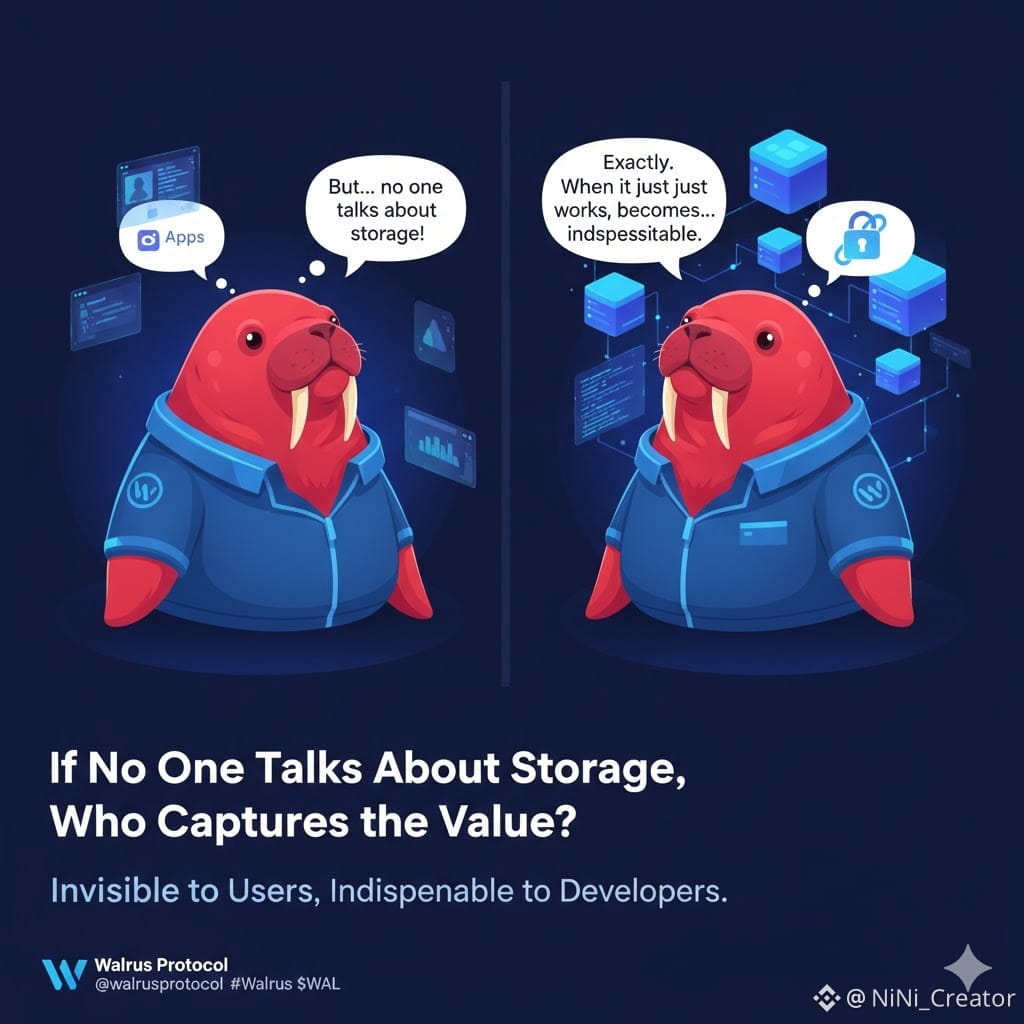
In Web3, storage is everywhere—and almost nowhere in conversation. Users talk about apps, rollups, AI agents, and throughput. Developers debate execution layers and UX. Storage, despite being foundational, often fades into the background. The question is simple but uncomfortable: if no one talks about storage, who actually captures the value it creates?
#walrus sits precisely at this intersection. As a Web3-native data availability and storage layer, its value is not speculative—it is functional. Every rollup posting data, every dynamic NFT, every data-heavy application relies on storage being reliable, verifiable, and cheap enough to ignore. And that is the paradox. When storage works well, it becomes invisible.
In most markets, invisibility shifts value upward. Applications capture user attention. Execution layers capture mindshare. Storage risks becoming a cost center rather than a value center explainable to end users. If developers treat storage as interchangeable infrastructure, the surplus value flows to whoever owns distribution, not whoever provides reliability.
For Walrus, this creates a strategic tension. Long-term success does not come from being talked about by users, but from being assumed by developers. If @Walrus 🦭/acc becomes the default choice—embedded in frameworks, SDKs, and design patterns—value accrues quietly through usage, not hype. In that world, storage does not need narrative dominance; it needs dependency.
The danger is commoditization. If storage is invisible and perceived as replaceable, pricing pressure intensifies and value leaks elsewhere. Walrus must therefore be invisible at the user layer, but opinionated and sticky at the developer layer. That is where real value capture happens in infrastructure.
In Web3, the loudest layer rarely wins. The layer that becomes non-optional does. The question is not who talks about storage—but who cannot build without it. $WAL