
One of the hardest problems in any system is coordination. Not execution, not speed, not even security. Coordination. Getting many independent actors to behave in a way that does not collapse the system over time. Most blockchains avoid this problem by pretending it does not exist. They push responsibility to applications, DAOs, or off chain processes. This is where Vanar Chain feels fundamentally different to me.
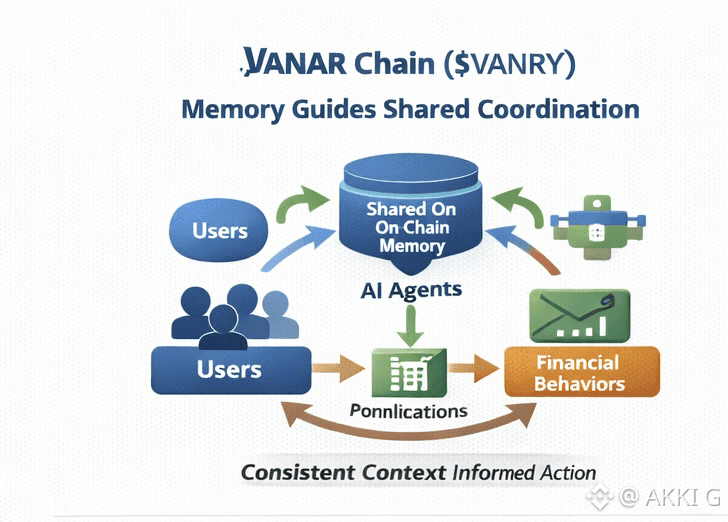
Vanar’s design suggests that coordination is not something you bolt on later. It is something you design into the base layer. When memory is persistent and AI agents can interpret historical context, coordination stops being reactive. The system does not wait for failures before adjusting. It anticipates patterns, nudges behavior, and smooths interactions before friction turns into damage.
What stands out is how this changes multi-actor environments. As more users, applications, and financial behaviors interact, the system accumulates shared context. Decisions are no longer made in isolation. They are informed by what the network has already experienced. This reduces conflict, duplication, and runaway behavior. Coordination emerges not from rules alone, but from awareness.
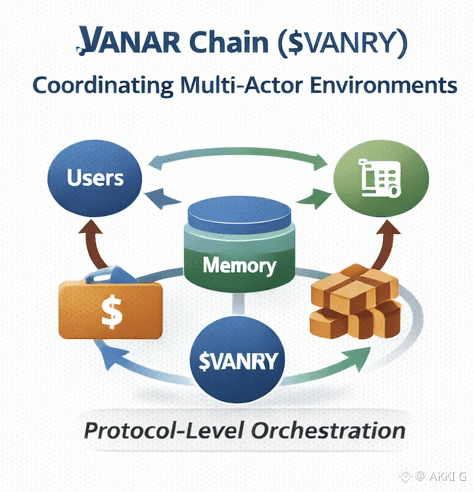
$VANRY plays a critical role here. Coordinating behavior across many actors is computationally and economically expensive. Querying shared memory, evaluating context, and aligning execution all consume resources. VANRY becomes the cost of alignment. As coordination deepens, demand for VANRY reflects not just activity, but the effort required to keep the system coherent.
I also think this has implications for governance and ecosystem growth. Instead of relying on constant human intervention, Vanar allows coordination to happen at the protocol level. That does not eliminate governance, but it reduces the load. The system absorbs complexity so communities do not have to manage every edge case manually.
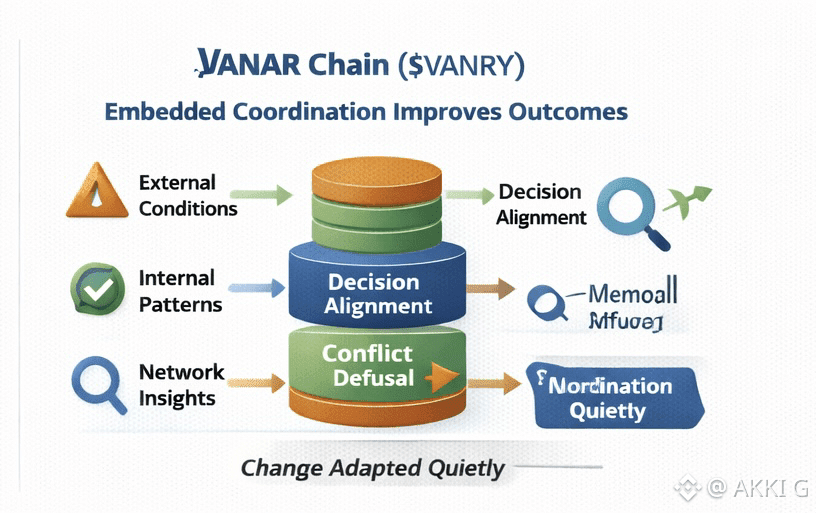
My take today is that Vanar Chain is quietly solving a problem most networks postpone until it becomes painful. By embedding coordination into memory and execution, it creates an environment where growth does not automatically mean chaos. That is the kind of infrastructure that scales not just technically, but socially.
