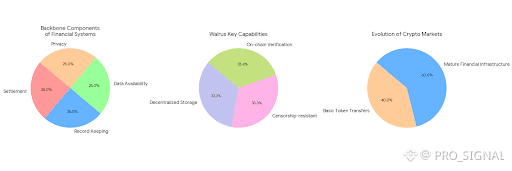
@Walrus 🦭/acc Value movement on blockchains goes far beyond simple peer-to-peer transfers. In today’s crypto markets, capital circulates through trading activity, collateral management, derivatives, stablecoin systems, and evolving application states. A transaction is not truly complete when a token changes hands it reaches finality only once the associated data, ownership records, and positions are settled into infrastructure that participants, protocols, and auditors can trust. This is why data availability and storage are as foundational as transaction throughput or block creation. Without dependable data, markets cannot accurately assess risk, confirm balances, or enforce agreements. Walrus is designed to operate precisely at this intersection of information and value.
Walrus and its native token, WAL, focus on decentralized, privacy-preserving data storage and settlement. Built on the Sui blockchain, the protocol uses erasure coding combined with blob storage to distribute large datasets across a network of independent nodes. Rather than keeping entire files in a single location, Walrus fragments data and spreads those fragments throughout the network. As long as a sufficient number of pieces remain accessible, the original data can be reconstructed. This architecture makes the system resilient to outages, censorship attempts, and individual node failures. For crypto applications, it enables large or sensitive information such as trade histories, application state, or user data to live outside the core execution layer while remaining verifiable and secure.
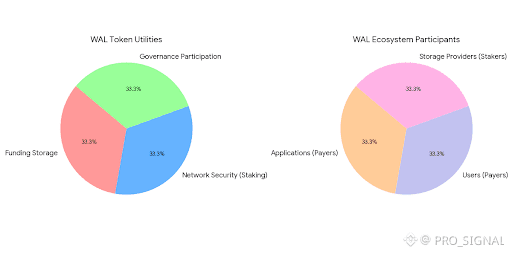
In DeFi and trading environments, it is neither practical nor necessary to store all information directly on chain. However, that data must be accessible when audits, disputes, or liquidations occur. Walrus is designed to serve this exact function. The WAL token underpins the system by funding storage, securing the network through staking, and enabling governance participation. Applications and users pay WAL to store and retrieve data, while storage providers stake WAL to supply capacity and maintain reliability. Governance decisions are also coordinated through WAL, linking the token’s value to the usefulness and robustness of the storage network rather than short-term trading dynamics.
Privacy and user control are core principles of Walrus’s design. Many crypto use cases depend on confidentiality traders do not want full visibility into their positions or strategies, and enterprises often require discretion over operational data. At the same time, systems still need verifiable records. Walrus supports private data handling by keeping sensitive information in decentralized storage while allowing cryptographic references or proofs to be settled on chain. This approach balances confidentiality with accountability: data can remain private, yet its integrity and existence remain provable.
Technically, erasure coding and blob storage define how Walrus operates. Erasure coding minimizes the storage burden on individual nodes while preserving fault tolerance, and blob storage allows large datasets to be handled efficiently without congesting the base blockchain. This results in lower costs compared to traditional on-chain storage. Running on Sui also gives Walrus access to fast execution and parallel processing, which is particularly useful when many applications interact with stored data simultaneously.
For traders and financial platforms, this means critical information such as positions, historical records, and application state can reside in a decentralized storage layer that is not dependent on a single provider. This reduces reliance on centralized cloud services, which are frequent points of failure and censorship. Even if one provider becomes unavailable or blocks access, the data remains recoverable through the broader network.
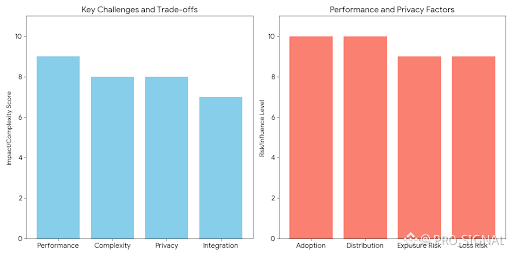
There are, however, trade-offs. Walrus introduces an additional layer alongside the base blockchain, increasing overall system complexity. Developers must integrate both Sui for execution and Walrus for storage. Network performance is also tied to adoption and node distribution; limited participation could impact retrieval speed and reliability. Privacy mechanisms require careful implementation as well misconfigured access controls or proofs could result in data exposure or loss. These challenges are common to decentralized storage systems and are not unique to Walrus, but they remain important considerations.
From the perspective of market infrastructure, Walrus addresses a growing need as crypto systems mature. Modern financial applications generate large volumes of data that do not fit efficiently on blockchains yet still demand security and verifiability. Centralized databases are convenient but fragile. Walrus offers an alternative that combines decentralization, privacy, and economic incentives.
WAL is therefore more than a simple utility or payment token. It functions as a coordination mechanism aligning storage providers, users, and governance participants around a shared network. Its long-term value is tied to network usage, reliability, and the extent to which real financial activity depends on the system.
As crypto markets evolve toward more complex and institutional-grade structures, infrastructure like Walrus becomes increasingly important. Settlement processes, record keeping, data availability, and privacy may not appear on price charts, but they form the backbone of any serious financial system. By delivering decentralized, censorship-resistant storage that integrates with on-chain verification, Walrus helps push crypto beyond basic token transfers toward more mature financial infrastructure.