

I wasn’t planning to write about @Vanarchain at first, but the more I read, the more it stayed in my mind. Some projects do not chase attention. They do not scream narratives. They just keep building quietly, layer by layer. In my understanding, Vanar Chain fits exactly into that category. The deeper I researched it, the clearer it became that this is not just another blockchain trying to survive the next cycle. It feels like an infrastructure project designed for where technology is actually going.
When we talk about blockchains, we usually frame them around transactions and tokens. Bitcoin secured value transfer. Ethereum brought programmable logic. But when I look at where the world is moving now, especially with AI, gaming, and autonomous systems, those models start to feel incomplete. From what I read, Vanar is built around the idea that blockchains should not just record actions but understand context. That shift sounds subtle, but in my knowledge, it changes everything about how applications can scale.
What really helped me understand Vanar was learning about its roots. This project did not appear out of nowhere. The team behind it comes from deep entertainment and enterprise backgrounds. We read about Gary Bracey’s history in the gaming industry long before crypto existed. He worked on bringing major Hollywood brands into interactive media when that idea was still new. In my view, that experience matters. It shows an understanding of how technology meets culture, and how products reach millions of users without feeling technical.
At the same time, Jawad Ashraf’s background brings a different angle. His focus has always been on emerging tech and real-world systems. When these two perspectives came together years ago, they did not start with a blockchain. They started with experiences, with digital ownership, and with consumers. Terra Virtua was an early step, and while many people saw it as just another NFT platform, I think it was more like a long experiment. They learned firsthand what breaks when you try to build rich applications on general-purpose chains.
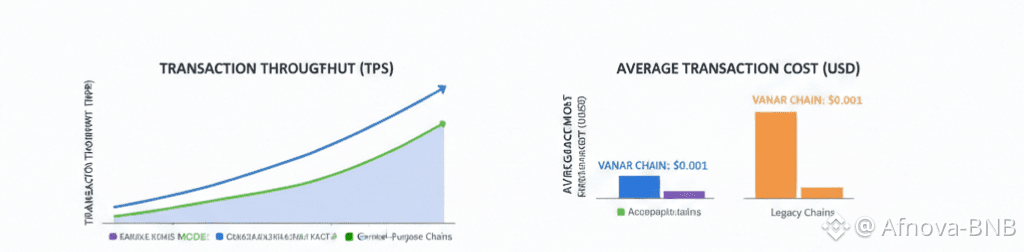
As Terra Virtua grew, the limitations became impossible to ignore. In my research, the biggest pain point was cost and latency. High-quality games and immersive environments generate constant interactions. On chains with volatile fees, that becomes unsustainable. We all saw how gas spikes push users away. Instead of patching the problem, the team decided to rethink the foundation entirely. That decision led to the transition into Vanar Chain.
This pivot was not cosmetic. It was a full shift from being an app built on someone else’s rails to owning the rails themselves. They migrated their token, their community, and their vision into a new Layer 1 designed specifically for performance-sensitive applications. In my opinion, that takes confidence and patience. Many teams avoid this step because it is hard and risky. Vanar leaned into it.
When I looked into the base layer of Vanar, I noticed how practical the choices are. They stayed compatible with Ethereum tools so developers do not need to relearn everything. At the same time, they changed what needed to be changed. Faster blocks, stable fees, and predictable costs are not exciting on social media, but they are essential for real products. In my understanding, fixed low fees are one of the most underrated design decisions here. Enterprises and game studios need certainty, not surprises.
The consensus model also reflects this balance. Vanar does not rely purely on anonymous capital. They combine reputation, authority, and community staking. This means validators are known entities with real-world accountability, while users still participate economically. I tell you honestly, for brands and IP holders, this matters a lot. They want decentralization, but they also want to know who is running the infrastructure behind their assets.
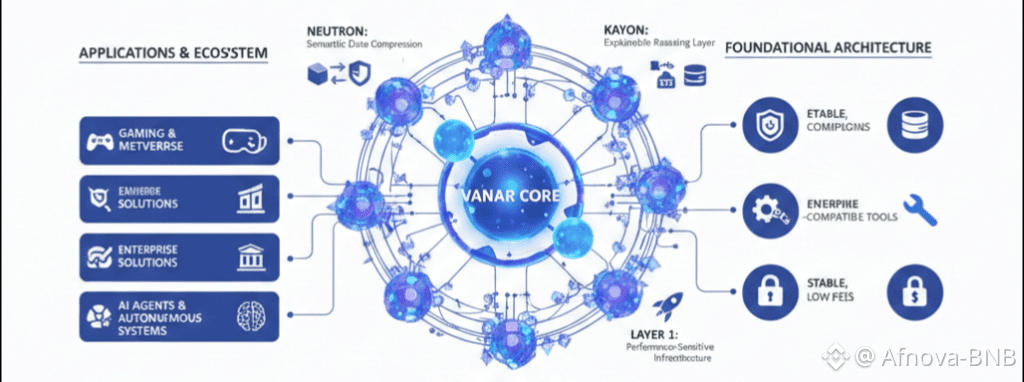
Where Vanar truly starts to feel different is beyond the base chain. As I kept reading, the idea of Neutron really stood out. Most blockchains are terrible at storing meaningful data. AI systems need memory. They need context. Storing large datasets off-chain creates fragility, while storing them directly on-chain is too expensive. Neutron tries to solve this by compressing data into small semantic units that still preserve meaning. In my knowledge, this is one of the most forward-looking ideas in the entire stack.
The idea that complex information can live on-chain in a compressed, meaningful form opens doors that most chains cannot even approach. Medical data, legal records, game assets, behavioral history. Instead of just pointing to external storage, Vanar brings memory into the chain itself. When I think about AI agents operating independently, this becomes crucial. Without memory, intelligence is shallow.
Then there is Kayon, which feels like the missing piece. Data alone is not enough. Systems need to reason about that data. Kayon allows smart contracts to interact with stored context and make decisions that are explainable and auditable. In my view, this matters because AI without accountability will never be trusted in finance or governance. Vanar seems to understand that trust comes from verifiable logic, not blind automation.
As we read more about the roadmap, it becomes clear that Vanar is not stopping at theory. Automation layers and industry-focused tools are being built to abstract complexity away from users. This aligns with what I believe is necessary for adoption. The best infrastructure becomes invisible. Users should feel the experience, not the chain.
The ecosystem itself reflects this philosophy. Gaming is not treated as a gimmick but as a gateway. Through partnerships with established studios and platforms, Vanar reaches users who may never care about wallets or tokens. They just play games. Behind the scenes, ownership and transactions happen naturally. In my experience, this is how technology truly spreads.
The metaverse side of Vanar also feels more grounded than most. Instead of endless promises, it builds on existing communities and partnerships. The continued link with Cardano users, for example, shows that Vanar values bridges over isolation. Ecosystems do not grow by cutting ties. They grow by connecting.
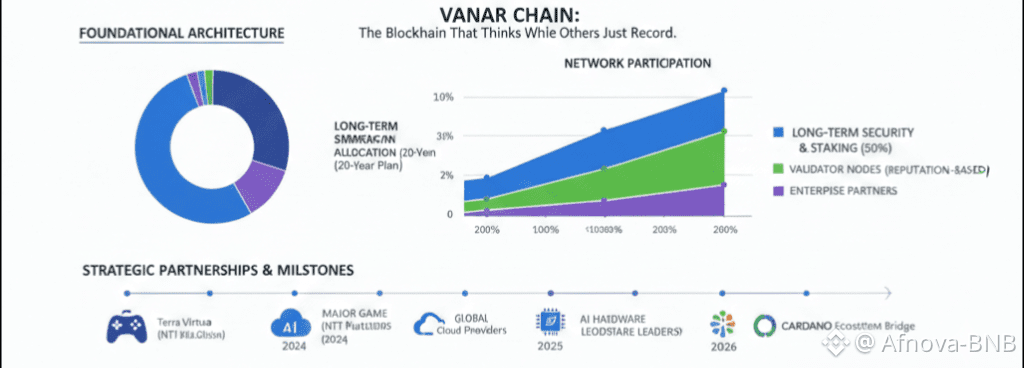
On the enterprise side, the partnerships speak quietly but clearly. Running infrastructure on trusted cloud providers, integrating with AI hardware leaders, and focusing on sustainability are not flashy moves, but they signal seriousness. In my knowledge, enterprises care about reliability, compliance, and long-term support far more than narratives.
The token model supports this long view. Emissions are spread over decades. Early supporters were carried forward rather than diluted. Incentives are aligned with long-term security instead of short-term speculation. I see this as another sign that Vanar is building for durability, not cycles.
When I step back and look at Vanar Chain as a whole, I do not see a project trying to win attention today. I see a system preparing for a future where AI, games, and autonomous applications need infrastructure that can think, remember, and reason. In my understanding, blockchains that remain passive ledgers will struggle in that world.
So if someone asks me why Vanar stayed in my mind, this is my answer. It is not loud. It is structured. It is patient. And sometimes, the projects that move slowly and deliberately are the ones that end up shaping what comes next.
