

In Web3, people usually talk about speed, transactions, TPS, and low fees. But the truth is that the future will belong to the networks that can store, serve, and manage data at scale. Apps are evolving, users are evolving, and the entire internet is moving toward heavier, richer, more intelligent experiences.
That shift exposes one huge problem.
Most blockchains were never designed to hold real data. They can settle money, but they cannot host the massive amount of information that modern apps need. And that is exactly where Walrus steps in as a new foundation for builders.
If you want a single line that explains Walrus, it is this:
Build on Walrus because the entire cycle of innovation begins with data.
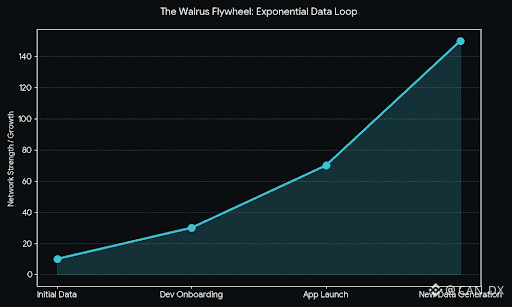
More data stored brings more developers.
More developers ship more apps.
More apps create more data.
And that data loops back into Walrus again.
This cycle is becoming one of the strongest emerging narratives in Web3.
Walrus Solves Web3’s Data Problem at the Root
Walrus is a decentralized storage and data network built on Sui. It is designed for the next era of Web3 where content, media, AI memory, and application state all need to live on chain instead of scattered across centralized servers.
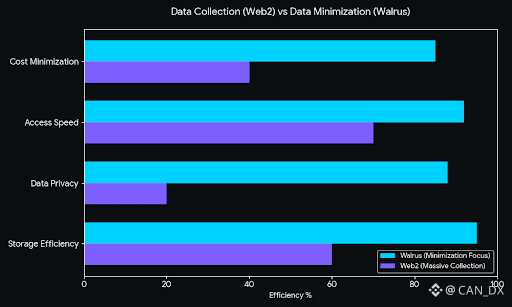
Instead of forcing apps to store files on Web2 clouds, Walrus gives them:
truly decentralized file storage
high availability
efficient encoding
low cost
and a system that scales as demand grows
Files are split into secure fragments and stored across many nodes. Even if several nodes go down, the data remains intact and recoverable. This gives developers the confidence to build apps that actually rely on the chain, not just use it for payments.
Most blockchains struggle when the data gets large. Walrus is built for the opposite. It gets stronger as more data arrives.
Why Data Attracts Developers
When storage becomes cheap, programmable, and reliable, a new kind of developer starts paying attention. Teams building AI agents, social apps, large media platforms, gaming ecosystems, virtual item markets, on chain analytics, and NFT experiences all need one thing above everything else: data capacity.
That is the shift Walrus has unlocked.
Developers suddenly have a place where they can store:
video
audio
game assets
AI datasets
metadata
documents
models
and anything their app depends on
And because Walrus is built to scale with demand, developers never hit the wall they hit on older chains.
This is the first spark of the loop:
more data stored → more developers show up.
When Developers Arrive, Apps Follow
When the storage limitation disappears, developers start building apps that simply were not possible before.
Decentralized social platforms can finally store posts and media.
Gaming projects can keep entire game states or assets on chain.
AI applications can save memory directly onto the network instead of using centralized servers.
NFT ecosystems can include full media, not links.
This is how real applications start forming. And once apps go live, a new wave of demand begins: apps start generating more data. Every user interaction, every update, every piece of uploaded content expands the network.
This is when the loop strengthens:
developers ship apps → apps need more storage → Walrus becomes more important.
Latest Momentum Pushing Walrus Forward
Creator Rewards and Community Growth
The Walrus ecosystem is currently seeing massive attention thanks to the latest creator campaigns and community missions. Content creators on Binance Square have been contributing deeply, bringing organic attention to the protocol and highlighting how Walrus solves data problems for Web3. This has led to a rapid rise in awareness and developer interest.
Growing Institutional Attention
Even traditional financial entities have started exploring Walrus through structured investment products. The creation of institutional trust vehicles around WAL signals that decentralized storage is not just an experimental niche, but a serious infrastructure category.
Positioning for AI and Intelligent Applications
Walrus is also benefiting from the rise of AI driven apps. These applications need long term memory, large datasets, and high availability. Walrus fits naturally into this new wave. Data is becoming the most important resource in digital economies, and Walrus is positioning itself as the network where that data actually lives.
The Walrus Adoption Loop: A Self Reinforcing Flywheel
The entire Walrus ecosystem revolves around one powerful loop that continues to feed itself:
1. More data gets stored on Walrus.
This increases demand for reliable storage and brings attention to the network.
2. Developers see that they finally have a place to build data heavy apps.
This is a major unlock because most blockchains can only handle transactions, not real content.
3. Developers ship better, more advanced applications.
Social apps, games, AI agents, NFT platforms, and marketplaces all start using more data.
4. These apps generate new data every day.
This increases storage demand significantly as user activity grows.
5. The Walrus network strengthens as more nodes participate.
And that leads right back to step one.
Few crypto ecosystems have such a natural, organic growth engine. Walrus is not expanding because of hype. It is expanding because apps actually need what it provides.
Why This Matters for the Future of Web3
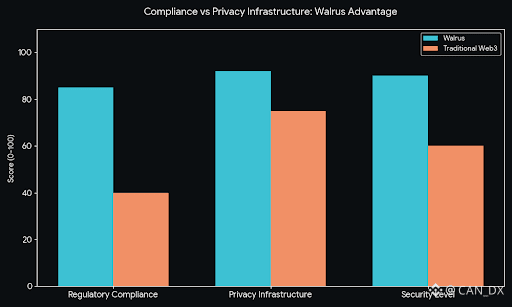
The blockchain world is shifting from speculation to utility. The next generation of successful networks will be the ones that solve real problems for developers and users. Storage, data availability, content hosting, and AI memory are becoming the backbone of modern applications. Without a dedicated layer for this, Web3 cannot scale into mainstream usage.
Walrus provides that missing foundation.
It gives developers the confidence to build real projects that go beyond tokens and transactions. It enables apps with depth, texture, and real user experiences. And most importantly, it converts data into the fuel that grows an entire ecosystem.
The message is simple:
if you want to build something real, you build on Walrus.
Because the cycle keeps strengthening:
more data stored
brings more developers
developers build more apps
apps need more storage
and the loop continues.
This is how Walrus is quietly becoming one of the most important underlying layers of the new Web3 internet.