Projects like Dusk tend to make the most sense when viewed through the lens of constraint rather than possibility. From the outside, it is easy to describe a layer-1 blockchain in terms of features—privacy, compliance, real-world assets—but those words only acquire meaning when placed against the realities of regulation, institutional operations, and long-lived financial infrastructure. Having spent time around regulated financial systems, what stands out about Dusk is not what it claims to enable, but what it appears to be trying to avoid.
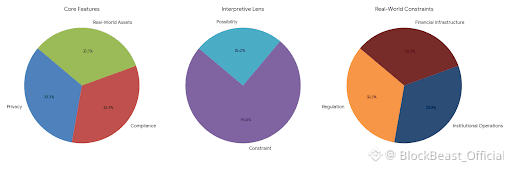
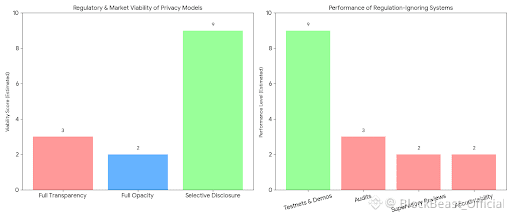
The core design philosophy seems rooted in an acceptance that financial infrastructure does not operate in a vacuum. Regulation is not an adversary to be defeated, nor a temporary inconvenience to be routed around; it is a persistent condition of the environment. Systems that ignore this tend to perform well in testnets and demos but struggle when exposed to audits, supervisory reviews, or the simple question of accountability. Dusk’s emphasis on regulated and privacy-aware infrastructure reads less like a positioning statement and more like a recognition that compliance requirements shape architecture as much as throughput or latency targets do.
Privacy, in this context, is treated as a spectrum rather than an absolute. In traditional finance, confidentiality is rarely binary. Client data is protected from public exposure, but it remains accessible—sometimes on demand, sometimes continuously—to auditors, regulators, and internal risk functions. Translating this into a blockchain setting requires uncomfortable trade-offs. Full transparency is operationally convenient but legally problematic; full opacity is attractive rhetorically but unworkable in regulated markets. The notion of selective disclosure, where transaction details can remain private while still being provably valid and auditable, reflects an attempt to mirror how financial privacy actually functions in practice. It is not a compromise so much as an alignment with reality.
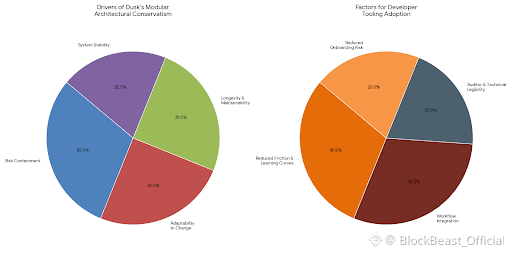
This perspective also explains the architectural conservatism in Dusk’s modular design. Separating consensus from execution, and treating components as replaceable or upgradable, is less about flexibility for its own sake and more about risk containment. In regulated environments, change is inevitable—rules evolve, reporting standards shift, cryptographic assumptions age—but wholesale rewrites are costly and dangerous. A modular architecture allows specific parts of the system to adapt without destabilizing the entire network. It is an engineering choice that favors longevity and maintainability over short-term performance gains.
Compatibility with existing developer tools follows a similar logic. While bespoke environments can be elegant, they impose learning curves and operational friction that institutions are slow to accept. Systems used in production are rarely adopted because they are novel; they are adopted because they integrate into existing workflows with minimal disruption. Supporting familiar tooling reduces onboarding risk and makes the system legible to auditors and technical reviewers who may not be inclined to learn an entirely new stack.
None of this eliminates limitations, and Dusk does not appear designed to pretend otherwise. Settlement latency, for example, is a real consideration when privacy proofs and compliance checks are involved. Faster is not always better if it undermines finality guarantees or complicates reconciliation. Similarly, any reliance on bridges, migrations, or external components introduces trust assumptions that must be documented, governed, and periodically reassessed. In traditional finance, these dependencies would be captured in risk registers and vendor assessments; in blockchain systems, they are often glossed over. Treating them as operational realities rather than temporary inconveniences is a more honest approach.
The less visible aspects of infrastructure matter disproportionately once systems move beyond experimentation. Node upgrade paths, backward compatibility, and the predictability of releases influence whether an operator can commit resources with confidence. Tooling maturity and documentation clarity affect not just developer experience, but auditability—if system behavior cannot be clearly explained, it becomes difficult to defend. These are not features that generate excitement, but they are the qualities that determine whether a system survives its first serious regulatory review.
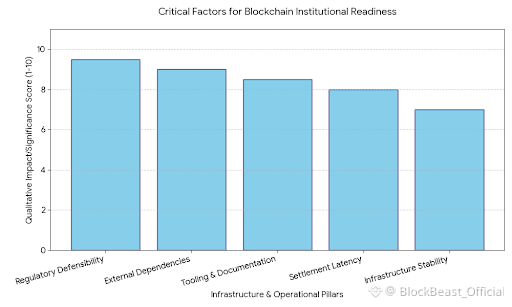
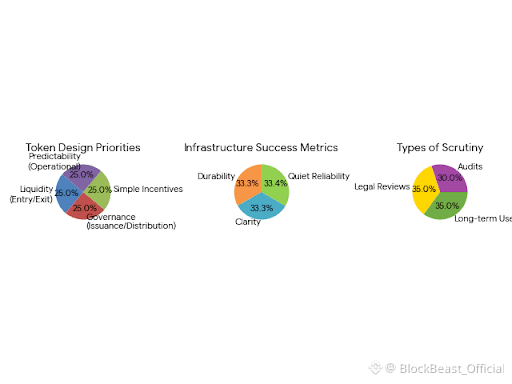
Token design, viewed through an institutional lens, is similarly unglamorous. Liquidity matters not as a proxy for popularity, but as a mechanism for entry and exit without destabilizing operations. Clear issuance and distribution rules reduce governance ambiguity and make balance-sheet treatment more straightforward. The absence of overly complex incentive schemes can be a virtue, as simplicity reduces the risk of unintended behaviors and regulatory misinterpretation. In regulated contexts, the token is less an investment narrative and more an operational component whose behavior must be predictable.
Ultimately, Dusk reads as infrastructure built with the expectation of scrutiny. Not the abstract scrutiny of social media or market sentiment, but the methodical scrutiny of audits, legal reviews, and long-term operational use. Success in this domain is rarely loud. It shows up as systems that continue to function after years of incremental change, that can be explained clearly to regulators and risk committees, and that fail gracefully rather than catastrophically. Durability, clarity, and quiet reliability are not glamorous goals, but for financial infrastructure, they are often the only ones that matter.