


The capture comes first, almost every time.
Not because anyone thinks Plasma is wrong. Because support needs an artifact they're allowed to escalate with.
A USDT payment cleared. The user says it did. The explorer agrees. Settlement monitoring looks clean... no obvious gaps, no alert that explains the ticket. From the network's side, this is routine.
Ops still asks for a capture anyway...less as proof, more as permission to move.
When an issue escalates, teams aren't hunting for "truth" in the abstract. They're hunting for a surface they can stand behind if the next message goes sideways. I've seen a clean explorer view still not end the argument.
Plasma does its part early. PlasmaBFT Deterministic finality closes state without the usual probabilistic "wait a bit longer" comfort. No reorg anxiety. No lingering maybe. The receipt exists and it's already final.
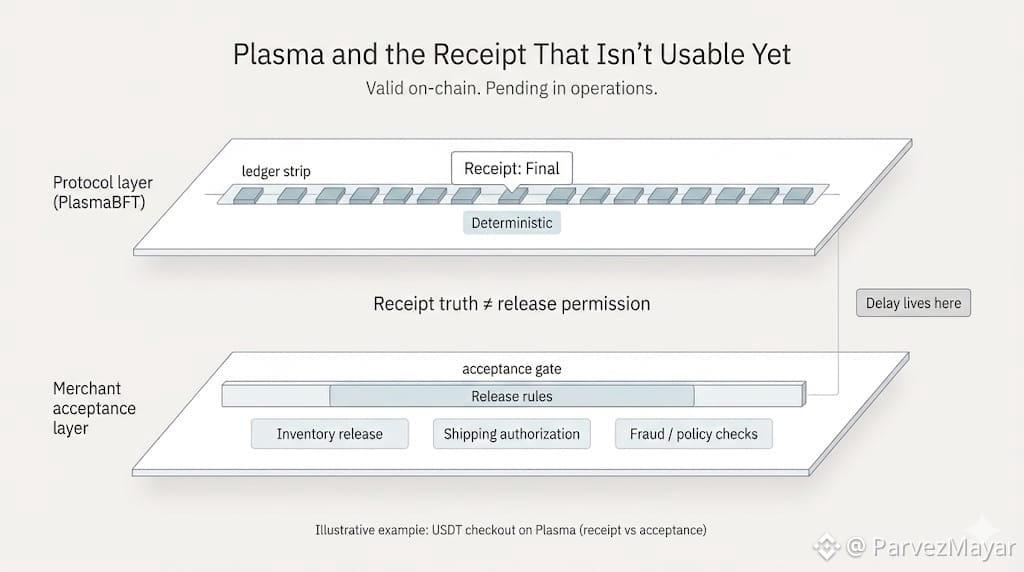
What doesn't consolidate as quickly is confidence.
Support sees one view. Ops has another. The merchant has a third screen from their own system. All can be correct. None is authoritative enough to end the conversation alone.
So the escalation flow becomes screenshot verification:
"Send a screenshot." "Refresh and confirm." "Show the explorer view again."
These aren't technical checks. They're coordination checks. A screenshot is a shared reference point... something stable enough that three roles can agree they saw the same thing at the same time.
Operational transparency helps here. The data exists and it's consistent. But three clean screens still don't tell you who's allowed to answer. Ops still has to decide which signal counts as "safe to act" when pressure shows up.
A user waits in chat. Support wants to answer. Ops doesn't want to answer twice. Nobody doubts the Plasma stablecoins settlement... they doubt whether they're the one who should move next.
That hesitation isn't caused by unreliability. It's caused by there being too many correct views and no single source of confidence that everyone treats as final.
Payment-grade uptime requirements keep Plasma steady. They don't tell an operator which screen gives them cover during an escalation. So teams add process: screenshots get archived, internal notes get attached, playbooks get thicker... because decisions travel across humans faster than they travel across tooling.
Even when incidents stop, the habit remains. Operators keep collecting proxies. Support keeps asking for visual confirmation. Not because the chain can't settle, but because "settled" and "I can safely respond" are different states.
Plasma keeps closing state deterministically.
The screenshots keep moving.