

One of the quiet problems in blockchain is not speed or even scalability. It is cost. Not just financial cost, but the cost in energy, hardware, and long-term sustainability. For many years, proof-of-work systems showed the world that decentralized networks can be secure, but they also showed how expensive that security becomes as a network grows. More competition means more machines, more electricity, and more waste. This might have been acceptable in the early days, but it is clearly not something that can support global financial infrastructure in the long run.
Dusk approaches this problem from a different direction. Instead of trying to improve proof-of-work, it uses a proof-of-stake based system called Succinct Attestation. The idea is simple, but the impact is important. Rather than asking the network to burn energy to prove it is honest, the network relies on staked value and clear rules to decide who produces and confirms blocks. This changes security from “who can spend the most electricity” to “who has something to lose if they behave badly.”
In proof-of-work systems, security grows by increasing difficulty. That means more and more computing power is needed over time, which leads to an arms race of hardware and energy use. In proof-of-stake systems, security grows by participation and stake. Adding more participants does not mean burning more electricity. It means spreading responsibility across more actors. This is one of the reasons large networks that moved away from proof-of-work were able to reduce their energy use so dramatically.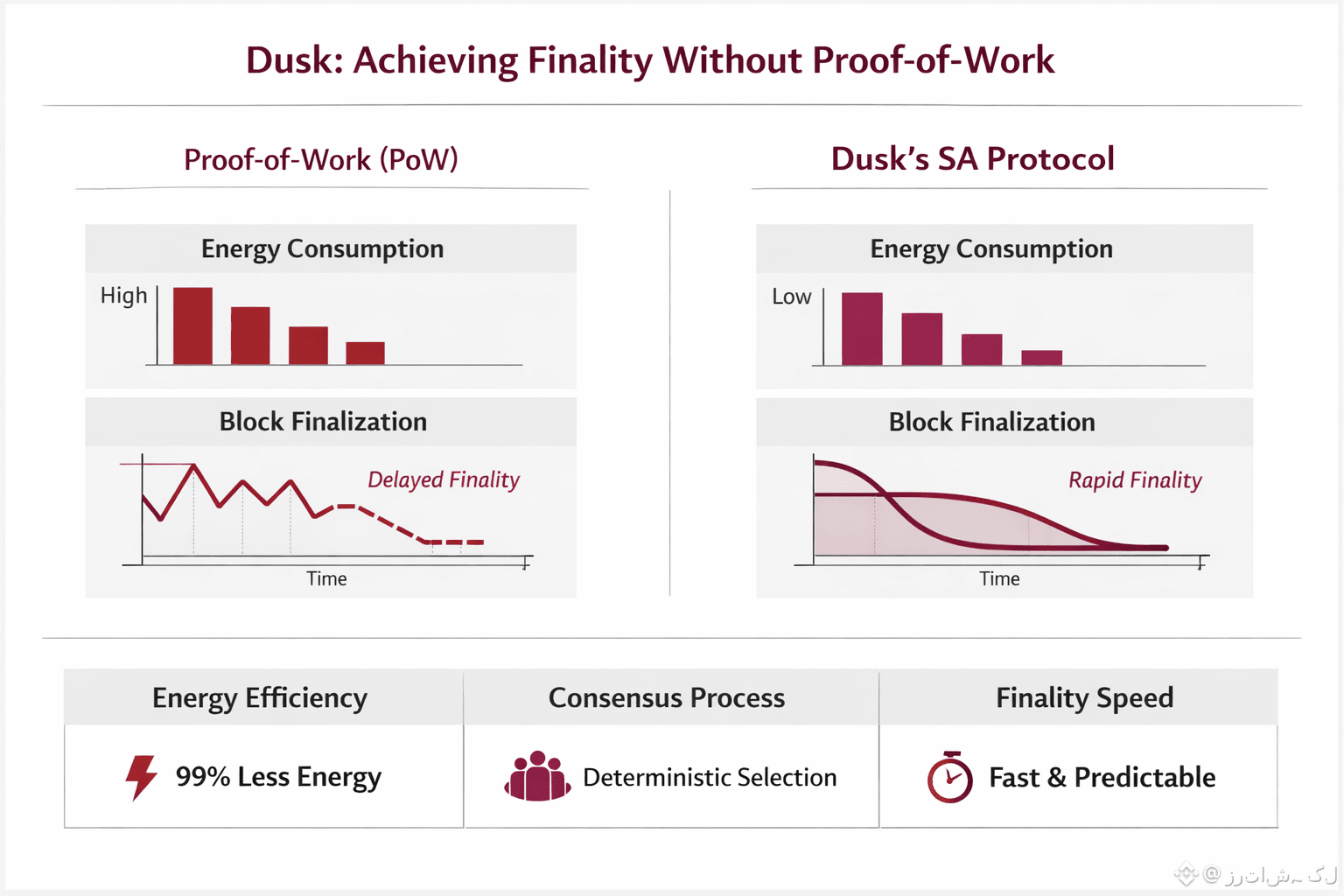
Dusk’s Succinct Attestation builds on this idea but adds structure to how agreement is reached. Instead of having everyone participate in every block, the system uses a committee chosen through deterministic sortition. In simple terms, the network can fairly and predictably choose who takes part in producing and validating blocks based on how much they have staked. There is no heavy computation involved. It is a logical process, not a race of machines.
This already saves a lot of energy, but Dusk goes further. The protocol is designed around rolling finality. In many blockchains, blocks become “more final” over time after many confirmations and repeated work. This means the network keeps spending resources on the same history just to increase confidence. On Dusk, finality is handled more directly. The protocol limits how many steps are needed before a block is considered final. This reduces repeated work, reduces network load, and makes the system more predictable.
Predictability matters more than it often gets credit for. In financial systems, knowing when something is final is not a technical detail. It is a requirement. Settlement, clearing, and accounting all depend on it. If a system is fast but uncertain, it cannot safely be used for serious financial workflows. Dusk’s approach focuses on reaching clear outcomes efficiently instead of constantly reprocessing the same information.
Another important aspect of Succinct Attestation is that it fits Dusk’s broader goal of being infrastructure rather than a spectacle. The network is not designed to show off how much work it can do. It is designed to quietly do exactly the work that is needed, and no more. Block production and validation happen without heavy computation. Communication is kept efficient. Redundant steps are avoided. All of this adds up to a system that can run for a long time without turning into an energy sink.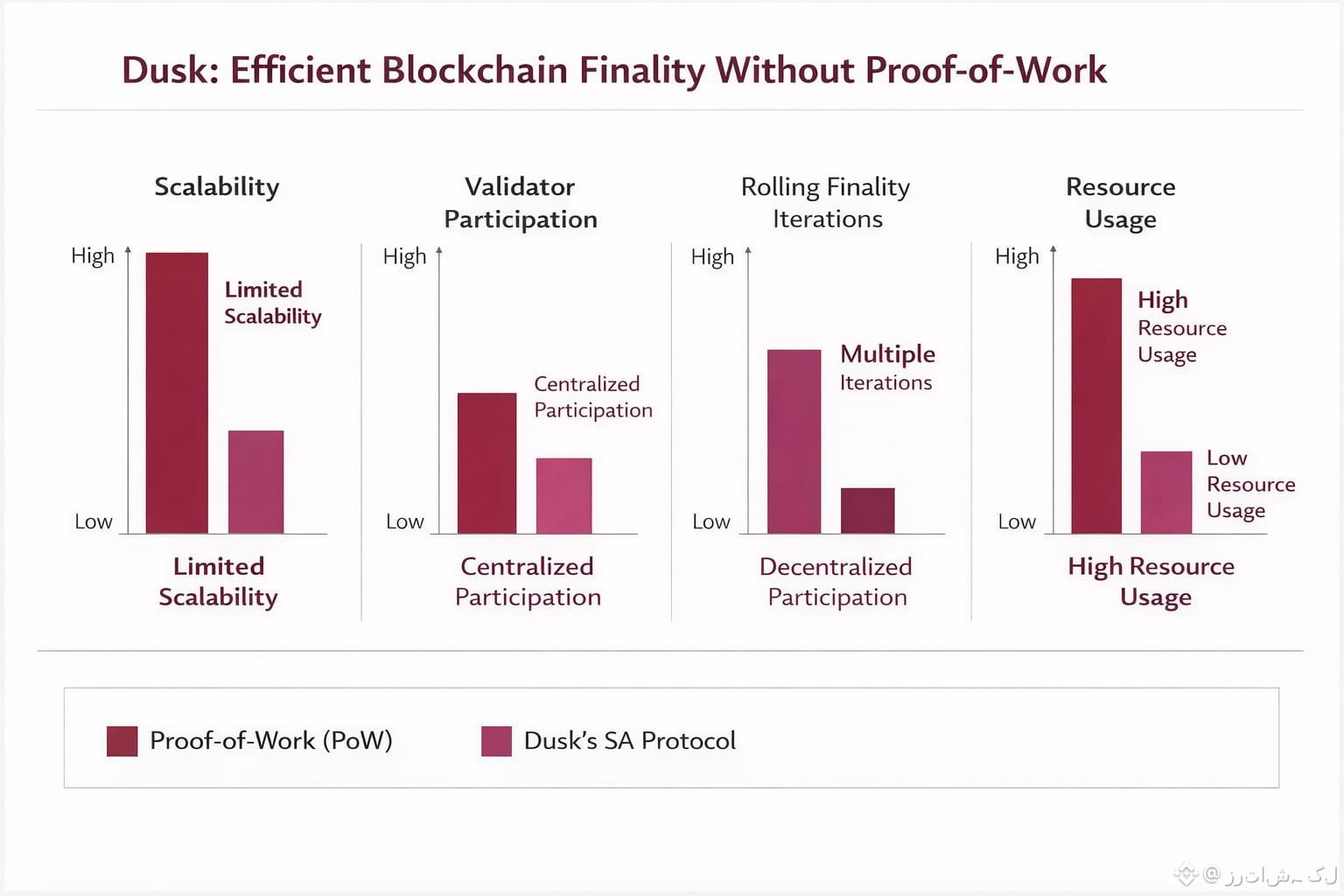
This also makes participation more accessible. In systems that rely on expensive hardware, only those who can afford large setups can realistically take part. In Dusk’s model, participation is more about commitment than machinery. This helps create a healthier and more diverse validator set, which is good for both security and long-term stability.
What makes this especially relevant is the kind of use cases Dusk is built for. The project is focused on regulated assets, confidential contracts, and financial workflows that may need to run reliably for many years. For that future, efficiency is not a luxury. It is a necessity. A system that becomes more expensive to operate every year cannot be the foundation of real financial infrastructure.
Succinct Attestation is not about making big claims. It is about making careful choices. It shows that strong security, clear finality, and low resource use can exist together when a system is designed with the right priorities. Instead of asking the world to keep paying more for the same guarantees, Dusk is building a system where good design does more of the work than raw power.
In the end, this is what fits Dusk’s philosophy best. The goal is not to be the loudest system in the room. The goal is to be the one that works quietly, reliably, and for a very long time.