
@Dusk is unique in the Layer 1 space where verifiable privacy is at the core of its design, particularly when it comes to applications needing institutional and regulatory requirements. It is the Rusk protocol that achieves this. When data is confidential, the state transition functionality of Dusk is provided by Rusk, to ensure that every transaction and smart contract is updated to the ledger in a deterministic and auditable manner. It is not regarding concealment of information to conceal it but rather letting execution stay secret and creating cryptographic evidence that validates rightness and adherence.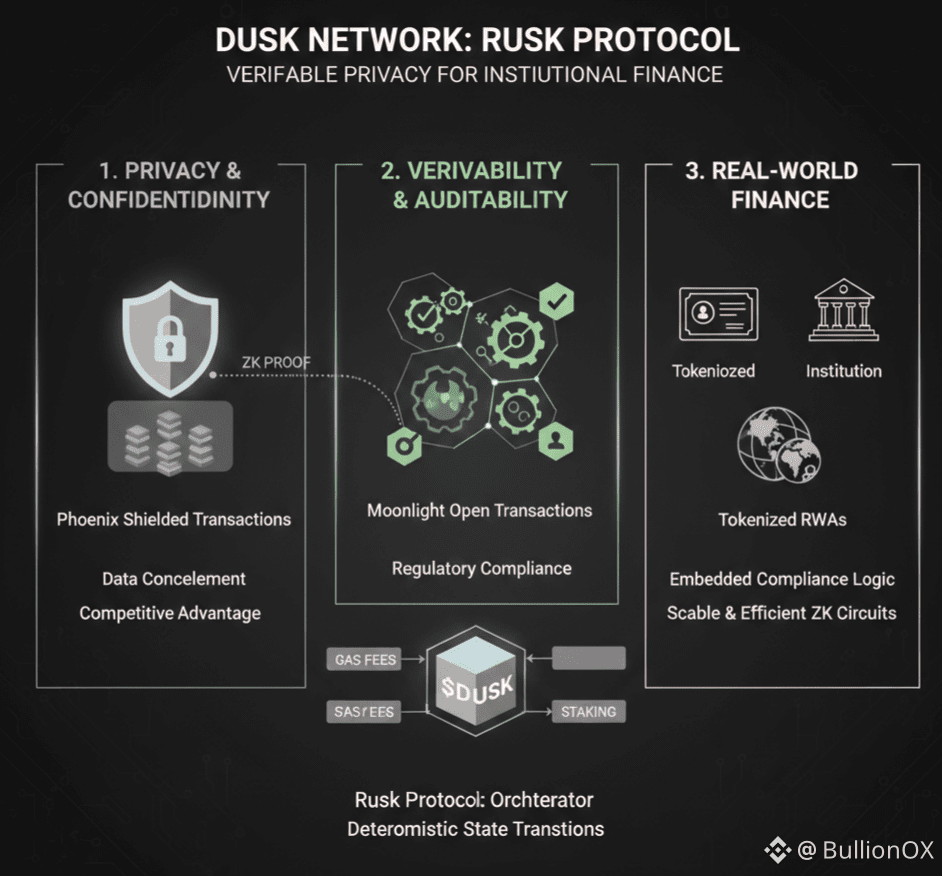
Rusk operations transform state in the modular layers of Dusk, such that a private computation (e.g. that of Hedger Alpha) can yield verifiable results without revealing any sensitive information like balances or identities. This type of balance is required in institutions that deal with tokenized real world assets: privacy to ensure competitive advantages and proprietary information, and verifiability so that regulators or auditors can identify that rules were observed (accreditation, limits, or reporting requirements). Rusk is able to do this by incorporating zero knowledge proofs in every confidential transition and produce succinct attestations that demonstrate that logic was correctly executed but the inputs and internal states were not disclosed.
The deterministic character of the protocol is a design decision. The inputs will always produce the same output and this is of necessity in the financial applications where predictability and audit trails are required. Ambiguity may cause legal or operational risks in the regulated environment. Rusk avoids that ambiguity by imposing constraints during running time, i.e. when a condition is not satisfied, the transition cannot occur at all prior to settling into place. Such proactive implementation decreases the use of post execution detection that is a major deficiency with transparent chains.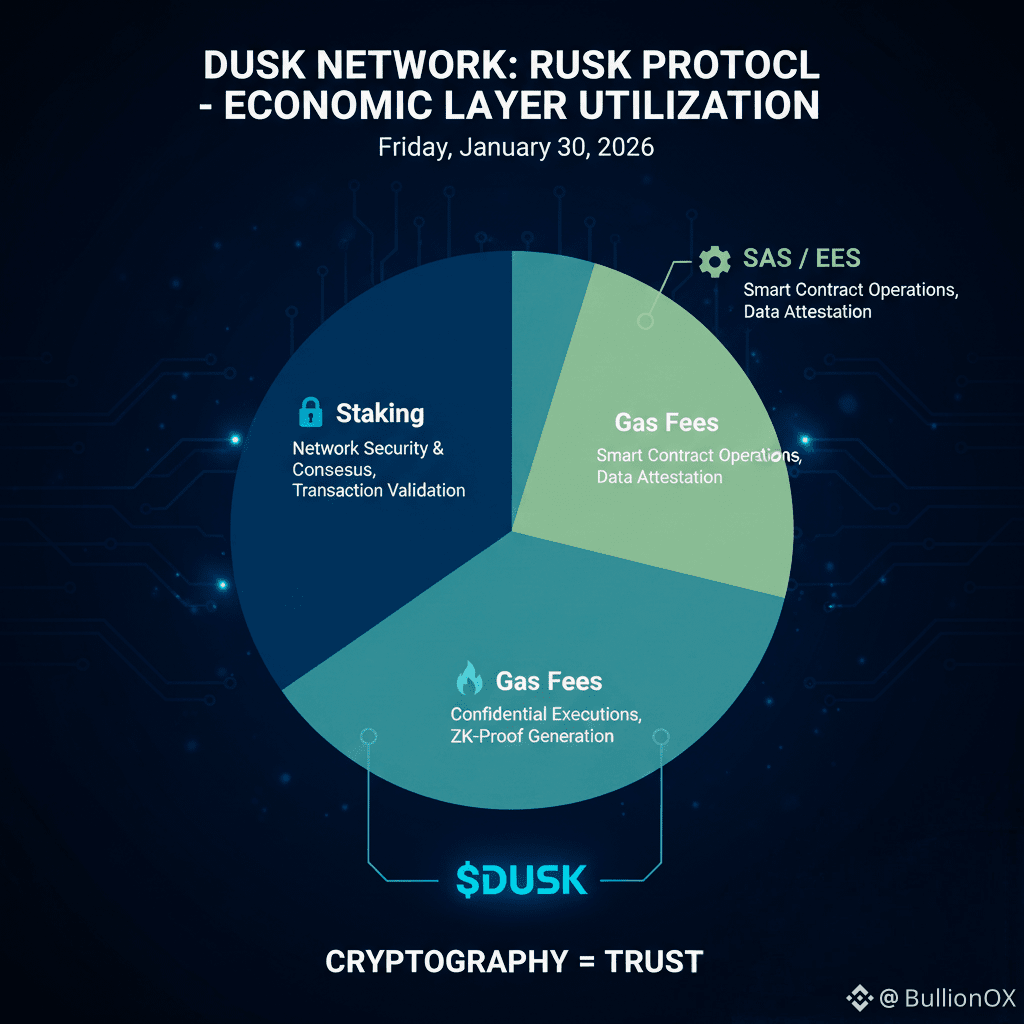
Rusk is also an advocacy of dual transaction models of Dusk. Phoenix offers shielded UTxO transactions, which are as private as possible, optimal when it comes to institutional flows that would reveal commercial information in detail. Moonlight provides open dealings on instances where transparency is needed to be complied with. Rusk manages to synchronize both models, so that the private states are held in the shielded path but can be verified publicly on demand. This is because Dusk can be configured to fit many types of institutional applications, such as personal credit arrangements and compliant settlement systems.
The $DUSK token is the economic layer that drives Rusk. Gas charges are used to pay the cost of confidential executions and generation of proof and staking guarantees the consensus that authenticates the transitions of Rusk. This forms a system of self-reinforcement in which the participants of the network have incentives to ensure that the network remains reliable and verifiable.
Practically, Rusk allows Dusk to be infrastructure of real world finance. The tokenized securities may have compliance logic embedded within them, and Rusk provides rules that are enforced privately and provable. ZK circuits in the protocol are lightweight, which makes operations efficient and allow scalability without compromising the auditability. This design purpose is in line with the increasing requirement in the Web3 of privacy layers that can be trusted by the institutions, not anonymity, but responsible and verifiable privacy.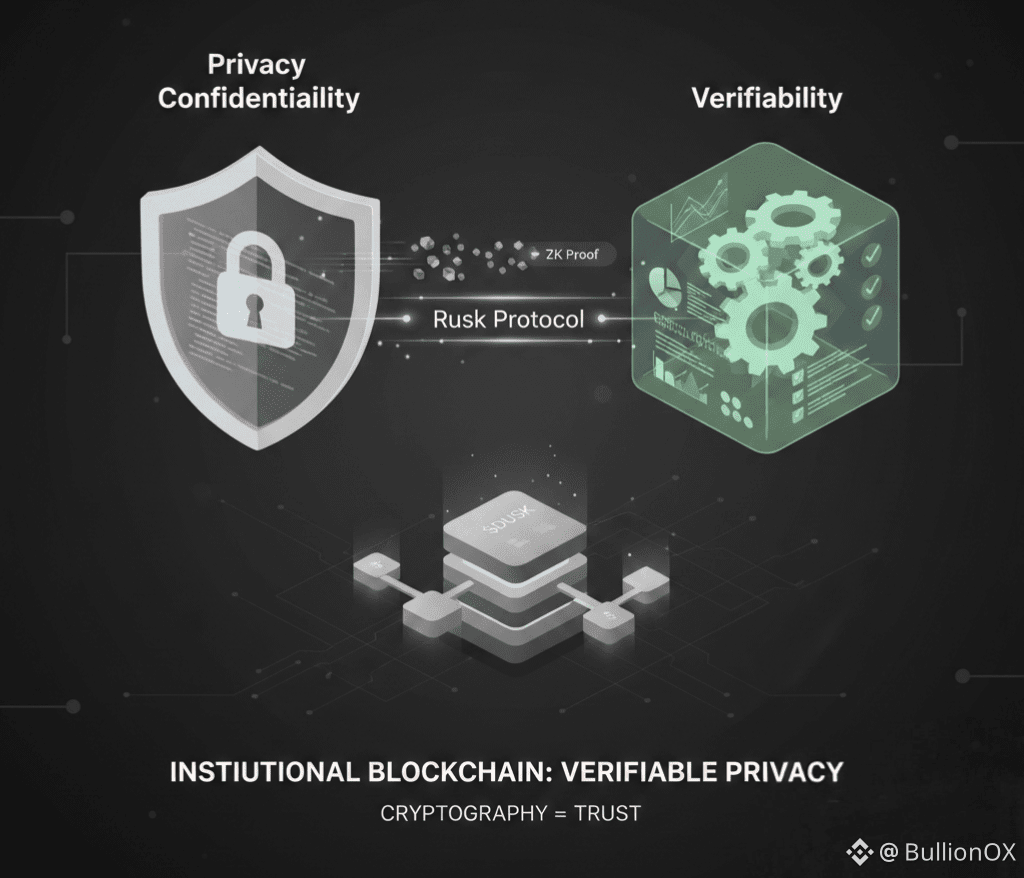
Rusk is given special attention by Dusk which represents a sophisticated perception of controlled finance: openness does not presuppose trust, but cryptography proves it. This is a long-term utility approach in a space that is trending towards institutional adoption, as it will address actual pain points such as data exposure and regulatory friction.
What do you think of institutional blockchain verifiable privacy?
Does such a provability accountability alter your perception of privacy levels?