

Integrating Blockchain with Mainstream Finance
The financial world is undergoing a dramatic transformation. Money moves digitally at lightning speed, regulatory frameworks are tightening, and both consumers and institutions expect seamless, secure experiences. Blockchain has long been heralded as the future, yet most networks haven’t been designed for the complex realities of international finance. Dusk changes this narrative by offering a platform tailored for today’s—and tomorrow’s—regulated markets.
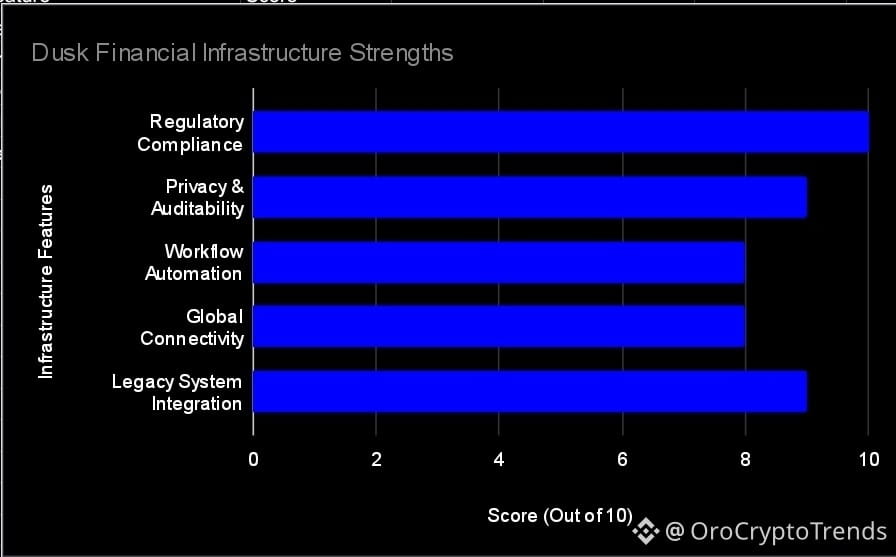
1️⃣ Engineered for Regulation, Not Just Disruption
Many blockchain ecosystems position themselves as open playgrounds, favoring decentralization at the expense of compliance. But global finance is governed by strict rules, and institutions can’t afford to ignore them. Dusk is built from the ground up for regulated environments, enabling banks, asset managers, and enterprises to confidently adopt blockchain without risking regulatory violations. This approach isn’t just about ticking boxes—it’s about fostering responsible innovation that jurisdictions and supervisors can embrace.
2️⃣ Advanced Privacy with Auditability
Financial institutions are under pressure to safeguard sensitive information while maintaining transparency for auditors and regulators. Unlike blockchains that expose everything or hide too much, Dusk uses privacy-preserving technologies—like zero-knowledge proofs—that balance confidentiality with accountability. Transactions can be validated and audited without revealing proprietary or personal data. This nuanced privacy model is crucial for real-world use, where both trust and compliance are non-negotiable.
3️⃣ Modernizing Legacy Workflows with Smart Automation
Despite advances in fintech, much of institutional finance still relies on cumbersome paperwork and manual intervention—slowing down processes such as bond issuance, syndicated lending, and trade settlements. Dusk replaces these outdated workflows with programmable, on-chain financial instruments. Smart contracts automate everything from compliance checks to settlement cycles, reducing operational risk and freeing up resources for higher-value activities. This shift not only cuts costs but accelerates innovation across the financial stack.
4️⃣ Streamlined Global Connectivity—No More Bottlenecks
Cross-border transactions have traditionally depended on layers of intermediaries, each adding friction, cost, and delay. Dusk leverages blockchain’s shared infrastructure to connect financial participants directly, regardless of geography or currency. This peer-to-peer architecture minimizes the need for custodians and clearinghouses, enabling instant, secure collaboration across markets. The result is a more inclusive, efficient financial system—where capital and information flow freely.
5️⃣ Building Bridges Between Old and New Systems
Rather than trying to replace traditional finance, Dusk offers a connective layer that brings established institutions into the digital age. Its technology is designed to integrate with existing infrastructure, allowing banks and enterprises to experiment with blockchain while maintaining continuity with legacy systems. This pragmatic approach paves the way for mass adoption, as stakeholders see blockchain as an enhancer—not a disruptor—of their core operations.
Looking Ahead: The Role of Regulated Blockchain Platforms
Dusk represents more than just another blockchain project—it’s a blueprint for the future infrastructure of global finance. By combining regulatory compliance, privacy, and automation, it addresses the biggest challenges facing banks, regulators, and innovators alike. As financial markets evolve, platforms that harmonize the old and the new will drive the next phase of growth.
Keep a close eye on how regulated blockchain networks like Dusk develop. Their ability to align innovation with regulatory clarity will be instrumental in shaping a more robust, transparent, and efficient financial ecosystem for everyone.
Disclaimer: This is not financial advice.