

Dusk Network has entered its current phase with a level of clarity that is rare in the layer-1 landscape. Rather than positioning itself as a general-purpose blockchain competing for retail attention or speculative liquidity, Dusk is deliberately engineered for regulated financial markets where confidentiality is not optional but mandatory. Its mainnet launch marked a shift from theory to execution, demonstrating that privacy-preserving infrastructure can exist without rejecting compliance or institutional oversight. This focus places Dusk outside the usual narratives of DeFi maximalism or ideological privacy, anchoring it instead in the operational realities of real-world finance.
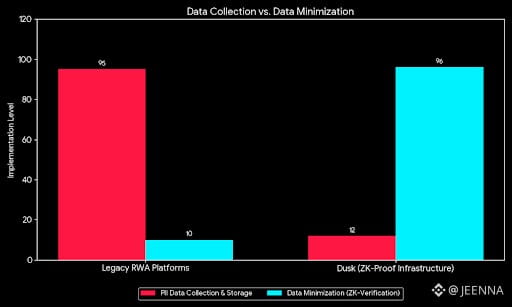
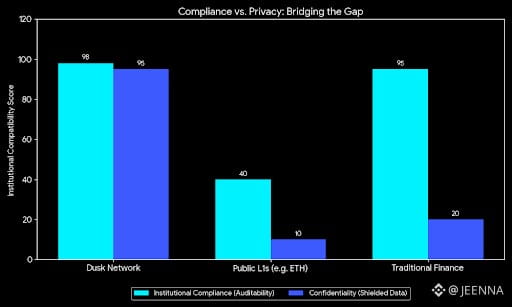
At the protocol level, Dusk is designed around a simple but difficult premise: financial data should remain private by default, yet provable when required. Through native zero-knowledge proofs and selective disclosure mechanisms, transactions, balances, and counterparties can stay hidden from the public while remaining verifiable to authorized entities such as regulators or auditors. This architecture mirrors how traditional financial systems already function off-chain, but translates that logic into a blockchain-native environment. The result is not anonymity for its own sake, but controlled confidentiality that aligns with legal and regulatory expectations.
One of the most significant developments reinforcing this direction is the introduction of Confidential Security Contracts. These enable tokenized securities — including equities, bonds, and other regulated instruments — to be issued and transferred on-chain without exposing sensitive market information. Ownership structures, transaction values, and settlement flows remain shielded, while compliance checks and audits can still be performed. This capability directly targets one of the largest barriers to institutional blockchain adoption: the incompatibility between public ledgers and confidential capital markets.
Recent ecosystem activity suggests that Dusk is prioritizing infrastructure maturity over short-term ecosystem optics. Integrations and partnerships have been oriented toward regulated venues, interoperability standards, and long-term asset issuance rather than rapid DeFi expansion or incentive-driven growth. Validator design, network stability, and conservative security decisions reflect an understanding that the intended users are institutions that demand reliability and predictability, not experimental throughput or hype-driven narratives.
In a market crowded with blockchains trying to be everything at once, Dusk’s narrow scope becomes its strategic advantage. Its success will not be measured by total value locked spikes or viral applications, but by whether regulated assets, compliant exchanges, and institutional issuers choose it as their settlement layer. If tokenization of real-world assets continues to mature, infrastructure that reconciles privacy with oversight will be unavoidable. Dusk is not marketing that future — it is methodically building toward it.