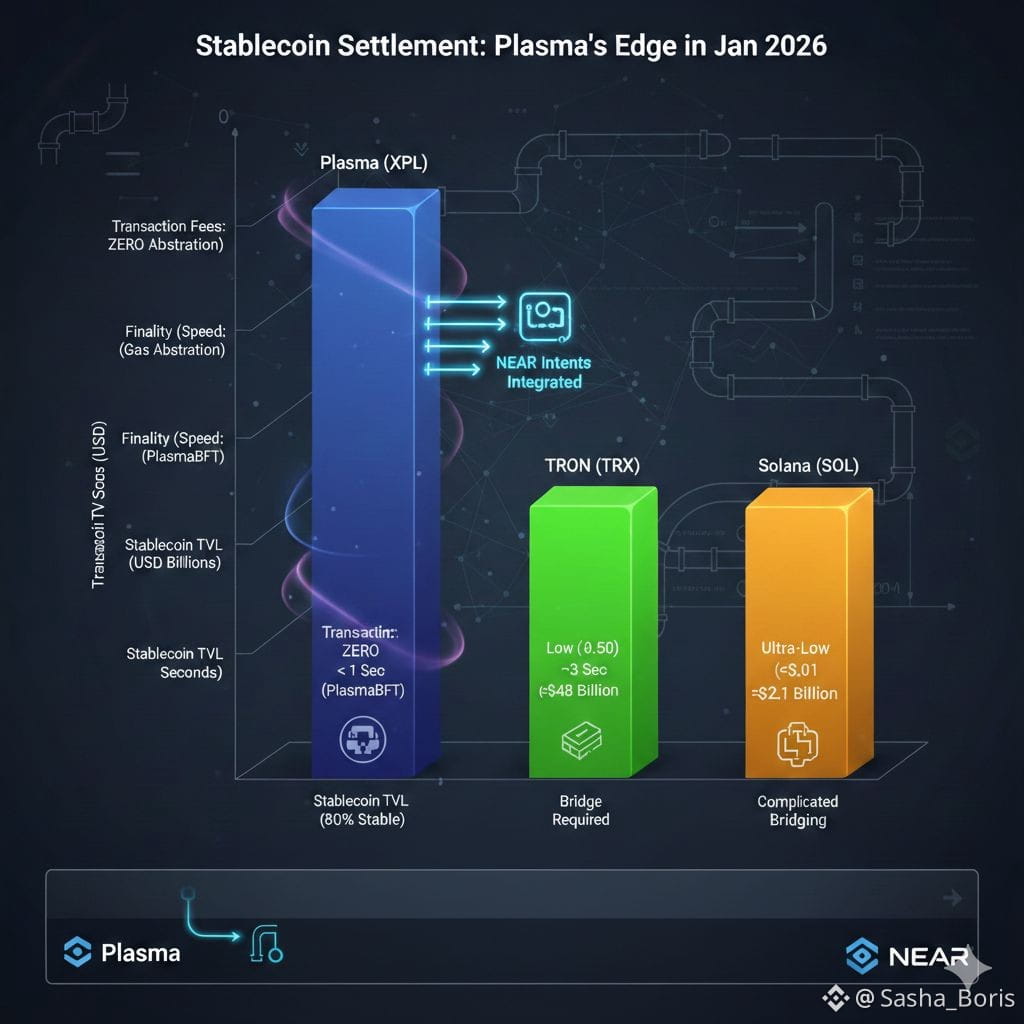
In the fast-moving world of digital finance, the loudest announcements often have the shortest lifespans. But in January 2026, a quiet integration between Plasma (XPL) and NEAR Intents started a ripple effect that is fundamentally rewriting how global money moves. While others are building "DeFi playgrounds," Plasma is building the plumbing. And as any civil engineer will tell you, the plumbing is what actually makes a city livable.
The project isn't just another Layer 1; it is a purpose-built settlement engine for stablecoins, backed by a "who’s who" of fintech royalty—including Peter Thiel (Founders Fund), Paolo Ardoino (Tether), and Framework Ventures. By joining forces with NEAR Intents, Plasma has moved from being a "destination" to becoming the "default routing layer" for the world's most liquid assets.
The Infrastructure of Certainty
Most blockchains suffer from a "jack-of-all-trades" syndrome. They want to host NFTs, gaming, and complex DeFi all at once, often leading to network congestion and unpredictable fees. Plasma rejects this. It focuses on one thing: Stablecoin Settlement.
The core technology, PlasmaBFT, is a high-performance consensus mechanism that delivers sub-second finality. For a global payment processor, this is non-negotiable. You can't run a retail checkout or a payroll system on a chain where you have to wait several minutes to know if a payment is "final."
What makes this even more compelling is Gas Abstraction. Through a protocol-level paymaster system, Plasma allows for zero-fee USDT transfers. Users don't need to hold a native token just to move their money—a friction point that has killed countless payment apps in the past. If a transaction isn't sponsored, users can pay gas in USDT or even Bitcoin, making the experience feel like a modern banking app rather than a complex cryptographic puzzle.
Why the NEAR Intents Integration Changes the Game
Before this integration, Plasma was a fast highway waiting for traffic. NEAR Intents acts as the ultimate traffic aggregator. Instead of forcing users to manually bridge assets across complex, risky pipes, NEAR Intents uses an "intent-based" architecture.
A user simply says, "I want to move 10,000 USDT to Plasma," and a decentralized network of "solvers" finds the most efficient route. This integration has plugged Plasma into a liquidity pool of over 125 assets across 25+ blockchains.
For institutional players like OTC desks and treasury managers, this means they can execute multi-million dollar swaps with centralized-exchange-level pricing, but with the security of an on-chain environment. It turns Plasma into a critical hub in the "chain-abstracted" future, where the end-user doesn't even need to know which blockchain they are using.
XPL Tokenomics: Balancing Growth and Gravity
The XPL token is the heartbeat of this ecosystem. While USDT is the primary medium of exchange, XPL provides the security. As of early 2026, the token serves three vital roles:
Staking & Security: Validators stake XPL to secure the network, earning real-world yields (3-5%) derived from transaction fees rather than just pure inflation.
Governance: Holders vote on protocol upgrades, such as the upcoming activation of confidential transactions for B2B privacy.
Deflationary Pressure: Following an EIP-1559-style model, a portion of all complex transaction fees is burned, creating a counter-balance to the 10-billion-token supply.
The market performance of XPL has been a lesson in resilience. After a massive surge following its Binance listing, the token faced an 80% drawdown—a common "shakeout" for early infrastructure plays. However, by January 2026, the on-chain metrics told a different story: Total Value Locked (TVL) has surged to over $3.3 billion, with over 80% of that liquidity sitting in stablecoins. This isn't speculative "farming" money; it’s working capital.
Real-World Utility: The Plasma One Vision
Infrastructure is only as good as the apps built on top of it. Plasma One, the project’s flagship neobank app, is currently in beta with users from 15+ countries. It allows people to spend USDT via virtual and physical Visa cards in 150 countries, earning up to 4% cashback in XPL.
This is where the "Bitcoin-anchored security" comes in. To satisfy institutional and regulatory requirements, Plasma periodically "checkpoints" its state to the Bitcoin blockchain. It inherits the "weight" of Bitcoin’s security without sacrificing its own speed. This dual-layer trust model is exactly what banks and fintechs look for when they decide where to settle billions in cross-border volume.
The Road Ahead: 2026 and Beyond
The roadmap for 2026 is ambitious but grounded. Key milestones include:
Validator Network Activation (Q1 2026): Enabling public delegation and staking to further decentralize the network.
Modular Execution Layer: Support for non-EVM languages like Move, expanding the developer pool.
The "July Unlock": A significant token unlock for public sale participants in July 2026. While this may create short-term price volatility, the team is focused on increasing staking utility and network volume to absorb the supply.
Plasma isn't trying to be a "moonshot" for a weekend trade. It is a bet on the long-term reality that stablecoins will eventually move more value than traditional banking rails. By focusing on the "boring" parts—settlement, speed, and safety—they are building the invisible giant of the next financial era.