I’ve been closely tracking Solana, and its recent price action definitely caught my attention. The sell-off was sudden and unsettling for many traders. The token dropped by about eight percent, settling near the $115 level. This move followed the decision by the U.S. central bank to keep interest rates unchanged, a type of announcement that often sends shockwaves through risk-on assets. Crypto markets, as usual, reacted quickly. Fear returned almost instantly, and many participants chose to exit their positions. But the situation didn’t stop there—and that’s what makes it worth examining.
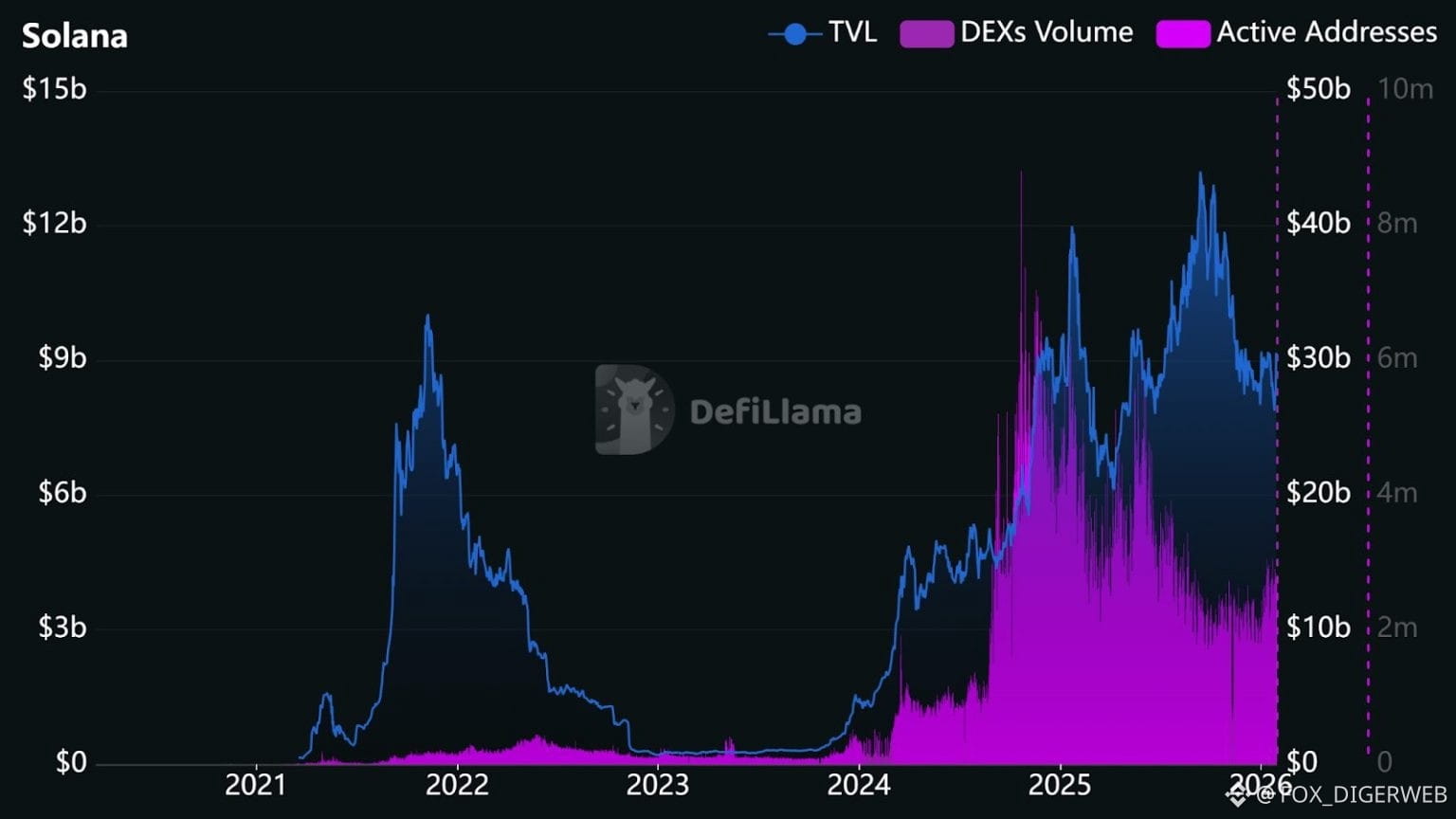
What stood out wasn’t just the price movement, but what was happening behind the scenes. Even as the token declined, Solana’s on-chain activity accelerated. In just one day, decentralized exchanges built on Solana processed close to four billion dollars in volume. That figure surpassed activity on Ethereum and several other leading blockchains over the same timeframe. The user data reinforces this trend. More than 2.7 million wallets were active over the past week, suggesting that engagement remains strong despite the shaky price sentiment.
A significant driver of this activity appears to be memecoin trading. Volume in that segment has picked up again, likely because traders are drawn to fast execution and minimal fees—areas where Solana consistently excels. Although the token is still well below its previous peak, the network itself feels far from dormant. In fact, it feels crowded and energetic, which isn’t typical of a project losing relevance.
From a technical perspective, price is currently hovering around the $116 area, a level that has proven important in the past. It has served as support before, though repeated tests tend to weaken its strength. If sellers push decisively below this zone and maintain control, the next downside target could be near $110. That scenario can’t be dismissed. On the other hand, a strong move back above $134 could quickly shift sentiment and reignite upward momentum.
I’ve also seen commentary from larger investors who believe Solana’s valuation should be significantly higher. Their argument centers on the network’s speed, user-friendly design, and its potential for real-world payment use cases. One idea that resonated with me is the notion that true value comes from actual usage, not just speculative holding. Solana appears designed with that principle in mind. Even its founder frequently emphasizes delivering consumer value first and monetization later—a mindset that supports long-term growth.
Another interesting observation is how tightly Solana’s performance is linked to the broader memecoin ecosystem. When Solana shows signs of strength, capital often rotates into newer, higher-risk projects. During my research, Maxi Doge kept coming up. It has already raised more than four million dollars and promotes aggressive staking incentives. That alone doesn’t ensure success, but it does show how quickly enthusiasm can return when traders sense renewed opportunity. A recovery in Solana could easily amplify interest in projects like this.
What makes this phase particularly intriguing is the disconnect between price and fundamentals. Market sentiment is shaky, and fear dominates the narrative. Yet network usage continues to expand. Over time, I’ve noticed that markets often move contrary to prevailing emotions. When attention is fixed on falling prices, underlying growth can go unnoticed. Solana currently feels under pressure—but far from broken.
As I keep watching how this unfolds, the current support zone feels pivotal. Either it gives way and opens the door to further downside, or buyers step in and reaffirm why Solana captured so much attention in the first place. For me, this goes beyond technical levels. It’s about whether sustained network activity can eventually be reflected in price again. That question alone makes this moment worth watching closely.