
Most blockchain projects begin with grand visions that gradually narrow toward specific use cases. Vanar’s story follows the opposite trajectory. Starting as Virtua, a metaverse platform with gaming ambitions, the project underwent a fundamental reimagining that expanded rather than contracted its scope. The transformation into Vanar represented more than a rebrand. It signaled a strategic pivot toward becoming the first blockchain infrastructure genuinely designed for mainstream adoption at the intersection of entertainment, artificial intelligence, and environmental sustainability.
Understanding how this evolution happened reveals insights about both blockchain’s maturation and the genuine challenges facing mass adoption.
The Foundation: Virtua’s Early Vision
Before Vanar existed, there was Virtua. Launched with the TVK token, Virtua built itself around a metaverse concept focused on digital collectibles and virtual experiences. The project targeted entertainment enthusiasts rather than crypto natives, attempting to bridge the gap between traditional gaming audiences and blockchain technology. This positioning proved both prescient and limiting. The team understood that mainstream adoption required infrastructure optimized for entertainment use cases, not generic smart contract platforms repurposed for gaming. However, the metaverse narrative alone couldn’t support the technical ambitions taking shape within the development team.
By 2023, the Virtua team had accumulated significant expertise in what worked and what didn’t for blockchain entertainment. They’d learned that transaction fees mattered enormously for in-game economies. They’d discovered that energy consumption questions from major brands couldn’t be dismissed with vague promises about future improvements. They’d realized that the artificial intelligence revolution would fundamentally change what applications needed from blockchain infrastructure. These insights demanded more than incremental updates. They required reimagining the entire project from first principles.
The decision to rebrand represented acknowledging that Virtua had outgrown its original conception. In November 2023, the community voted overwhelmingly to approve the transformation from TVK to VANRY tokens on a one-to-one basis. This wasn’t just ticker symbol cosmetics. The rebrand accompanied the announcement of Vanar Chain, a completely new Layer 1 blockchain designed specifically for entertainment and gaming with integrated artificial intelligence capabilities and carbon-neutral operations. The transition completed across major exchanges in late November and December 2023, with Vanar officially emerging as a distinct entity with dramatically expanded ambitions.
Leadership and Strategic Direction
Vanar’s transformation happened under the leadership of Jawad Ashraf, who serves as CEO, and Gary Bracey, both bringing complementary expertise to the project. Ashraf’s background combines technical understanding with strategic vision for how blockchain intersects with mainstream industries. His emphasis on practical adoption over speculative hype informed many of Vanar’s distinctive choices, particularly the focus on environmental sustainability and real-world partnerships. Bracey’s experience in the gaming and entertainment industries provided crucial insights into what major brands actually need from blockchain infrastructure.
The leadership team recognized early that technical excellence alone wouldn’t drive adoption. Major entertainment companies care deeply about brand association, environmental impact, and user experience. They’re building games and platforms for millions of users who don’t know and don’t care about blockchain technology. This reality shaped Vanar’s development priorities in fundamental ways. If the goal was mainstream adoption, the infrastructure needed to be invisible to end users while providing unprecedented capabilities to developers and brands.
This philosophy led to partnerships rather than competition as the primary growth strategy. Instead of positioning Vanar as another blockchain fighting for developer mindshare, the team focused on solving specific problems that prevented major brands from embracing blockchain. Energy consumption topped that list. Regulatory concerns about user data followed closely. Technical complexity in integrating blockchain features into existing applications rounded out the major barriers. Vanar’s roadmap addressed each of these systematically rather than claiming technical superiority alone would overcome adoption resistance.
The Google Cloud Partnership: Carbon Neutrality as Infrastructure
Perhaps no partnership better exemplifies Vanar’s approach than the collaboration with Google Cloud announced in late 2023. While other blockchains touted theoretical future improvements in energy efficiency, Vanar built carbon neutrality directly into its infrastructure layer. The partnership leverages Google Cloud’s data centers powered by renewable energy sources including solar, wind, and hydropower. More importantly, it provides measurable, verifiable environmental credentials that major brands can integrate into their own sustainability reporting.
The technical implementation goes beyond simple greenwashing. Vanar’s validators can operate within Google Cloud infrastructure that runs entirely on renewable energy. The blockchain measures and tracks energy consumption with transparency that allows brands to calculate exact environmental impact. This matters enormously for companies facing shareholder pressure around environmental, social, and governance metrics. When a major entertainment company builds on Vanar, they’re not gambling on future carbon credits or offset promises. They’re deploying on infrastructure with renewable energy backing from day one.
The partnership extends further into technical optimization. Google Cloud’s global network infrastructure addresses latency concerns that plague many blockchains attempting to serve worldwide audiences. The collaboration utilizes Google’s undersea cable networks and distributed data center architecture to ensure consistent performance across regions. For gaming applications where milliseconds matter, this infrastructure foundation provides advantages that purely decentralized networks struggle to match. The partnership represents pragmatic recognition that mainstream adoption requires meeting users where they are rather than demanding they adapt to blockchain’s limitations.
takes the environmental commitment beyond passive carbon neutrality toward active positive impact. The project encourages brands building on its platform to calculate the power usage that would have occurred without renewable energy support and contribute equivalent amounts as carbon credits. This philosophy pushes beyond mere neutrality toward genuine environmental benefit. Given that the next generation will inherit the Web3 ecosystem being built today, this forward-thinking approach resonates with companies thinking long-term about their environmental legacy.
Technical Architecture: AI-Native Blockchain
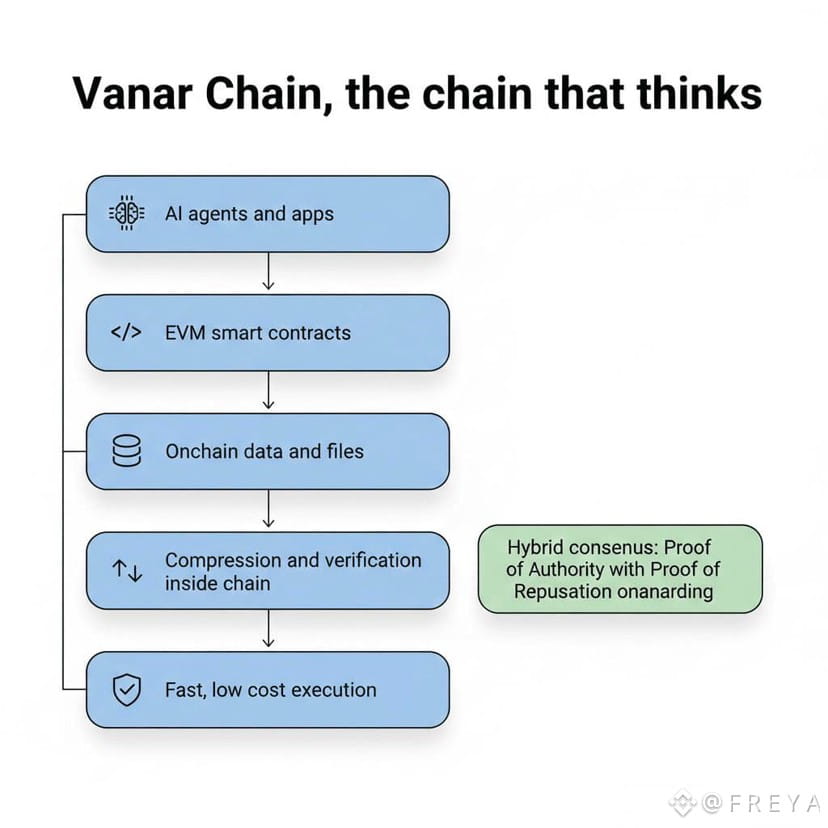
Vanar distinguishes itself through architecture designed from inception around artificial intelligence integration. Traditional blockchains treat AI as an add-on, running AI computations off-chain and storing results on-chain. Vanar embeds AI capabilities directly into its infrastructure through two primary innovations: Neutron for intelligent data compression and storage, and Kayon as an on-chain reasoning engine. Understanding these systems reveals why Vanar positions itself as fundamentally different from other Layer 1 blockchains.
Neutron transforms how blockchain handles data storage. Traditional approaches store minimal data on-chain due to cost and scalability constraints, pushing most information to external systems like IPFS or centralized servers. This creates broken links, lost metadata, and assets that become meaningless when external storage fails. Neutron compresses files up to five hundred to one using neural and algorithmic compression, transforming raw documents into compact, queryable units called Seeds that live entirely on-chain. These Seeds aren’t just compressed data. They’re AI-readable knowledge objects that maintain context, meaning, and relationships.
The implications extend far beyond storage efficiency. When legal documents, financial records, or compliance data exist as Seeds, smart contracts can query them directly. A tokenized real estate asset can carry complete property records on-chain. A gaming NFT can store full game history and player interactions. PayFi applications can maintain compliance documentation that’s instantly queryable for regulatory verification. This eliminates the fragility of external dependencies while enabling entirely new categories of applications that require smart contracts to understand and act on complex data.
Kayon represents the reasoning layer that activates this data. Operating as Vanar’s on-chain AI logic engine, Kayon analyzes, validates, and executes decisions based on seed data and external inputs. This isn’t marketing fluff about AI buzzwords. Kayon provides actual structured AI logic embedded into the chain itself, allowing contracts to understand context, identify patterns, and make intelligent decisions. For compliance-heavy applications like tokenized securities or cross-border payments, Kayon can validate transactions against complex regulatory requirements in real-time without external oracle dependencies.
The five-layer architecture integrates these AI capabilities throughout the stack. The base Layer 1 provides the secure, high-throughput foundation built on GO Ethereum codebase for proven reliability and full EVM compatibility. Above this sits the intelligent data storage layer powered by Neutron. The AI analysis layer leverages Kayon for on-chain intelligence. Application and interface layers complete the stack, providing developers with comprehensive tools and users with seamless experiences. This integrated approach means every application on Vanar can be intelligent by default rather than requiring developers to build AI capabilities from scratch.
Gaming and Entertainment Ecosystem
Gaming represents Vanar’s most developed use case, with World of Dypians standing as the flagship example. This MMORPG combines DeFi mechanics, NFT integration, AI elements, and engaging gameplay into a virtual world that has attracted over 1.25 million players globally. The numbers tell a compelling adoption story. World of Dypians records approximately 895,000 daily active users and 1.4 million monthly active users. The game has generated over 174 million on-chain transactions and sold more than 320,000 NFTs within its ecosystem. These metrics demonstrate that blockchain gaming can achieve meaningful scale when the underlying infrastructure performs adequately.
World of Dypians launched its WOD token through a Token Generation Event in November 2024, adding another layer to the game’s economy. Players use WOD tokens for staking, governance participation, and trading in-game items and NFTs. The game’s success attracted recognition from industry programs, winning the BNB Chain DAU Incentive Program, Core Ignition Builders’ Program, and Taiko Trailblazers Season 1. These achievements validated both the game itself and the Vanar infrastructure supporting it. The fact that World of Dypians operates entirely on-chain while maintaining this level of activity demonstrates the throughput and cost efficiency that Vanar’s architecture provides.
Beyond World of Dypians, Vanar’s gaming ecosystem expanded throughout 2024 through numerous partnerships. Farcana introduced AI-driven gaming with intelligent NPCs and strategic gameplay powered by Vanar’s AI capabilities. SoonChain AI simplified game development with tools facilitating seamless Web2 to Web3 transitions. Partnerships with GALXE, SWAYE, Trinity DAO, NitroDome, and Real Ape Arcade created immersive ecosystems fostering player engagement and gamified communities. The NVIDIA partnership particularly strengthened the gaming infrastructure, providing developers access to technologies including CUDA, Tensor, Omniverse, and GameWorks integrated directly into Vanar’s platform.
The gaming focus extends beyond entertainment value to solving practical adoption barriers. High transaction fees make microtransactions and frequent in-game actions economically impractical on many blockchains. Vanar’s low fixed transaction costs and infrastructure optimizations address this directly. Slow finality creates lag that disrupts gameplay, particularly in competitive scenarios. Vanar’s sub-second finality maintains responsive user experiences that match traditional gaming standards. Complex wallet management and gas token requirements create onboarding friction. Vanar’s work on social wallets and simplified interfaces reduces these barriers toward mainstream accessibility.
The Mainnet Journey and Ecosystem Growth
Vanar’s testnet, codenamed Vanguard, launched in March 2024 as the first public demonstration of the platform’s capabilities. The testnet provided developers with environments to build and test applications while the team refined infrastructure based on real-world usage patterns. Following successful testnet operations, Vanar’s mainnet deployment in 2024 represented the culmination of years of development and strategic planning. The mainnet launch demonstrated the platform’s readiness for production applications, with nearly 12 million transactions processed and over 1.5 million unique addresses created relatively quickly.
The ecosystem expansion throughout 2024 showed Vanar’s momentum accelerating beyond gaming alone. The platform announced over one hundred strategic partnerships spanning artificial intelligence, gaming, real-world assets, and PayFi sectors. These collaborations built a diverse ecosystem rather than concentrating solely on entertainment use cases. Griffin AI developed decentralized networks for monetizing AI agents with secure transaction tools. ChatXBT changed protocol engagement and social media growth through innovative AI tools. Ringfence AI empowered users to autonomously monetize and secure their data. Zebec AI launched ZAI Smart Payment Layer advancing financial processing with AI-driven fraud detection. BitsCrunch improved NFT and digital asset transparency through AI-driven analytics solutions.
The real-world asset and PayFi focus particularly distinguished Vanar’s positioning. While many blockchains discussed tokenizing real-world assets theoretically, Vanar’s architecture with Neutron Seeds and Kayon reasoning actually enables the compliance-ready queries and data storage that tokenized securities, real estate, or financial instruments require. Financial institutions and brands can deploy tokenized assets knowing that complete documentation, regulatory compliance, and audit trails exist on-chain and remain queryable. This moves beyond simple token issuance toward genuine infrastructure for regulated digital assets.
Partnerships with established technology companies validated Vanar’s approach beyond crypto-native circles. The Google Cloud collaboration already mentioned represented just one example. Work with BCW Group on validator infrastructure demonstrated institutional interest in operating network security. Collaborations with Emirates Digital Wallet, DeQuest, and Kaizen Finance showed regional and sectoral diversity in adoption. Security partnerships with HAPI, ImmuneBytes, and Immunefi addressed the critical concern of smart contract and platform security that major brands require before deployment.
Environmental and Social Impact
Vanar’s carbon-neutral positioning represents more than marketing differentiation. It addresses genuine concerns preventing major brands from blockchain adoption. Companies face increasing pressure from shareholders, regulators, and consumers about environmental impact. When a Fortune 500 entertainment company considers blockchain integration, energy consumption becomes a board-level discussion topic, not just a technical consideration. Vanar’s ability to provide measurable renewable energy credentials transforms that conversation from defensive justification to competitive advantage.
The social wallet development similarly targets real barriers to mainstream adoption. Traditional wallet management with seed phrases, gas tokens, and transaction signing creates friction that prevents non-technical users from accessing blockchain applications. Social wallets simplify this experience toward something approximating familiar applications while maintaining security and decentralization. For entertainment brands serving millions of users, reducing onboarding complexity directly impacts adoption rates and user retention.
The Vanar ECO module provides developers and brands tools to track energy expenditures consistently and transparently on-chain. This matters enormously for corporate sustainability reporting and Environmental, Social, and Governance metrics that increasingly influence investment decisions. Rather than making vague claims about efficiency improvements, brands building on Vanar can provide auditable data about actual energy consumption and renewable energy usage. This transparency addresses skepticism about blockchain’s environmental impact with verifiable evidence rather than promises.
The Prestaking Success and Community Building
Community engagement played a crucial role in Vanar’s evolution, particularly visible in the prestaking program that preceded mainnet launch. The initiative attracted 75.24 million VANRY tokens staked across Polygon and Ethereum networks, offering an impressive 191.36 percent APR. This tremendous participation demonstrated community confidence in the project’s direction and signaled strong growth potential as the transition to mainnet approached. The numbers represented more than speculative interest. They showed genuine belief in Vanar’s vision and willingness to lock capital during development phases.
The community vote approving the TVK to VANRY transition passed with overwhelming majority support. This democratic approach to major strategic decisions built legitimacy and alignment between project direction and community sentiment. Rather than top-down changes imposed on token holders, the transformation proceeded with explicit community endorsement. This participatory governance approach would continue as a core principle, with VANRY stakers gaining access to voting systems for platform upgrades and development priorities.
Community building extended beyond token mechanics toward education and ecosystem participation. The Stablecoin Collective and various developer communities provided forums for collaboration, learning, and contribution. Partnership announcements celebrated ecosystem growth while involving community members in expansion. This approach recognized that blockchain platforms succeed through network effects that require active, engaged participants rather than passive token holders.
Challenges and Ongoing Development
No blockchain project exists without challenges, and Vanar faces several worth noting honestly. The transition from Virtua to Vanar represented both opportunity and risk. Rebrands sometimes signal projects attempting to distance themselves from past failures rather than genuine strategic evolution. Vanar needed to demonstrate that the transformation represented authentic platform advancement rather than cosmetic changes. The mainnet launch, partnership announcements, and technical development visible throughout 2024 provided evidence supporting the authentic evolution narrative, but maintaining that momentum requires continued delivery.
Competition in the blockchain gaming and entertainment space remains intense. Established platforms like Ronin, Immutable X, and others specifically target gaming use cases with mature ecosystems and proven traction. General-purpose chains like Polygon and Arbitrum also compete for gaming applications through scaling solutions and growing developer communities. Vanar’s AI-native positioning and environmental credentials differentiate it, but ultimately adoption depends on delivering superior developer experiences and user outcomes compared to alternatives.
The AI integration, while innovative, also brings complexity and potential points of failure. Neutron compression and Kayon reasoning represent sophisticated systems that must perform reliably under production loads. Any bugs or limitations in these core capabilities could undermine applications depending on them. The relative newness of embedding AI this deeply into blockchain architecture means Vanar treads less-proven ground compared to established smart contract patterns. This innovation carries both upside potential and execution risk.
Regulatory uncertainty around gaming, AI, and tokenized assets affects Vanar as much as any blockchain project. Different jurisdictions treat blockchain gaming and digital assets with varying levels of restriction or prohibition. AI governance and data handling face evolving regulatory frameworks. Real-world asset tokenization requires navigating securities laws and financial regulations. Vanar’s success depends partly on regulatory environments evolving in directions that permit rather than prohibit the use cases it’s optimized to serve.
Looking Forward: The 2025 Vision and Beyond
As Vanar entered 2025, the project outlined ambitious expansion plans building on 2024’s foundation. The focus on AI-first tools intensified, with development of advanced AI-driven capabilities enhancing blockchain applications. PayFi integrations expanded financial services through blockchain with compliance-ready infrastructure. Real-world asset innovation continued, with improvements to tokenization and utilization of RWAs on the platform. These priorities reflected the belief that blockchain’s next wave of adoption comes from solving real problems in finance, gaming, and entertainment rather than speculative trading alone.
The platform’s dedication to establishing a global standard for blockchain adoption centered on sustainability, scalability, and innovation positions it distinctively. While other projects chase transaction speed or total value locked, Vanar emphasizes practical adoption metrics. How many mainstream users interact with applications on the platform? How many major brands build on the infrastructure? How much renewable energy powers the ecosystem? These questions guide strategic decisions more than purely technical benchmarks.
The integration of NVIDIA technologies represents just one example of future-focused partnerships bringing cutting-edge capabilities to developers. As AI continues advancing across all industries, having infrastructure that natively supports AI workloads rather than awkwardly bolting them onto blockchain platforms provides genuine competitive advantage. Applications from intelligent NPCs in games to automated compliance checking in finance all benefit from on-chain AI capabilities that Vanar uniquely provides.
The gaming ecosystem expansion continues targeting both developers and players. Making game development easier through improved tools and SDKs reduces friction for studios considering blockchain integration. Improving player experiences through simplified wallets and seamless transactions addresses adoption barriers on the user side. Success requires satisfying both constituencies simultaneously, which demands infrastructure optimized for gaming rather than adapted from other use cases.
Reflections on Mainstream Adoption
Vanar’s journey from Virtua to its current form reflects blockchain’s broader maturation. Early projects often prioritized decentralization purity or technical innovation without sufficient attention to practical adoption requirements. Vanar represents the next phase, where infrastructure gets designed around specific use cases with mainstream audiences in mind. The carbon-neutral commitment isn’t peripheral greenwashing. It’s fundamental infrastructure addressing actual concerns from major brands. The AI integration isn’t marketing buzzwords. It’s architectural decisions enabling applications impossible on traditional blockchains.
The test of this approach won’t come from token price or speculative trading volume. It comes from whether major entertainment companies actually build on Vanar rather than just announcing partnerships. It comes from whether millions of users interact with Vanar-powered applications without knowing or caring about blockchain technology underneath. It comes from whether regulatory clarity emerges that permits the PayFi and tokenized asset use cases that Vanar optimizes for.
The transformation from gaming-focused metaverse platform to AI-native blockchain infrastructure demonstrates willingness to evolve based on market realities rather than clinging to original visions when evidence suggests different directions. This adaptability combined with technical execution, strategic partnerships, and environmental consciousness creates a distinctive positioning in crowded blockchain markets. Whether that positioning translates to the mainstream adoption Vanar seeks remains the question defining the project’s next chapters.
We’re seeing blockchain move from crypto-native speculation toward real-world utility. Gaming leads because it naturally aligns with digital ownership and token economies. Entertainment follows as brands recognize blockchain’s potential for fan engagement and new revenue models. Finance increasingly acknowledges that tokenization and programmable money represent genuine improvements over legacy infrastructure. Vanar positions itself at the convergence of these trends, building infrastructure that enables rather than merely theorizes about mainstream adoption.
The years ahead will reveal whether purpose-built infrastructure for specific use cases outcompetes general-purpose platforms adapted for everything. They’ll show whether environmental sustainability becomes mandatory rather than optional for blockchain projects. They’ll demonstrate whether AI integration represents genuine value addition or temporary hype. For Vanar, the answers to these questions determine whether the transformation from Virtua created lasting value or proved merely transitional toward further evolution. The foundation has been laid through technical development, strategic partnerships, and ecosystem building. What gets constructed atop that foundation will define Vanar’s ultimate impact on blockchain’s role in entertainment, gaming, and beyond.