


Vanar didn’t start as a random token that popped up overnight. It came from a project world that already cared about games, entertainment, and digital experiences, and over time it grew into something broader: a blockchain brand that wants to be the “home base” for mainstream apps, not only a niche playground. You can actually see this turning point in the public swap history where Virtua’s TVK moved into Vanar’s VANRY at a 1:1 ratio, and exchanges like Binance confirmed that rebrand and swap happened as an official process.
And I think that matters emotionally, because when a project is willing to rename itself and move its identity forward, it’s basically saying: “We’re trying to grow up. We’re trying to become bigger than what we were.” If that growth is real, it becomes exciting. If it’s only branding, it becomes disappointing. So we have to look at the details, slowly, like we’re reading a story from the first page to the last.
At the heart of Vanar is a simple problem they keep pointing at: Web3 still feels hard for normal people. Fees can be annoying, steps can feel scary, and the whole “wallet first” experience turns off the exact people Web3 claims it wants. In their whitepaper, Vanar talks about those adoption hurdles—high cost, slow speeds, and complex onboarding—and they frame their mission like this: build a chain that’s fast, predictable on costs, and friendly enough to welcome “billions” without making them feel lost.
This is where their “next 3 billion” message fits. They’re not aiming at the typical crypto-only crowd. They’re aiming at people who arrive through games, digital worlds, creators, brands, and everyday apps. And if we’re being honest, that’s where the real numbers are. Because the next massive wave won’t come from people who already love crypto. It’ll come from people who barely care about it, as long as the experience feels smooth.
Now here’s the piece that sounds technical but is actually easy to understand. Vanar positions itself as EVM-compatible, meaning developers can build with the same general tools and style they already use in the Ethereum world. The whitepaper even says the rule out loud in a way that’s very direct: “What works on Ethereum, works on Vanar.”
That line is important because it’s not just bragging. It’s a strategy. It means they want builders to move fast, launch faster, and not waste months learning a totally new system. And when builders move fast, users get more apps, more games, more reasons to stay.
Vanar also keeps pushing the idea of stable, low transaction costs as a big part of the identity. In the whitepaper’s early section, they even describe a fixed transaction cost target at a tiny level, which is their way of saying: “We don’t want users to feel fees every time they breathe.”
If you’ve ever watched people try Web3 and quit, you already know why this matters. They don’t quit because the idea is bad. They quit because the experience feels like work.
Where the story becomes more layered is how Vanar tries to connect “infrastructure” with “real products.” You mentioned Virtua and VGN, and that’s basically the point: Vanar wants to sit across multiple mainstream verticals, not only one. It’s trying to be a place where gaming networks and metaverse-style worlds make sense, while also leaving room for brand solutions and newer AI-focused tools. Their own site leans into this evolution hard by presenting Vanar as an AI-native infrastructure stack, not only a chain.
And this is where the vibe changes. Because Vanar is now describing itself as “The AI Infrastructure for Web3,” and it talks about an internal stack that includes ideas like semantic memory and on-chain reasoning. In simple English, they’re trying to move from “a blockchain that records things” to “a blockchain that can understand and act on meaning,” so apps can store useful context and make smarter decisions over time.
If that sounds big, it is big. But it also explains why they keep repeating that they want mainstream adoption. Because in their vision, the chain becomes more like a silent brain underneath applications, while the user just sees a clean interface and a smooth experience. It becomes less about “teach the user crypto” and more about “hide the complexity and let them live.” And honestly, that is the only way the next wave happens.
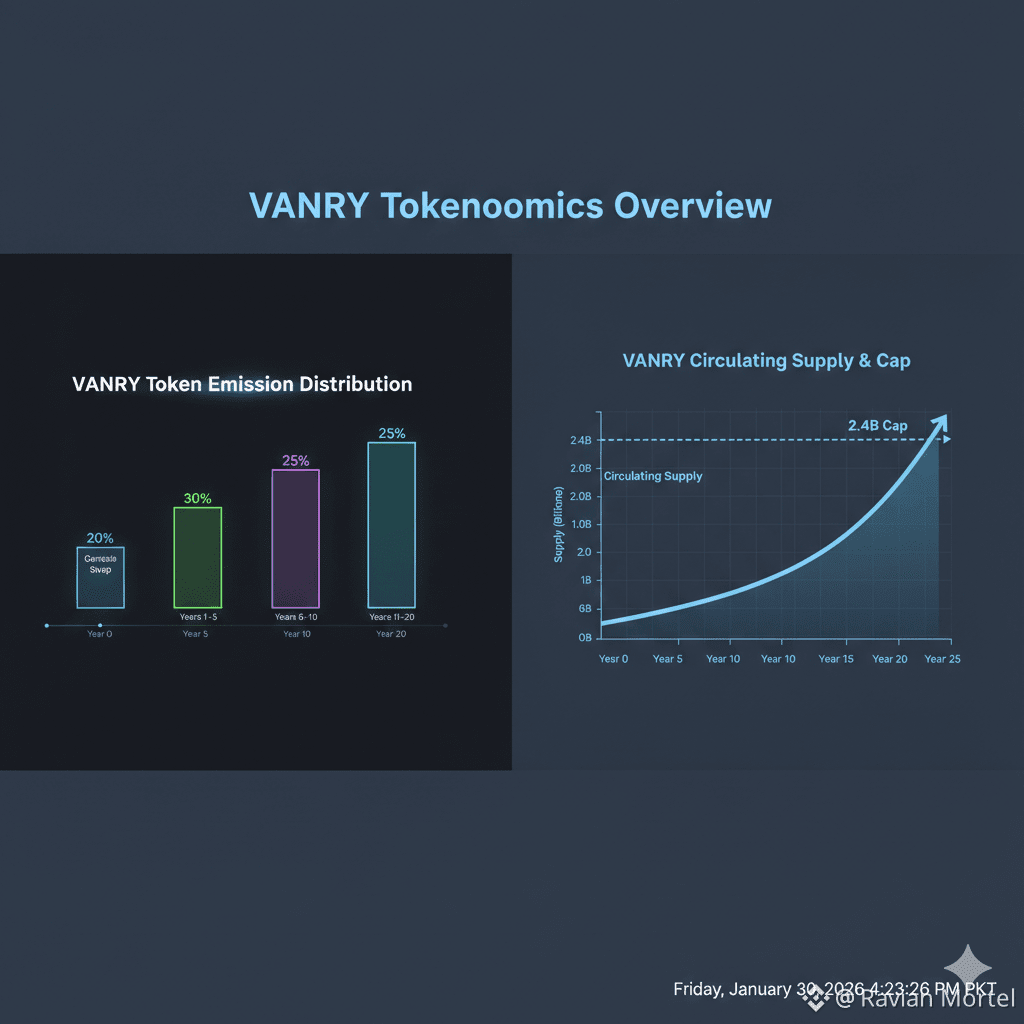
Now let’s talk about the token, because VANRY is the fuel that ties the whole thing together. Public trackers list the max supply at 2.4 billion, and they show the circulating supply sitting a bit over 2.2 billion.
Vanar’s own documentation explains the token’s role in block rewards and validator incentives, and it frames issuance beyond the genesis supply as being created through block rewards to support network security.
And in simple terms, here’s what that means: VANRY isn’t only “something to trade.” It’s meant to pay for activity, support validators, and keep the network running while the ecosystem grows. If people actually use the chain for real apps, the token has a living purpose. If they don’t, the token becomes a story without a daily life. That’s why utility must come first, not hype.
Now I’ll give you the last 24 hours update in a clean, real way, because you asked for it. We’re seeing VANRY having a softer day: CoinMarketCap shows it around $0.00697 with roughly -5.16% in the last 24 hours and about $8.33M in 24-hour trading volume.
Binance’s price page shows a very similar picture, also around $0.006985 with roughly -4.94% over 24 hours and the same general volume figure, which helps confirm it’s not a random glitch.
On the “project news” side, I didn’t see a clearly dated major official announcement in the last 24 hours from the main official pages we checked, so today’s update is mostly market movement rather than a brand-new launch headline.
So where does that leave us, from beginning to end? It leaves us with a project that started with consumer energy—games, entertainment, digital worlds—and then tried to mature into an infrastructure layer that’s friendly for builders and simple for users. Now it’s also trying to step into the AI-native narrative, where data isn’t just stored, it’s understood and used.
And here’s the only question I’ll leave you with, because you asked for just 1–2 questions and I want it to hit: If Vanar really wants the next 3 billion people, will it make Web3 feel like a normal app where nobody feels fear?
I’ll end with something real. A lot of projects chase attention. Vanar is trying to chase adoption, and adoption is slower, quieter, and honestly harder. Price will go up and down and people will panic and people will celebrate, but the part that matters is whether the product experience becomes so smooth that nobody even talks about “blockchain” anymore—they just use it. If Vanar can pull that off, it won’t just be another chain with another token. It becomes a doorway, and once a doorway opens for everyday people, the world doesn’t go back.
