

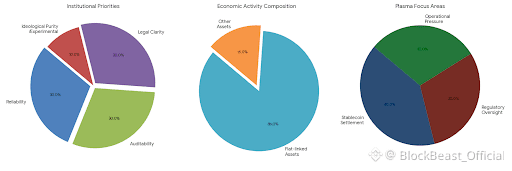
Plasma approaches blockchain design from a perspective that is often missing in public discourse: how systems behave once they are placed under regulatory oversight and operational pressure. By focusing explicitly on stablecoin settlement, Plasma accepts a basic reality of the current financial environment—most on-chain economic activity is already denominated in fiat-linked assets, and institutions care far more about reliability, auditability, and legal clarity than ideological purity or experimental features.
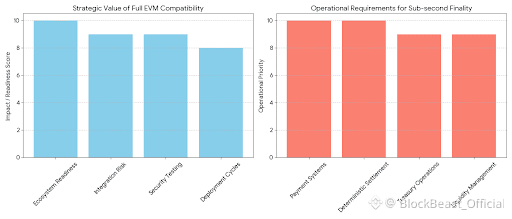
Full EVM compatibility through Reth reflects a conservative engineering mindset. Rather than introducing new execution environments that require bespoke tooling and unfamiliar security assumptions, Plasma builds on an ecosystem that has already been stress-tested by auditors, developers, and compliance teams. This choice reduces integration risk and shortens deployment cycles, which matters when systems are expected to operate continuously and predictably, not just demonstrate technical capability.
Sub-second finality via PlasmaBFT is best understood as an operational requirement rather than a performance claim. Payment systems, treasury operations, and liquidity management workflows depend on deterministic settlement, not probabilistic assurances. At the same time, fast finality introduces coordination and governance responsibilities for validators, a trade-off Plasma appears to acknowledge by prioritizing controlled consensus behavior over permissionless experimentation.
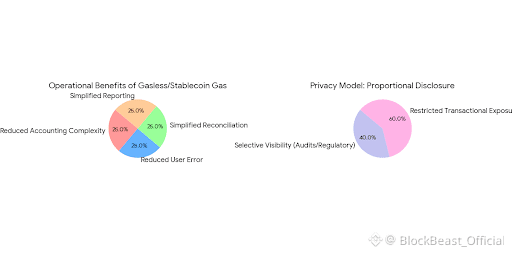
Features such as gasless USDT transfers and stablecoin-first gas further illustrate this pragmatism. Abstracting gas away from volatile assets reduces accounting complexity and user error, particularly in high-volume or retail-heavy environments. These design decisions simplify reconciliation and reporting, which are often the hidden costs that prevent blockchain systems from being used in production.
Privacy within Plasma is treated as a matter of proportional disclosure. Rather than framing transparency and confidentiality as opposing forces, the system appears designed to support selective visibility—enough to satisfy audits and regulatory inquiries while limiting unnecessary exposure of transactional data. This reflects how real financial infrastructure operates, where privacy is contextual and governed, not absolute.
Bitcoin-anchored security adds another layer of restraint. Instead of asserting complete sovereignty, Plasma borrows stability from a system with a long operational history and broadly recognized neutrality. This does not remove trust assumptions, but it makes them explicit and anchored to an external reference point that institutions already understand.
Plasma also does not attempt to obscure its constraints. Settlement dependencies, bridge risks, and operational overhead are treated as realities to be managed rather than flaws to be dismissed. Attention appears to be given to less visible infrastructure concerns—upgrade processes, tooling maturity, and documentation clarity—which ultimately determine whether a network can survive audits, incidents, and long-term use.
Taken together, Plasma reads less like a speculative platform and more like payment infrastructure built to endure scrutiny. Its success is unlikely to be measured by visibility or rapid adoption narratives, but by whether it can remain predictable, compliant, and operationally stable over time. In regulated financial systems, that quiet durability is often the only metric that truly matters.