


Plasma the way I’d explain it to someone sitting next to me, because this project only makes sense when you stop looking at it like “another chain” and start looking at it like a real attempt to make stablecoins feel like normal money. The very first idea is simple, and it’s almost emotional in a quiet way: people already use stablecoins every day, especially in places where saving in local currency feels risky, and if that’s true, then moving stablecoins should not feel like a technical puzzle. If someone is trying to send USD₮ to family, or pay a supplier, or move business funds, they don’t want to think about gas tokens, complex steps, or waiting while the network decides whether the transfer is really final. It becomes exhausting, and when it becomes exhausting, people stop using it, even if the tech is “good.”
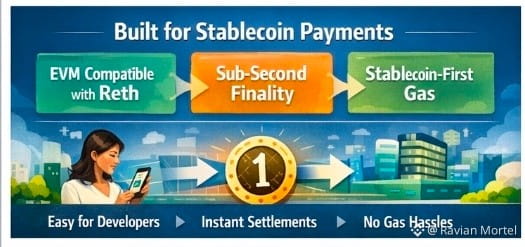
Plasma is built around a stablecoin-first mindset, which means the chain is shaped around what stablecoins need, not what speculators need. They’re designing the system so stablecoin transfers can be fast, predictable, and simple, and they’re not treating that as a side feature. If you look closely, everything points back to one feeling: the transfer should feel like money moving, not like a game of clicking the right buttons. That’s why you keep seeing ideas like gasless USD₮ transfers and stablecoin-first gas, because they’re trying to remove the friction that most chains quietly accept as “normal.”
One of the biggest choices Plasma makes is that it wants to be fully compatible with Ethereum’s world, and this is where the Reth piece matters. Reth is used as the execution foundation, and in plain English that means Plasma wants smart contracts to behave like Ethereum smart contracts, so developers can build with the tools and habits they already trust. I’m saying this in a soft way because it’s easy to miss how important it is: when a chain forces developers to learn a totally new environment, it creates risk, slow adoption, and strange bugs, and it also creates fear that the chain might not behave the way builders expect. Plasma is trying to reduce that fear by keeping the execution layer familiar, then optimizing everything around payments so the chain can still move fast without turning into a foreign planet for developers.
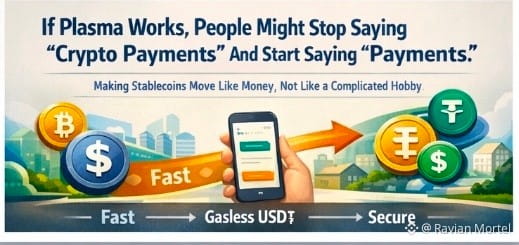
Now, speed by itself is not the real dream, because lots of chains claim speed, but payments need something more specific than speed, and that thing is finality. Finality is the moment when everyone can say: this transfer is done, it’s real, it’s not getting reversed, and you can move on with your life. Plasma pushes for sub-second finality using PlasmaBFT, and the reason this matters is not just technical, it’s human. When finality is slow, people hesitate, and when people hesitate, the payment experience becomes tense, and tension kills the idea of “everyday use.” With fast finality, the system stops feeling like a blockchain you have to babysit, and it starts feeling like a payment rail, and that is the kind of shift that changes behavior.
The stablecoin-centric part is where Plasma starts to feel like it understands normal users. Gasless USD₮ transfers are designed so a person can send stablecoins without first being forced to buy another token just to pay fees, and that sounds simple, but it’s one of the biggest psychological barriers in crypto. If someone opens a wallet and they’re told “you can’t send your dollars because you don’t have gas,” it becomes confusing and humiliating, especially for people who are new, or people who just want to do one simple thing. Plasma is trying to remove that moment entirely, using a paymaster-style mechanism at the protocol level so the network can sponsor eligible transfers. They’re basically saying: we want stablecoin payments to be smooth enough that the user doesn’t feel punished for not being a crypto power user.
Stablecoin-first gas fits the same philosophy. The reason gas in a volatile token feels bad is because it turns basic money movement into something unpredictable. People don’t budget in a token that can jump up or down in a day, and businesses don’t want their costs swinging around when they’re just trying to settle payments. When the system is built so fees can be handled in a stablecoin-first way, the experience becomes easier to understand, and it becomes easier to trust, and trust is the real currency behind any payment network. It becomes less about excitement and more about reliability, and reliability is what institutions and everyday users both quietly want.
Then there’s the part you mentioned that sounds big and philosophical: Bitcoin-anchored security, designed to increase neutrality and censorship resistance. This is not just a marketing phrase if you take it seriously, because neutrality is the difference between a network that feels like public infrastructure and a network that feels like a private club. The idea of anchoring to Bitcoin is meant to strengthen the “you can’t easily rewrite history” story, because Bitcoin’s proof-of-work security is known for being hard to challenge. Plasma’s direction is basically: we can have a fast chain for stablecoin settlement, but we also want a deeper backbone that supports long-term integrity, so the system doesn’t feel like it can be bent by pressure as easily. If it works the way they intend, you get a strange but powerful combination: fast everyday transfers with a harder-to-change anchor underneath, and that combination is the kind of thing that can make people feel safer when serious money is on the line.
When you ask who this is for, the answer is not one group, and that’s part of the ambition. Retail users in high-adoption markets matter because they’re already treating stablecoins like real money, and they need a network that respects that reality. Institutions matter because they need settlement that is fast, final, and predictable, and they want infrastructure that feels neutral enough to rely on. Plasma is trying to sit in the middle of both worlds, and you can feel that intention in every design choice: make it easy enough for ordinary people, and structured enough for serious payment flows.
The token piece fits into that same story in a quieter way. In most networks, the token becomes the whole identity, and the user experience ends up serving the token instead of serving the money. Plasma’s approach is trying to keep the stablecoin experience at the center, while the token supports the network’s security and incentives, like validator participation and long-term ecosystem growth. If they do it right, the average user doesn’t have to emotionally attach themselves to the token just to send USD₮, and that’s the point: stablecoins should not feel like they come with hidden homework.
I’ll put one simple line here because it captures the whole project in a way that sticks, and I’ll keep it clean the way you asked: "A stablecoin payment network should feel like money first, and blockchain second" : that’s the heart of Plasma’s direction, and everything else is built around making that sentence real.
If you imagine the full end-to-end experience, the dream is boring in the best way. A person opens a wallet, chooses USD₮, sends it, and it finalizes fast enough that nobody argues about whether it’s done. A business sends payroll or pays suppliers without worrying that fees will suddenly spike into something silly. An institution settles flows with confidence that finality is real and the system is designed to stay neutral under pressure. We’re seeing more stablecoin usage across the world already, so the bigger question becomes: if stablecoins are acting like money, shouldn’t the rails behind them start acting like money too?
What I like about this whole direction is that it doesn’t rely on fantasy. It’s not promising a perfect world, and it’s not pretending tradeoffs don’t exist, but it is trying to remove the most painful friction points that keep stablecoins from becoming truly everyday. And if Plasma delivers the way they’re aiming to deliver, it becomes something bigger than a technical stack. It becomes a signal that the industry is finally growing up a little, finally choosing usefulness over noise, finally building for the person who just wants to send value without fear. Because at the end of the day, the strongest technology is the one that disappears into normal life, and if Plasma succeeds, it won’t feel like “using crypto,” it will feel like the world quietly learned how to move money with dignity and that’s the kind of progress that stays with you long after the hype fades.

