
Dusk In most public blockchains, everything is exposed by default—balances, movements, counterparties, contract interactions. That’s fine for open experiments, but it clashes with how real financial systems operate. In real markets, not everything can be public: trades leak strategy, positions become targets, order flow becomes information warfare. At the same time, regulated systems can’t be pure darkness either—there has to be accountability, controls, and a way to prove rules were followed. Dusk’s entire project revolves around that tension: keep what must be confidential, while still letting the system be verifiable and usable for regulated finance.
Dusk leans into a “choose the right visibility” approach. It supports both public and private-style flows, because financial activity isn’t one-size-fits-all. Some things should be open—like certain issuance details or settlement proofs—while other things must remain shielded—like sensitive transfers, trading intent, or positions. That philosophy shows up across the stack: it’s not privacy as a vibe, it’s privacy as infrastructure.
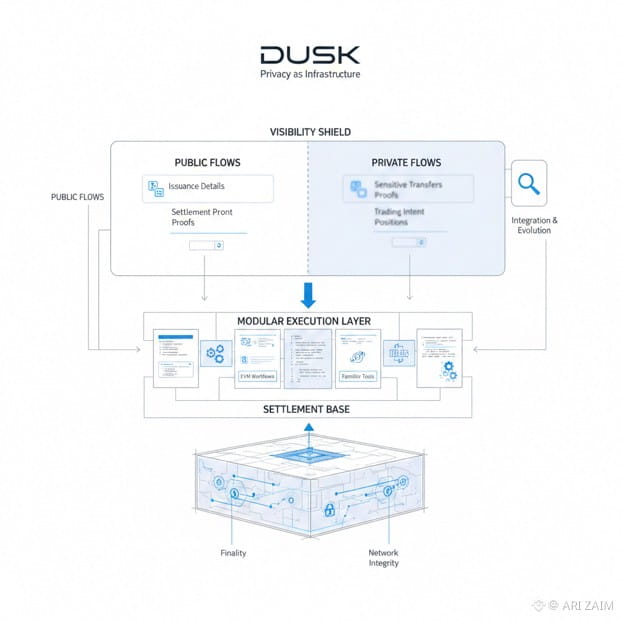
Dusk is doing behind the scenes is building the network as layers rather than one tangled monolith. Think of a reliable settlement base that prioritizes finality and network integrity, and then execution environments above it where applications can run. That modular direction matters because it makes integration more realistic: developers can enter through familiar tools (especially EVM workflows), while the deeper confidentiality features can evolve without forcing the whole ecosystem to rebuild every time the privacy layer improves.
Dusk Their EVM direction is especially telling. It’s not about “becoming Ethereum,” it’s about removing friction. If you want builders, you meet them where they already are: Solidity, common wallets, standard dev tooling, familiar patterns. Dusk’s play is to make the front door easy—so adoption doesn’t require a full rewrite of how teams already build—while still keeping its own identity in what happens under the hood: confidential finance primitives that standard EVM chains don’t natively offer.
Dusk Then there’s the part that really defines Dusk as a project: the focus on regulated assets and market structure, not just token transfers. They’ve put a lot of narrative and design attention into how real-world financial instruments behave—things like lifecycle rules, compliance constraints, and the kinds of controls you need when assets represent regulated value. That’s a different mindset from most chains that start with “money moves fast” and only later try to bolt on governance, permissions, or reporting. Dusk’s project thesis is closer to: “if this is going to be used for serious markets, the rules have to be native.”
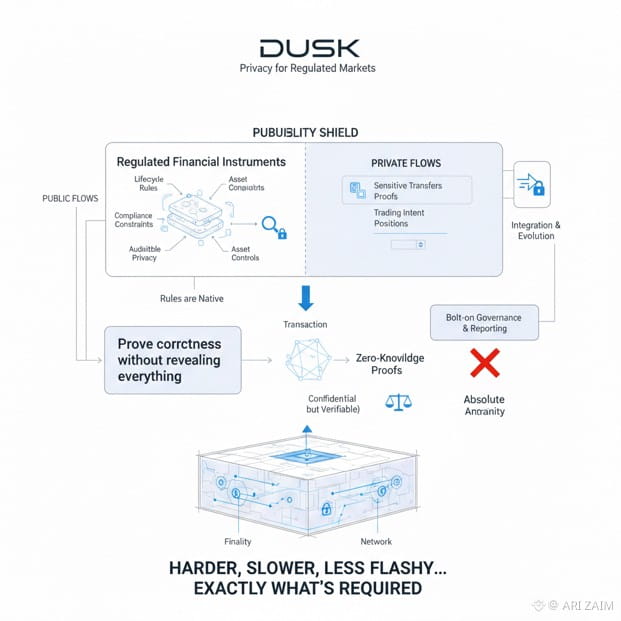
Dusk Privacy in that environment also can’t be absolute. Institutions don’t just need confidentiality—they need confidentiality that can still be audited when required. That’s why a lot of Dusk’s deeper work isn’t merely “hide transactions,” but “prove correctness without revealing everything.” In practical terms, that means building systems where someone can verify that a transaction followed the rules, without learning the sensitive details. It’s the kind of design that’s harder, slower, and less flashy, but it’s exactly what regulated financial infrastructure demands.
Dusk If you zoom out, the project reads like a long game: build the settlement reliability, make the developer entry path easier through familiar execution tooling, then keep pushing confidentiality deeper into the application layer—especially around the parts of finance where privacy is non-negotiable, like trading workflows and sensitive asset movement. That’s also why Dusk doesn’t look like it’s chasing every trend. It’s trying to become the place where on-chain finance stops being a public demo and starts resembling infrastructure that institutions can actually plug into.
