
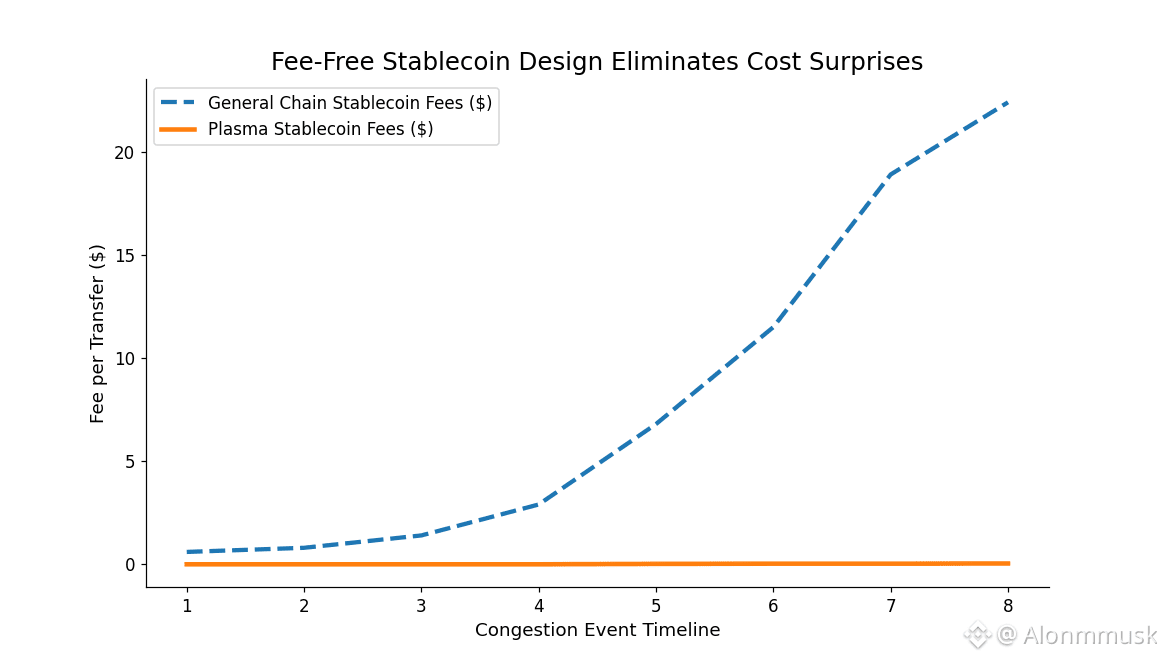
A few weeks back, I was settling a cross-border payment for a freelance job. Nothing big, just a couple thousand USDT. I sent it over what’s supposed to be a fast, well-used layer-2, expecting it to clear in minutes. Instead, the bridge lagged, fees quietly crept toward twenty dollars, and by the time it finally confirmed, the person on the other end was already asking if something had gone wrong. I’ve been around long enough to rotate through chains like Solana and Polygon, and moments like that still catch me off guard. Not because it’s catastrophic, but because moving stable value shouldn’t feel uncertain. Watching confirmations crawl while guessing final costs turns a basic transfer into something you have to babysit.
That kind of friction isn’t accidental. It comes from how most blockchains are designed. They try to do everything at once: volatile trading, NFTs, experiments, governance, memes. Stablecoin transfers just get mixed into that chaos. When traffic spikes for unrelated reasons, fees jump, block times stretch, and reliability quietly degrades. For assets meant to behave like cash, that’s a problem. Merchants don’t want to wait. Users don’t want surprises. Over time, that inconsistency chips away at trust, even if the system never fully breaks. It’s not dramatic failure. It’s death by a thousand small annoyances.
I tend to think about it like shared highways. Freight trucks and commuter cars using the same lanes work fine until traffic picks up. Then everything slows, wear increases, and arrival times become guesswork. A dedicated freight route doesn’t look exciting, but it moves goods consistently. That’s the trade-off Plasma is leaning into.
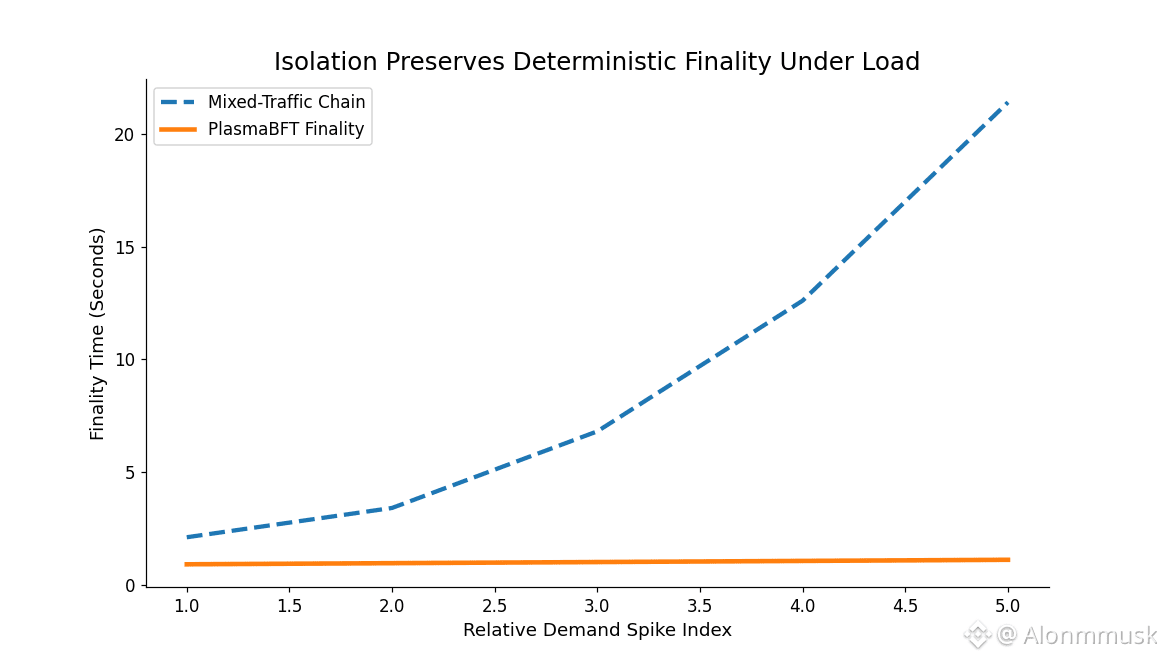
Instead of positioning itself as another general-purpose playground, #Plasma narrows the scope almost aggressively. It’s EVM-compatible, but beyond that, the behavior is intentional. Sub-second settlements are the priority. Simple USDT transfers don’t require native gas. Speculative apps that would introduce noisy demand just aren’t the focus. The idea is to keep the environment quiet enough that payments behave predictably, even when volumes grow. That design choice matters if you’re thinking about real usage, like merchants or payroll flows, where consistency matters more than optional features.
Recent developments show how that philosophy plays out. Mainnet beta went live in late 2025, and this month StableFlow was rolled out, enabling large-volume transfers from chains like Tron with near-zero slippage for amounts up to one million dollars. That’s not flashy tech. It’s infrastructure tuned for one job: moving stable value without drama.
Under the hood, a couple of choices explain why the network behaves the way it does. The first is PlasmaBFT, a pipelined version of HotStuff that overlaps proposal, voting, and commitment phases. In practice, that keeps block times hovering around one second, with testing showing throughput above a thousand transactions per second. The trade-off is deliberate. Execution is kept simple to avoid edge-case complexity. The goal isn’t to squeeze out maximum theoretical TPS, but to keep outcomes deterministic under payment-heavy loads.
The second is the paymaster system. Gasless USDT transfers aren’t a bolt-on contract trick. They’re built into the protocol, funded through controlled pools and rate-limited to prevent abuse. At the moment, the network averages just over four transactions per second, with total transactions now above 146 million since launch. Those numbers don’t scream hype, but they do show steady usage. Stablecoin deposits have climbed to roughly seven billion dollars across more than twenty-five variants, placing the network among the top holders of USDT liquidity.
Integration choices follow the same pattern. Aave alone accounts for over six billion dollars in deposits, with yields in the mid-teens depending on pools like Fluid. Pendle and CoW Swap are live, adding flexibility without overwhelming the system. Daily active addresses sit around seventy-eight thousand. That’s not explosive growth, but it’s directional, and more importantly, it’s usage that actually matches the network’s purpose.
$XPL , the native token, stays firmly in the background. It’s used when operations aren’t gasless, like more complex contract calls. Fees are partially burned, tying supply reduction to real activity. Validators stake XPL to secure the network, earning rewards from an inflation rate that starts around five percent and tapers toward three percent over time. Governance runs through it as well, covering adjustments to validator parameters or systems like StableFlow. There’s no attempt to stretch the token into ten different narratives. It exists to keep the network running.
From a market standpoint, the setup is fairly straightforward. Capitalization sits near 260 million dollars, with daily trading volume around 130 million. Liquidity is there, but it doesn’t feel overheated.
Short-term price action still responds to headlines. StableFlow’s launch pushed volumes higher this week. Upcoming token unlocks in early 2026 could add pressure if sentiment turns. I’ve traded enough of these cycles to know how quickly partnership excitement fades once attention moves elsewhere. Those moves are tradeable, but they’re reactive.
Longer term, the bet is much quieter. It’s about whether reliability actually turns into habit. If users keep coming back because transfers just work, and if integrations like Aave continue to deepen, demand for block space and staking can build organically. That kind of value doesn’t show up overnight. It shows up when people stop thinking about the network at all.
There are real risks. Generalist chains like Solana offer massive ecosystems and flexibility that Plasma intentionally avoids. Ethereum’s rollups are catching up on speed while offering broader tooling. Bridges, including the Bitcoin-anchored pBTC design, introduce attack surfaces. Regulatory pressure on stablecoin-heavy networks is an ongoing unknown. And technically, no system is immune to stress. A coordination failure during a high-volume event could still push finality beyond promised thresholds and shake confidence quickly.
Still, specialized infrastructure tends to prove itself slowly. Not through big announcements, but through repeat usage. Second transfers. Routine settlements. The kind of activity no one tweets about. Whether Plasma’s isolation from speculation leads to lasting throughput or just a temporary niche will only be clear after a few more cycles.
@Plasma #Plasma $XPL