
I first paid attention to @Vanarchain on a day when nothing was happening, no rally, no drama, just a routine transaction and the quiet question of whether it would behave like a tool or like a mood.
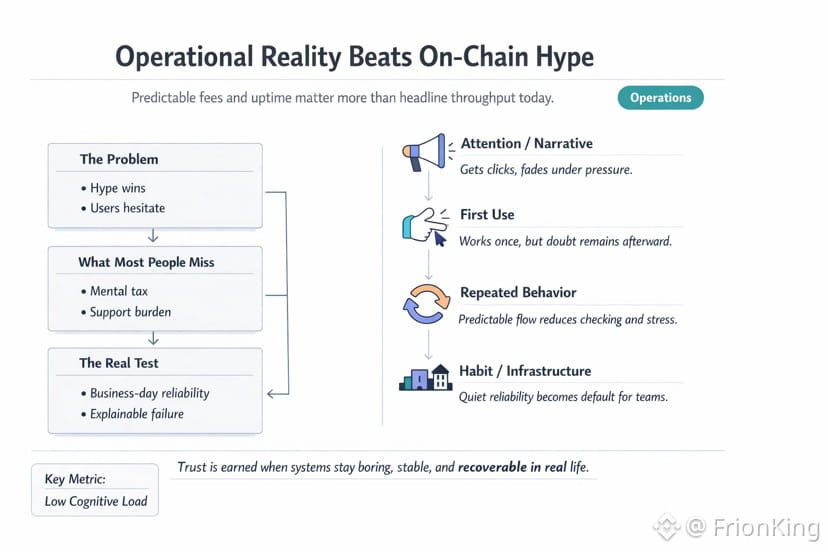
After decades of watching markets repeat themselves, I have learned to distrust the moments that feel loud, the banners, the partnerships, the timelines, the confident voices that only show up when candles are green. Operational reality does not care about excitement, it cares about boring consistency, uptime, predictable costs, predictable failure modes, and the kind of support work nobody screenshots. The real test for any chain is not whether it can run on chain, it is whether it can run inside a business day, inside a customer support queue, inside a compliance review, inside a product team that has deadlines and no patience for mystery.
That is the frame I use for Vanarchain, not as a story about features, but as a question about operations. Can a team ship in a way that reduces the number of decisions a normal user has to make. Can fees behave like a price instead of a surprise. Can confirmations feel routine instead of performative. Can wallets and signing flows stop demanding attention for every small action.
The market loves to argue about speed and throughput, but most failures I have seen happen earlier, at the point where the user hesitates. They hesitate because the system asks them to think, to double check, to interpret, to carry risk in their head. That mental tax compounds, and retention dies quietly long before any chain hits a technical ceiling.
Operational success also means accepting an uncomfortable truth, real usage is messy. Real usage includes refunds, chargebacks in the off chain world, mistaken addresses, lost devices, regulators asking naive questions, and non technical teams needing clear explanations.
If Vanarchain is serious about living outside crypto native circles, the chain has to feel legible, not just to engineers, but to finance teams and product managers and risk officers. It has to tolerate peaks without becoming unpredictable, and it has to handle quiet periods without pretending that silence is growth. A chain that only looks good during a campaign is not an infrastructure, it is a marketing artifact.
The hardest part is that the market will not reward this work in the short term. The crowd rarely applauds fewer incidents, fewer support tickets, fewer confused users, fewer fees that spike at the wrong moment. People clap for novelty, they trade on narrative, they chase the sensation of being early. Operational competence is slow, it is repetitive, it is thankless, and it often shows up as an absence, the absence of panic, the absence of downtime, the absence of sudden complexity. I have watched enough cycles to know that most teams cannot stay committed to that kind of discipline once the market starts pulling them back toward spectacle.
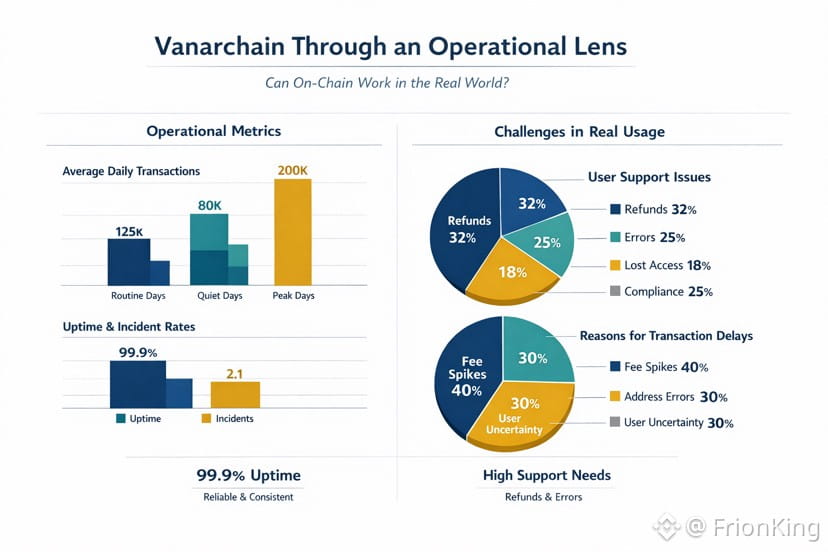
So my view of Vanarchain under an operational lens is simple and slightly grim. If it can make on chain behavior feel like normal software, predictable, explainable, and boring in the right ways, it earns the only thing that lasts, habit. If it cannot, then it will join the long list of projects that looked impressive on a chart and failed the moment real life asked them to be accountable. In this business, the final judge is never the whitepaper or the token price, it is whether the system still works when nobody is watching. #vanar $VANRY
