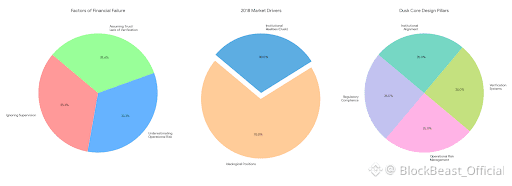
Dusk emerged in 2018 at a time when many blockchain projects were driven by ideological positions rather than institutional realities. What distinguishes Dusk is not an attempt to redefine finance, but a quieter decision to work within the constraints that already govern it. From a regulatory and compliance perspective, this starting point is significant. Financial systems do not fail because they lack innovation; they fail because they ignore supervision, underestimate operational risk, or assume trust where verification is required. Dusk’s design choices reflect an understanding shaped by these lessons.
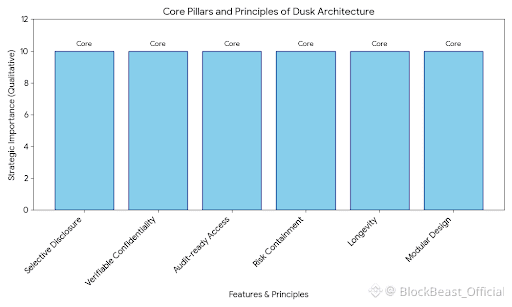
At its core, Dusk is built around the assumption that privacy and regulation are not opposing forces. In regulated markets, privacy is rarely absolute. Banks, asset issuers, and intermediaries are expected to protect sensitive information while remaining capable of demonstrating compliance to regulators and auditors. Dusk treats privacy as a controlled capability rather than a blanket guarantee. Selective disclosure, verifiable confidentiality, and audit-ready data access are not framed as concessions, but as essential features. This aligns closely with how confidentiality already operates in capital markets, where information is shielded by default but accessible under defined legal processes.
The architectural structure of Dusk reinforces this practical mindset. Its modular approach, separating consensus, execution, and privacy components, reflects a preference for risk containment over maximal performance. In real-world financial infrastructure, complexity is not inherently valuable. Systems that entangle too many responsibilities become fragile under regulatory change or security stress. By isolating key functions, Dusk reduces the likelihood that a change in one area—such as compliance requirements or cryptographic standards—forces a full system overhaul. This is a conservative engineering choice, but one that supports longevity.
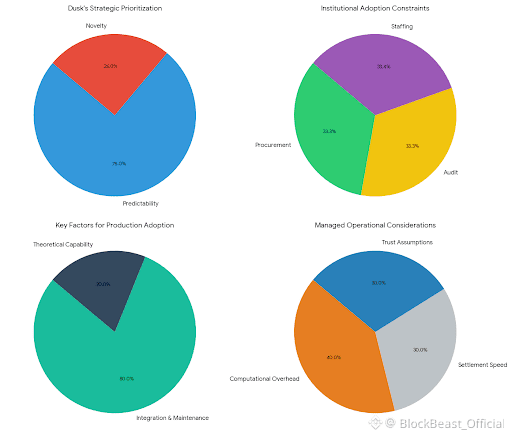
Compatibility with established development tools further underlines Dusk’s institutional orientation. Financial institutions operate under strict procurement, audit, and staffing constraints. Introducing unfamiliar tooling or experimental environments increases operational risk and slows adoption. By maintaining alignment with known standards and developer workflows, Dusk prioritizes predictability over novelty. This decision limits some flexibility, but it lowers the barriers to integration and long-term maintenance—factors that matter more in production than theoretical capability.
There are clear limitations, and Dusk does not appear to obscure them. Privacy-preserving execution introduces computational overhead, which can affect settlement speed and throughput. In regulated contexts, this has tangible consequences for liquidity management and reconciliation processes. Similarly, any reliance on bridges or migration mechanisms introduces trust assumptions that must be governed and monitored. These realities are not unique to Dusk, but the difference lies in how they are treated: as operational considerations to be managed, rather than flaws to be dismissed or hidden.
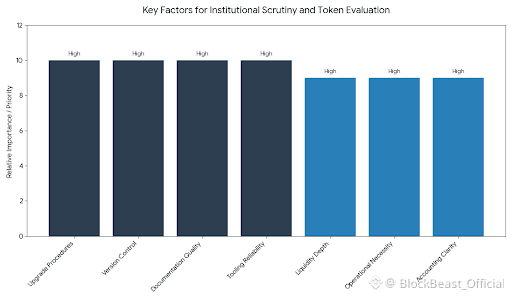
Uncelebrated infrastructure details play an outsized role in determining whether a system survives institutional scrutiny. Upgrade procedures, version control, documentation quality, and tooling reliability influence whether compliance teams can sign off on deployment. A blockchain that behaves consistently and predictably under audit pressure is more valuable than one that rapidly adds features without operational clarity. Dusk’s focus appears to be on stability and clear system behavior, even if that comes at the cost of slower iteration.
The network’s token design also reflects a restrained perspective. From an institutional standpoint, tokens are evaluated based on liquidity depth, operational necessity, and accounting clarity—not speculative upside. A token that supports network security and transaction finality while allowing orderly entry and exit is more useful than one optimized for narrative-driven demand. Dusk’s token functions primarily as infrastructure, supporting consensus and usage rather than serving as a vehicle for financial experimentation.
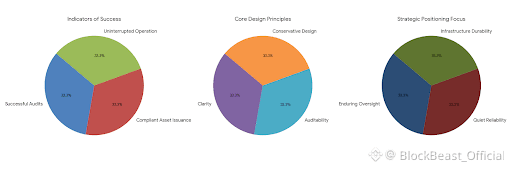
Taken together, Dusk positions itself as infrastructure meant to endure oversight rather than attract attention. Its success is unlikely to be measured through viral adoption or headline metrics. Instead, durability will show through successful audits, compliant asset issuance, and years of uninterrupted operation. In regulated finance, systems earn trust slowly and lose it quickly. By prioritizing clarity, auditability, and conservative design, Dusk reflects an understanding that quiet reliability—not visibility—is what allows financial infrastructure to persist.