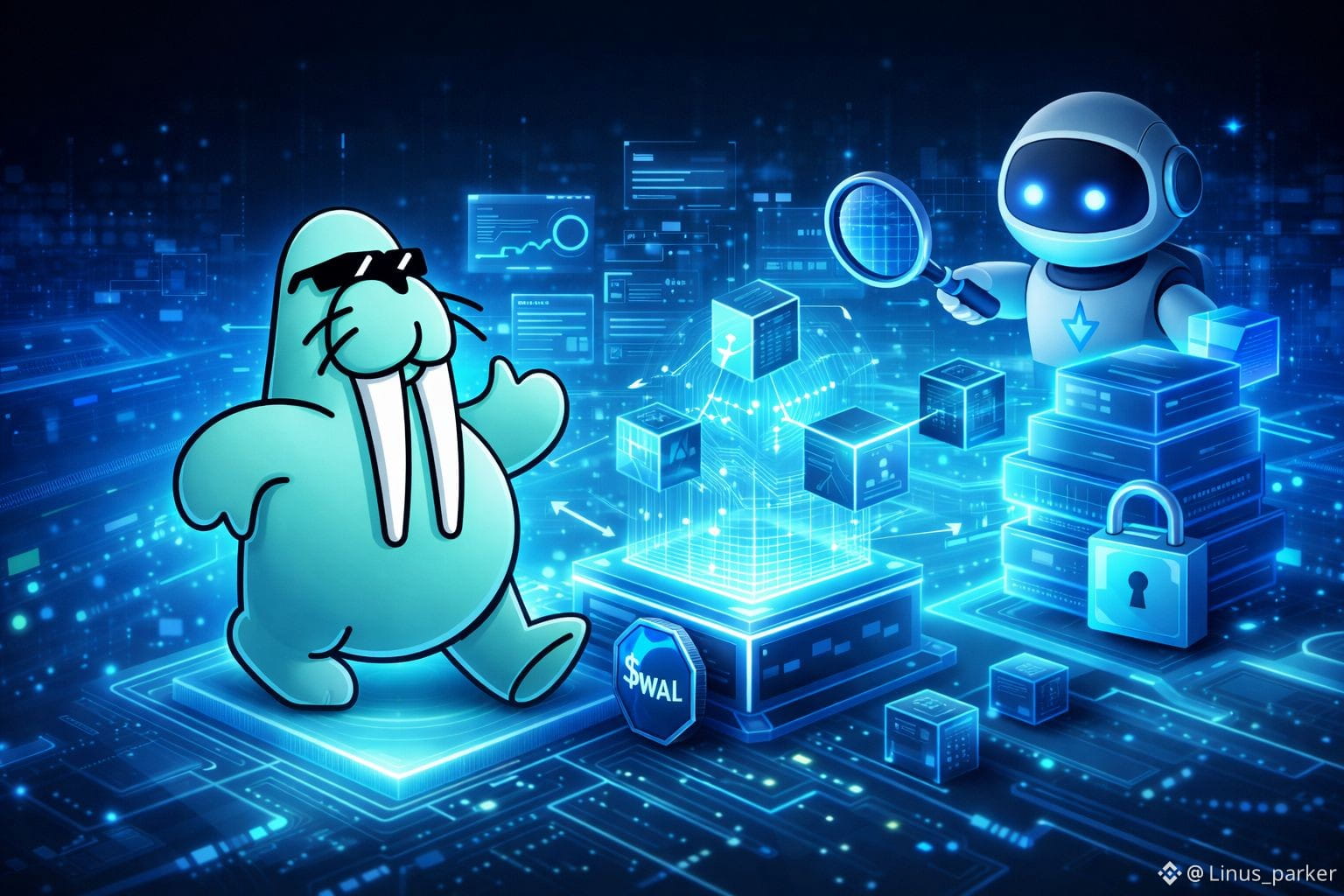
The more our world leans into AI, automation, large-scale models, autonomous agents, mixed reality, and machine-to-machine networks, the more one truth becomes impossible to ignore. The entire digital ecosystem is being rebuilt around data. Not just data in quantity, but data in high-integrity, verifiable form. Every major breakthrough happening today depends on how reliably machines can trust the information they consume. And this is exactly where Walrus has started positioning itself as one of the most important foundational layers in Web3.
The industry originally talked about blockchains as financial rails, then as smart contract platforms, and later as general-purpose ecosystems. But the AI era has introduced a completely different requirement profile. AI agents need data they can verify, trace, audit, and trust. They need storage architectures that do not slow down as scale increases. They need environments where data does not require blind trust in opaque intermediaries. Walrus enters the picture with a value proposition that directly fits the future being built right now.
Its approach is not about competing with legacy storage networks. Walrus solves one of the most important and difficult problems in the Web3 data economy: data provenance for autonomous systems. When an AI model or an automated agent makes a decision, that decision is only as good as the data it receives. Walrus provides the cryptographic foundation that confirms whether a piece of data is legitimate, unaltered, and sourced from the right origin. In practice, it means AI agents can rely on data without human supervision.
Developers who work with large datasets, creative media pipelines, decentralized social platforms, game engines, or enterprise-level integrations face one repeated pain point: storage solutions that either break at scale or cannot provide the verification guarantees required for modern applications. Walrus solves this structurally. Its storage layer uses unique techniques optimized for large-scale throughput, meaning that even high-volume applications can run without friction. Unlike conventional infrastructure that slows down or becomes cost-prohibitive, Walrus becomes more efficient as more nodes and more demand enter the network.
This is why recent months have seen a surge in developer attention. Teams working with AI, gaming, digital identity, or models that need clean data streams find Walrus naturally aligned with their needs. Large-scale platforms building next-generation applications have started recognizing that verifying the origin and integrity of data is no longer optional. AI systems making automated decisions cannot rely on unverified inputs. Walrus solves this by design. And in an industry defined by rapid iteration, this reliability becomes a competitive advantage.
The ecosystem shift toward verifiable data has completely changed how builders think about storage networks. Walrus is not merely storing data. It is validating it. It is enabling environments where AI systems do not have to blindly trust their data sources. It is creating a system where creators, brands, enterprises, and developers know that their content, files, and digital assets are not just stored but secured against manipulation. This solves problems that go way beyond blockchain and enter the broader digital transformation sweeping every sector.
The most interesting part is how Walrus approaches the trade offs between compliance and privacy. Most networks end up sacrificing one for the other. Walrus is proving that strong privacy does not require sacrificing verifiability. Data can remain private without becoming unverifiable. And that is exactly what future regulatory frameworks demand. Whether it is enterprise adoption, digital identity systems, or large-scale AI agents, privacy without accountability is unusable, and compliance without privacy is unacceptable. Walrus sits at the center of this balance.
As more applications scale toward billions of daily operations, data minimization becomes equally important. AI does not need to store everything. It needs to store the right things. Walrus enables architectures where only essential data is retained, and every part of it remains cryptographically verifiable. Data minimization is not just a privacy practice but a compute optimization strategy, and Walrus is designed to support this principle naturally. The storage system itself encourages efficient, verifiable, minimal data pipelines that make a massive difference for large-scale deployments.
Developers coming from Web2 environments quickly realize that Walrus provides something they never had before. It offers predictable, efficient storage while maintaining cryptographic verification that traditional cloud providers simply cannot replicate. As the Walrus ecosystem expands, more tools, SDKs, integrations, and enterprise-level solutions are being built around this foundation. Each new addition strengthens the ecosystem and attracts more builders.
When combined with the overall direction of AI-driven infrastructure, Walrus is positioned exactly where the market is heading. The next generation of web services will not simply store information. They will verify information. They will rely on cryptographic proofs rather than blind trust. They will depend on networks that can scale without losing reliability. And they will need a data layer that gives them confidence in every input they process.
This is why Walrus remains one of the most fundamentally aligned projects with the coming transformation. It is not chasing hype narratives. It is building practical solutions to real problems AI developers face daily. As more teams realize the importance of verifiable data pipelines, Walrus will continue positioning itself as the go to choice for the future of AI, Web3 creators, and enterprise-scale applications. Long term, the networks that secure and verify data will define the value of digital systems. Walrus has entered that category with clarity, purpose, and strong execution.
In a world moving toward autonomous agents, decentralized platforms, on chain applications, and AI driven decision making, Walrus is not just a storage network. It is a foundational layer for the next evolution of the internet.
If you want to understand where real long term value is forming in Web3, look closely at the networks building the infrastructure for AI and data integrity. Walrus is one of the very few doing it right.