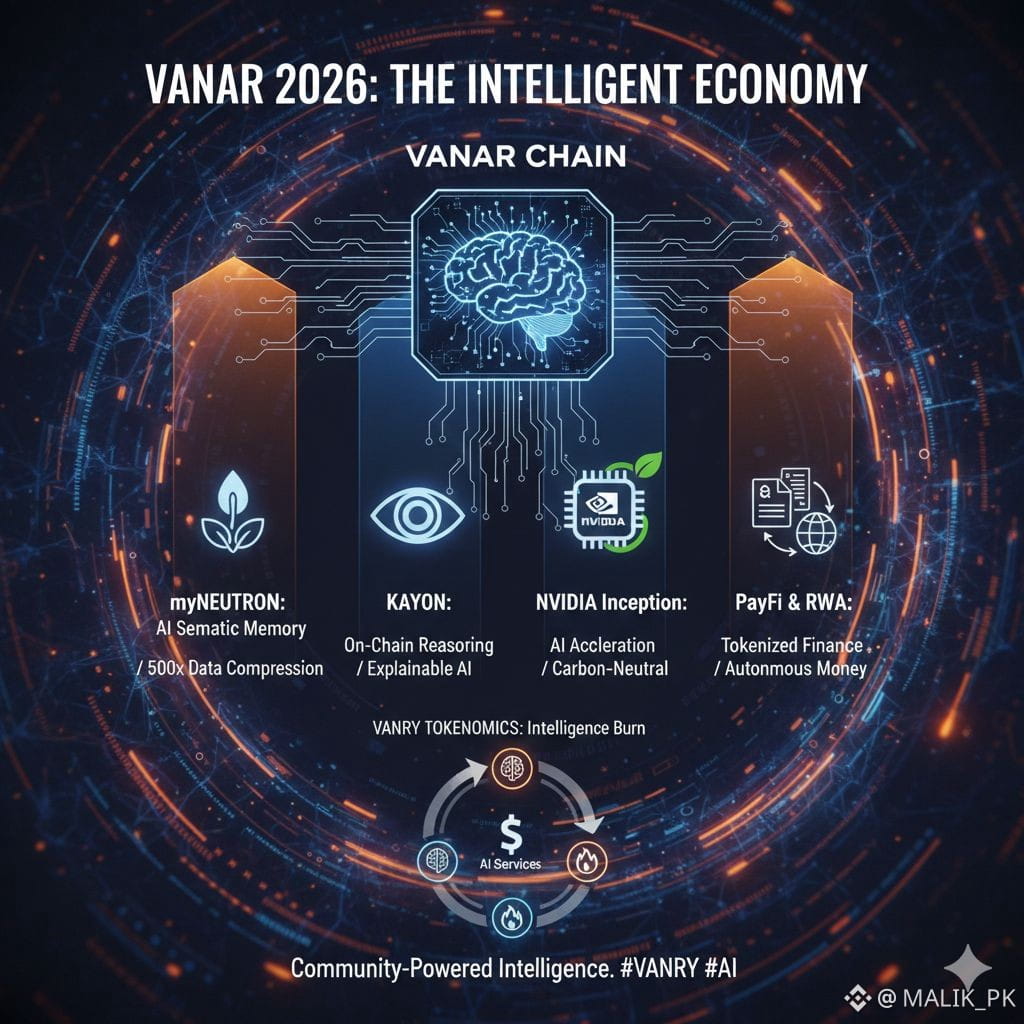
As we move through January 2026, the crypto market has reached a state of "Performance Saturation." We have plenty of fast chains. We have plenty of cheap chains. But until now, we haven't had a Smart Chain. Vanar Chain has spent the last 12 months quietly pivoting. It recognized that the future isn't just moving tokens from Point A to Point B; it’s about moving context. With the release of the V23 Protocol Renewal on January 19, 2026, Vanar has officially matured into an AI-native infrastructure that actually understands the data it stores.
1. The Death of "Amnesiac" AI
The biggest problem with AI in 2024 and 2025 was that it lived in a vacuum. If you used an AI agent on a blockchain, it forgot everything the moment the transaction was finalized. It was "amnesiac."
Vanar’s Neutron Layer changed that. Instead of just acting as a database, Neutron acts as a Persistent Semantic Memory. * The "Seed" Technology: Vanar uses neural compression to turn massive enterprise files—like legal contracts, 4K video assets, or medical records—into queryable "Seeds."
The Efficiency: We are talking about a 500x compression ratio. A file that would normally cost thousands of dollars to store on Ethereum now lives natively on Vanar for a fraction of a cent.
For the first time, an AI agent can "remember" your preferences, your history, and your specific business rules because the data is stored in an AI-readable format directly on-chain.
2. Kayon: The Reasoning Engine
If Neutron is the "memory," Kayon is the "brain."
Kayon is Vanar’s native reasoning engine. Unlike traditional chains that require "Oracles" (like Chainlink) to bring in outside data, Kayon allows for On-Chain Reasoning. Imagine a decentralized insurance protocol. In the old days, you’d wait for an oracle to tell the contract it rained. In 2026, on Vanar, a Kayon-powered agent can look at the compressed weather data in the Neutron layer, reason through the policy terms, and trigger a payout instantly—all without leaving the blockchain environment. This is "Zero-Latency Intelligence."
3. The NVIDIA Inception Factor: Why it Matters Now
You’ll see a lot of talk about the NVIDIA Inception partnership on Binance Square. In 2026, this has evolved from a logo on a website into a core infrastructure advantage.
Vanar is now utilizing NVIDIA’s CUDA-X AI and TensorRT toolkits to optimize AI model training directly on its validator nodes. This means that Vanar isn't just a place where AI lives; it’s a place where AI grows. By tapping into NVIDIA's hardware expertise, Vanar validators can process AI workloads that would crash a traditional blockchain node.
4. The "PayFi" Revolution: Money with a Mind
One of the most exciting developments this month is the rise of PayFi (Payment Finance) on Vanar.
By integrating AI into the payment layer, Vanar has enabled Autonomous Money Flows. A great real-world example is the VGN Gaming Network. In 2026, games on Vanar don't just have stores; they have "Economic Agents." These agents analyze player behavior in real-time. If a player is about to quit, the Kayon engine can sense the "churn risk" and autonomously offer a custom, AI-generated discount or a rare item to keep them engaged. This isn't a pre-written script; it's a dynamic, intelligent economy.
5. Tokenomics 2.0: The Value Flywheel of $VANRY
As of Q1 2026, the $VANRY token has been completely reconstructed around a Utility-First Model.
The "V23 Protocol" introduced a new economic cycle that investors are calling the "Intelligence Burn."
AI Tool Subscriptions: To access the advanced features of the Neutron and Kayon layers, enterprises must pay in $VANRY.
Agent-to-Agent Economy: As autonomous agents become the primary users of the chain, they pay each other in VANRY for data retrieval and computation tasks.
Buyback & Burn: A portion of the fees generated by these high-level AI services is automatically used to buy back and burn $VANRY tokens, creating a deflationary pressure that is directly tied to how "smart" the network becomes.
6. Real-World Assets (RWA): The Trust Bridge
Vanar has become a magnet for Real-World Asset tokenization in 2026 because of its compliance features.
Traditional banks don't just want a "fast" chain; they want an auditable one. Kayon’s "Compliance by Design" module monitors global regulations across 47+ jurisdictions. When a bank tokenizes a building or a bond on Vanar, the AI ensures that the asset cannot be traded to an unverified wallet, automating the "KYC/AML" (Know Your Customer/Anti-Money Laundering) process entirely.
7. The Community and Governance 2.0
Finally, let’s talk about the people. Vanar has launched Governance Proposal 2.0. In 2024, governance was about "yes or no" votes on spending money. In 2026, VANRY holders are voting on AI Model Parameters. * Should the Kayon engine prioritize speed or precision for this specific dApp? * How should the Neutron compression algorithms be calibrated for medical data?
The community has become the "trainers" of the network’s intelligence. This level of engagement is why Vanar’s social metrics on Binance Square have spiked by over 40% this month.
🏆 Conclusion: The Intelligent Choice
Vanar Chain has successfully navigated the "Valley of Death" that many 2024 projects fell into. It didn't just survive; it evolved. By focusing on Memory, Reasoning, and Real-World Utility, it has created a niche that no other Layer 1 can easily replicate.
In 2026, the question isn't "How many transactions can your chain do?" The question is "How much can your chain think?" For Vanar, the answer is: More than anyone else.