

Time is the invisible cost in every business
Most payment discussions focus on speed as a technical metric. Seconds versus minutes. Blocks versus confirmations. But for businesses, time behaves very differently. It shows up as delayed salaries, frozen working capital, cautious inventory decisions, and finance teams constantly planning around money that exists — but isn’t usable yet.
Settlement time is not a feature. It is a behavioral force.
When money moves faster, decisions change
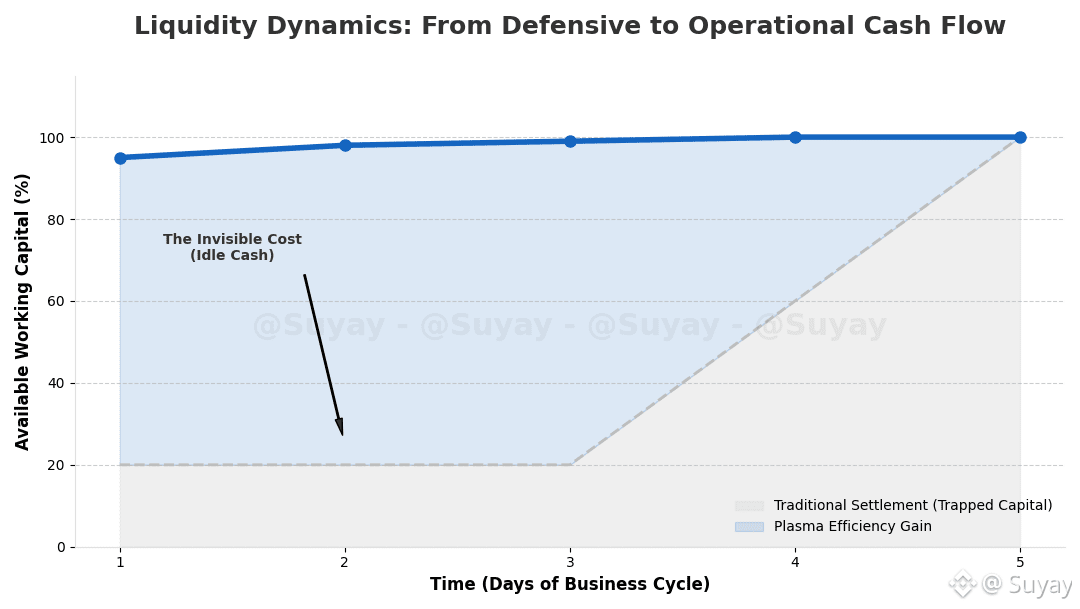
If funds take days to settle, businesses learn to wait. Payrolls are scheduled earlier than necessary. Suppliers are paid with buffers. Cash reserves sit idle “just in case.” The organization adapts, but the cost is hidden inside conservative decisions.
When settlement happens in seconds, those buffers start to disappear. Companies can pay closer to real delivery. Payroll timing becomes flexible instead of rigid. Liquidity stops being something you plan around and becomes something you actually use.
Working capital becomes dynamic
Slow settlement turns cash flow into a forecasting problem. Fast settlement turns it into an operational tool. Finance teams don’t need to ask “Will this clear in time?” They can act based on actual balances, not expected ones.
This changes how businesses manage inventory, subscriptions, and global operations. Money that settles quickly doesn’t just arrive sooner — it circulates more efficiently.
Payroll stops being a calendar event
In traditional systems, payroll is an anxiety-heavy process. Delays cascade. Errors require manual fixes. International payouts amplify friction. When settlement is predictable and near-instant, payroll becomes less about timing and more about correctness.
That shift reduces operational stress. It also changes how companies think about hiring globally, paying contractors, and adjusting compensation cycles.
Merchants optimize behavior, not transactions
Merchants don’t measure payments in transactions per second. They measure them in trust. Can I ship once I see the payment? Can I restock today? Can I reconcile without chasing errors tomorrow?
Faster settlement shortens the distance between action and confidence. That confidence compounds across daily operations.
Why speed alone is not enough
Fast systems that behave unpredictably create new risks. What matters is not raw speed, but consistent, observable settlement. Businesses care about knowing when money is final — not just when it is fast.
This is where infrastructure design matters more than product design.
Plasma as a settlement rail
Plasma approaches stablecoin payments from this operational reality. The focus is not on showcasing speed in isolation, but on building rails where settlement is fast, predictable, and usable within real business workflows. The goal is not to make payments impressive, but forgettable — because they simply work.
The real shift is psychological
When money settles in seconds instead of days, businesses stop managing around payments. They start managing with them. Cash flow becomes less defensive. Operations become less constrained. And finance teams spend less time anticipating problems and more time executing decisions.
That is when payments quietly disappear into daily work — which is exactly when infrastructure has done its job.
@Plasma $XPL #plasma