
I remember the first time I watched Dusk Network get passed around a trading room, the charts were moving, the voices were moving faster, and someone demanded a single metric to settle the mood. A few people shouted volume, a few people shouted TVL, and the moment a number appeared everyone relaxed, as if the screen had spoken an objective truth. I have seen that ritual repeat so many times that it now feels like watching the same film with different actors.
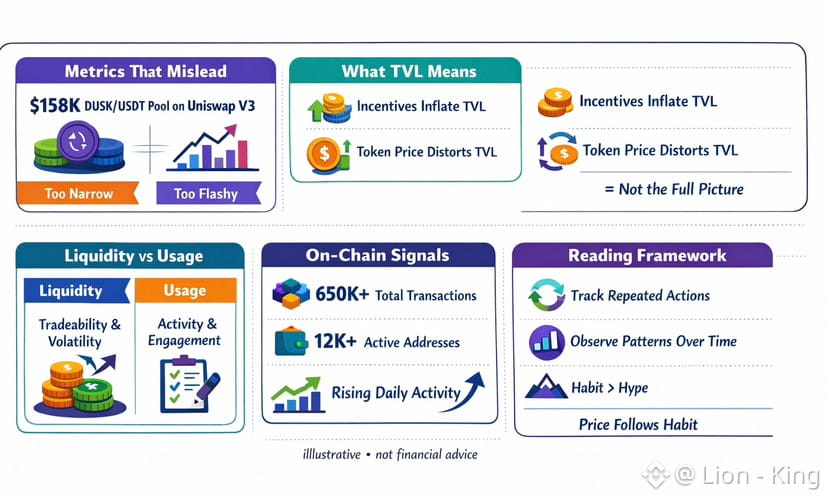
TVL can be a helpful lens, but it can also be a trap. In early DeFi it was closer to a usage meter, users deposited assets, contracts held them, and locked value loosely tracked demand. Over the years TVL became easier to manufacture. Incentives pull liquidity in, incentives expire and it leaves, token prices rise and the same deposits look larger, token prices fall and the same activity looks like decay. With Dusk Network there is another complication, many public dashboards do not present a simple chain level TVL number for the network, so people reach for whatever number is available and pretend it answers a deeper question.
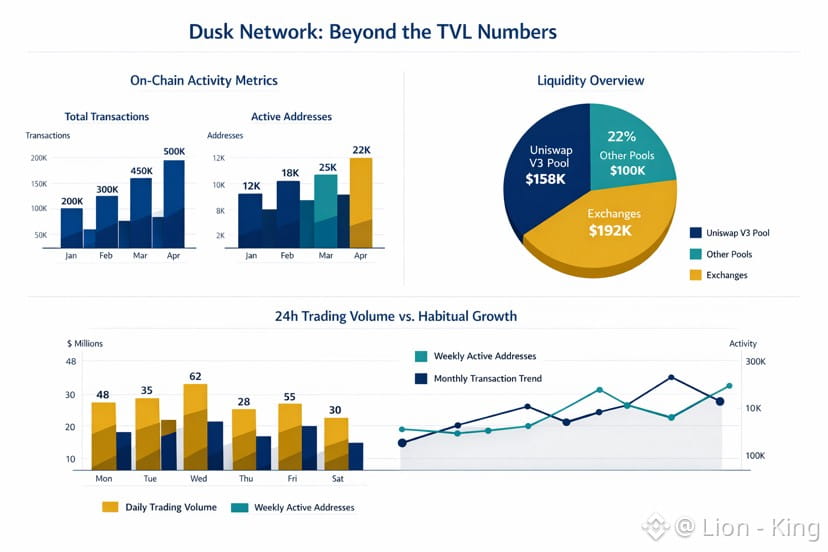
What they usually find is DUSK liquidity on other venues. You might see a DUSK USDT pool on Uniswap V3 on Ethereum holding around one hundred fifty eight thousand US dollars, and you will hear someone treat that as the whole projects balance sheet. It is not malicious, it is just convenient, and convenience is the fastest way to confuse a proxy for reality. Pool liquidity tells you how easily the token can be traded, and how fragile the price might be under pressure. It does not tell you whether builders are shipping, whether users are returning, or whether the chain is forming a habit loop.
Privacy and compliance oriented chains are built to look quiet. They do not reward spectators with constant clarity, they reward participants with guardrails. That design choice makes the data feel blurred, and when numbers feel blurred, impatient observers sprint back to the brightest object in the room, the twenty four hour exchange volume. Volume is bright and seductive, but it measures excitement, not habit. Excitement is weather, habit is climate, and the market is full of people who confuse a warm afternoon for a new season.
If you want to read Dusk Network with less self deception, you have to look where the market rarely looks, on chain. Transaction counts, repeated actions, and the shape of activity over time matter more than a single day of attention. When an explorer records hundreds of thousands of total transactions, that is not a promise, it is residue. It means someone executed code, someone sent value, someone tested a contract, someone came back and tried again, even if they never posted about it. When active addresses spike in short windows, that does not prove adoption has arrived, but it does suggest there were moments when the network was touched by real hands, not just quoted by traders.
I have lived through enough bull runs and enough quiet winters to know how the market rewards the wrong kind of certainty. It prices the story first, then punishes everyone for believing the story when liquidity turns. Dusk Network does not need more narrative to survive that pattern. It needs a better way to be read, with patience, with boring metrics, and with the humility to admit that some systems only reveal themselves slowly. If you want a conclusion you can hold onto, here it is, price follows habit, and habit only shows up after the spotlight leaves. $DUSK @Dusk #dusk
