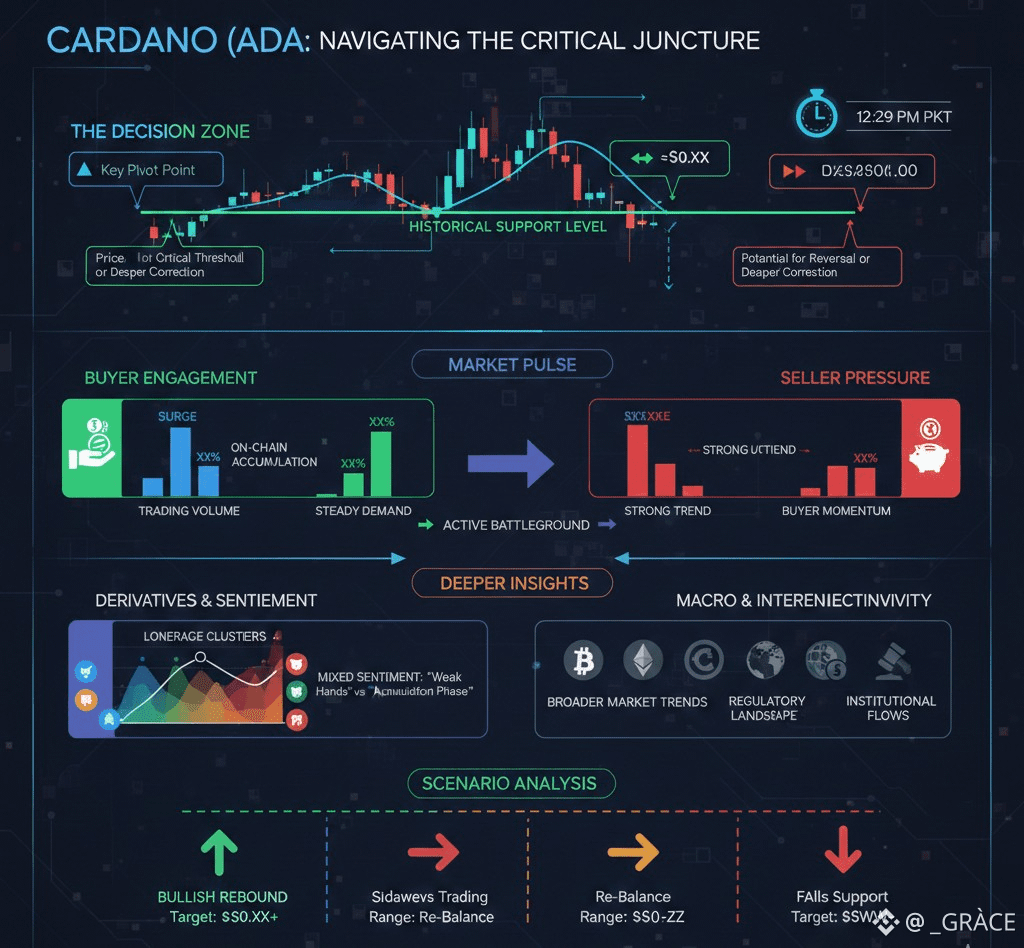
The cryptocurrency landscape is defined by volatility, and few tokens illustrate this better than Cardano. Over recent weeks, ADA has experienced a noticeable decline, prompting investors and traders to closely monitor its trajectory. The current environment presents a critical moment for the token, as price action, market behavior, and trader sentiment converge around a key decision zone. Understanding these dynamics is essential to gauge whether the asset is on the brink of a rebound or a deeper correction.
Despite the downward movement, trading activity has surged, suggesting that participants remain actively engaged rather than withdrawing from the market. Typically, when prices fall, volume diminishes, reflecting hesitancy and reduced interest. ADA’s recent volume spike, however, indicates a more contested scenario where buyers and sellers are actively shaping outcomes. This increased engagement suggests liquidity has not evaporated and that the market is finely balanced between those defending positions and those anticipating further downside.
Price action reveals a series of repeated reactions around a historically significant level. This region has previously acted as a pivot point, with the asset bouncing off it multiple times over recent months. Technical analysts consider such areas critical because they represent points where past market participants exhibited decisive behavior. If buyers step in with sufficient force, it could stabilize the token and set the stage for a rally. Conversely, failing to hold this zone could open the path for continued declines, potentially leading to lower support levels that had been tested in prior cycles.
Momentum indicators provide additional insight into the strength of the prevailing trend. Current readings suggest that ADA’s decline is supported by meaningful trend strength, highlighting that the sellers driving this move have significant conviction. At the same time, measures that assess capital inflow and outflow indicate waning buying pressure. This combination suggests that while the downtrend is intact, oversold conditions have not yet reached extremes, leaving room for potential stabilization if demand resumes. Such nuances underscore that momentum can persist longer than many anticipate and that trend strength does not always signal imminent reversals.
Beyond price and technical indicators, on‑chain behavior offers a deeper understanding of market dynamics. Direct buying activity has remained notable despite the broader decline. Traders are continuing to acquire ADA at prevailing prices rather than waiting for lower levels, which implies persistent demand. This behavior can signal accumulation, with participants viewing the current levels as favorable entry points, or it may reflect short-term tactical positioning. The divergence between falling prices and ongoing buying often precedes periods of stabilization, suggesting that the market may be preparing for a potential shift in trend.
The derivatives market adds another layer of complexity. Leveraged positions are clustered around specific price points, revealing where traders anticipate support or resistance. Both long and short positions are concentrated near critical levels, demonstrating active engagement on both sides of the market. This creates a dynamic environment in which price movement can trigger cascading reactions, such as liquidation-driven selling or short-covering rallies. Observing these clusters can provide insight into potential volatility as the market approaches key thresholds.
Trader psychology is intertwined with these technical and on‑chain factors. The current sentiment around ADA is mixed. Some participants interpret the decline as a necessary consolidation phase, a period in which weak hands are shaken out, paving the way for more sustainable upward momentum. They point to the historical resilience of the decision zone and argue that volatility in this context is part of a natural market rhythm. Others view the situation with more caution, emphasizing that declining prices coupled with diminished buying intensity could indicate a fragile market prone to deeper corrections. These differing perspectives highlight the human element behind market behavior, emphasizing the role of perception alongside quantitative signals.
Scenario analysis can help frame expectations. In a favorable scenario, ADA stabilizes above its critical pivot zone, attracting renewed buying interest and potentially setting up a period of consolidation before attempting higher levels. In such a scenario, confirmation might come through upward breaks of short-term resistance and sustained volume, signaling confidence in the recovery. In a less favorable scenario, failure to maintain this level could accelerate declines, particularly if stops or leveraged positions are triggered, pushing price toward lower historical supports. A neutral scenario is also possible, in which ADA moves sideways within a defined range, allowing supply and demand to rebalance before a decisive move occurs. Each of these paths carries implications for risk management and strategy.
The broader cryptocurrency market also shapes ADA’s movement. Bitcoin, Ethereum, and other major assets often influence altcoin sentiment and capital flows. Positive momentum in larger caps can create a spillover effect that benefits ADA, while risk-off conditions can amplify downward pressure. Macro factors, regulatory developments, and institutional engagement further contribute to the environment in which ADA operates. This interconnectedness underscores the need to consider both internal market dynamics and external forces when evaluating the token’s potential path.
At this juncture, ADA’s behavior reflects the interplay of multiple market forces. Price thresholds act as battlegrounds where buyers and sellers exert influence. Rising trading volume amid a declining price demonstrates active participation and contested sentiment. On-chain buying signals ongoing demand, even as momentum indicators show trend strength in favor of sellers. Leveraged positions reveal the psychology and expectations of traders who are prepared for moves in either direction. These factors collectively illustrate a market that is dynamic, engaged, and uncertain, emphasizing the importance of careful observation and analysis.
The token’s current position also provides insights into broader lessons about cryptocurrency markets. Active engagement during periods of decline, the persistence of buying pressure, and the interplay between technical thresholds and sentiment all highlight the complexity of market behavior. Investors and traders benefit from considering multiple dimensions price, volume, momentum, on-chain data, derivatives activity, and psychological context rather than relying on a single metric. This multi-layered perspective can help navigate uncertainty and inform decisions in a volatile environment.
Ultimately, Cardano is at a critical juncture that requires attentive monitoring. Its price action, trading behavior, on-chain activity, and broader market influences converge around a pivotal zone that may determine its short-term trajectory. The coming sessions are likely to be decisive, with stabilization or further declines contingent on the balance between buyer conviction and seller pressure. Observing how these forces resolve will provide important insights into ADA’s next phase, whether it continues to navigate a downtrend, consolidates, or mounts a rebound.
The current situation emphasizes the importance of patience and analysis in cryptocurrency markets. Decisions should be informed by patterns, data, and context rather than reactive emotion. ADA’s trajectory is being shaped not just by historical price points but also by active market engagement, trader psychology, and broader market conditions. Recognizing these layers allows participants to approach the token’s movements with greater awareness and a structured approach to risk.
In this complex environment, the notion of a “decision zone” is more than a technical term; it represents the convergence of multiple factors influencing market behavior. Historical support, ongoing buying interest, trend momentum, leveraged positioning, and broader market forces all intersect to create a pivotal moment for ADA. How the token navigates this intersection may define its short-term and even medium-term outlook, making the current period particularly noteworthy for those invested in or observing the asset.
While volatility introduces uncertainty, it also provides opportunity. Divergence between price and on-chain activity, active engagement from traders, and the presence of strong trend signals offer insights into potential market mechanics and points of interest for those evaluating positions. Careful observation and measured interpretation of these elements can inform strategies, whether the focus is on short-term trading or longer-term accumulation.
The interplay of technical, on-chain, and psychological factors illustrates the nuanced nature of cryptocurrency markets. ADA’s decline is not a simple signal of weakness; it is part of a broader tapestry of market behavior that requires multi-dimensional analysis. Recognizing how different forces interact from volume spikes to momentum readings to leveraged positions provides a clearer lens through which to view potential outcomes and manage expectations.
In conclusion, Cardano’s current situation exemplifies the intricate dynamics that shape digital asset markets. The token is navigating a period of heightened significance, with price, trading activity, on-chain behavior, and market psychology all converging. While future movements remain uncertain, understanding these layers and observing how they resolve will provide valuable insight into ADA’s near-term path. Investors and traders can benefit from approaching this moment with awareness, structured analysis, and an appreciation for the complexity underlying apparent price action. ADA’s trajectory is far from predetermined, but careful evaluation of the forces at play can guide decisions and inform strategies as the market continues to evolve.