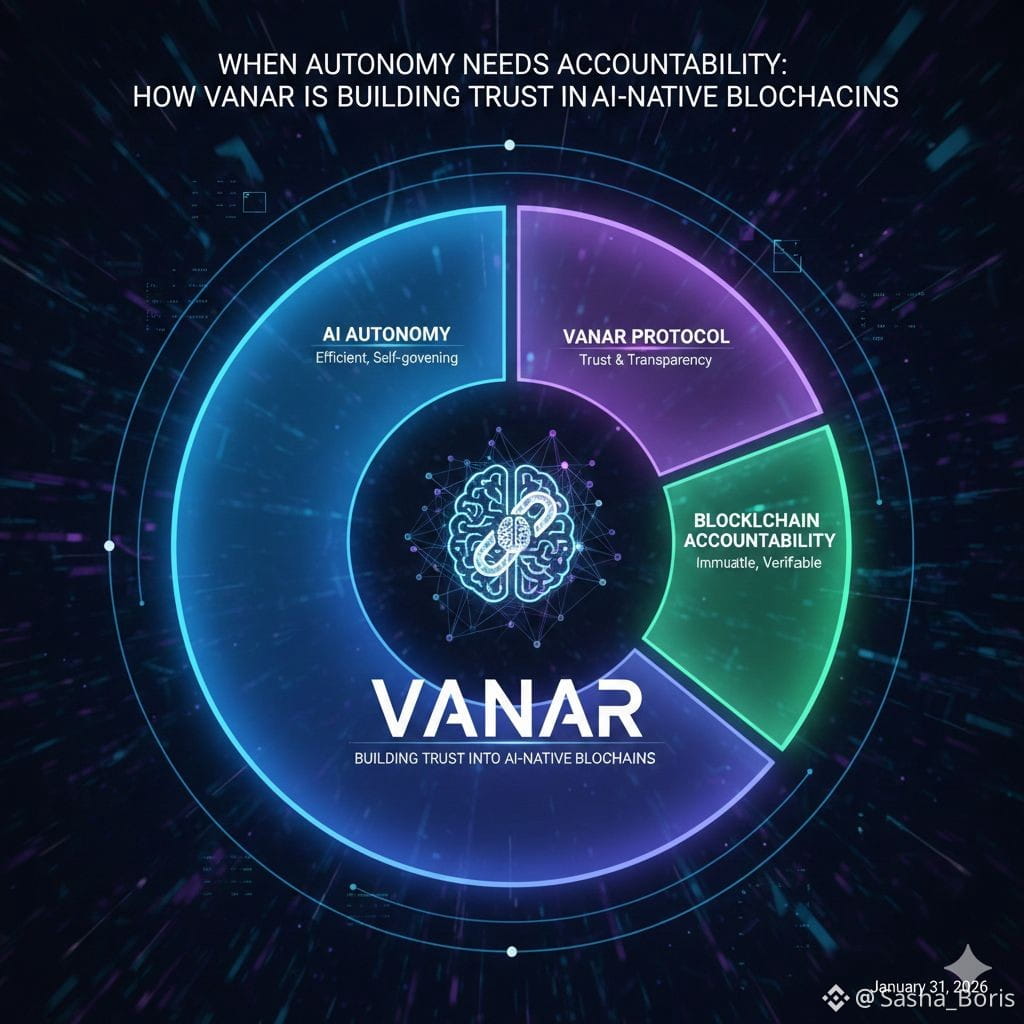
Web3 promised to replace gatekeepers with open, provable systems — yet for many projects that promise never fully arrived. Decentralized networks still lean on centralized services, teams ask for trust without delivering verifiable proof, and complicated off-chain logic keeps users in the dark. The arrival of truly autonomous, agentic AI — systems that can reason, act, trade, and move value without human babysitters — only makes that gap more dangerous: when an algorithm controls wallets and payments, opacity becomes a systemic risk. Vanar’s approach is to stop asking users to trust and start giving them ways to verify.

From opaque decisions to inspectable evidence
Most deployed AI today behaves like a sealed appliance: feed inputs in, get outputs out, and hope nothing went wrong. That model can be acceptable for convenience apps — but it’s unacceptable where capital, legal obligations, or user funds are at stake. Vanar reframes the problem: instead of running reasoning off-chain behind private services, it designs primitives that let the chain carry not just outcomes but verifiable traces of the reasoning that produced them. In short: make decisions auditable, not mysterious.
Neutron Seeds — putting meaning on chain
A core piece of Vanar’s stack is Neutron, a semantic compression and storage layer that converts documents, files, and structured data into compact, queryable on-chain objects called “Seeds.” These Seeds are not blobs — they preserve the semantic structure and intent of source material so agents can reference, validate, and reason about evidence on chain rather than relying on off-chain documents that can vanish or be altered. That shift turns archives into executable knowledge.
Kayon — a reasoning layer you can audit
Building on structured Seeds, Kayon provides the on-chain logic to query memory, apply rules, and produce decisions in a way that can be replayed and reviewed. Rather than accepting a final transaction as an unexplained artifact, observers can trace which policies, constraints, and semantic facts the agent used — enabling compliance checks, dispute resolution, and forensic review after the fact. This is the practical difference between “trust me” and “here’s the evidence.”
Why this matters for DeFi, PayFi and RWAs
Decentralized finance benefits from automation, but automation without explainability creates fragility. Intelligent agents can optimize strategies and manage risk — but counterparties, custodians, auditors, and regulators need a way to verify that those agents followed rules. For payment rails and tokenized real-world assets (RWAs), on-chain semantic proofs and auditable reasoning are prerequisites for institutional adoption: they let legal and compliance requirements be mapped to verifiable on-chain behavior. Vanar explicitly targets that intersection.
Moving beyond marketing — infrastructure, not buzzwords
Many projects add “AI” as a label while keeping core logic off chain. Vanar’s pitch is different: it’s an L1 built from the ground up to support AI workloads — vector-friendly storage, semantic memory, and reasoning layers designed to work together. The goal isn’t flashy demos; it’s an operational stack that makes autonomous agents accountable and useful in production contexts.
The pragmatic case for verification
Accountability is not an ideological stance — it’s a business requirement. Exchanges, custodians, and regulated entities demand audit trails. Users demand explanations when money moves. Vanar’s architecture aims to reconcile autonomy with traceability: agents can operate without constant human supervision, yet every decision leaves a verifiable breadcrumb trail on chain. That’s the bridge from experimentation to durable infrastructure.
Final thought — trust must be demonstrable
Decentralized systems promised trustless interactions, but in practice we still see faith-based dependencies. As AI becomes the actor in those systems, the stakes rise. Vanar’s contribution is straightforward but consequential: bake verifiability into the AI stack so autonomous agents become auditable actors of the ecosystem. If Web3 is to host financial systems and real-world obligations driven by AI, proving how decisions were made will be the foundation of lasting trust.