
Recently, I’ve been moving stablecoins around for a cross-border payment setup. Nothing advanced — just trying to move money on time without fees quietly eating into it. And it reminded me, again, how fragmented the experience still is. Confirmations stall when traffic picks up, fees jump without warning, and what should be routine suddenly needs attention. Last week, I sent a small USDT remittance, roughly a thousand dollars. Peak hours hit, the network slowed, and the transaction sat there for over a minute. By the time it cleared, almost twenty dollars was gone in gas. Not catastrophic, but enough to stop and think. Why does something as simple as moving digital dollars still feel awkward? When speed matters, it hesitates. Under load, reliability softens. Finality feels just uncertain enough to make you double-check everything. Do this often enough and the costs add up quietly, while UX friction — extra approvals, bridge hops, confusing prompts — turns a basic task into something you babysit.
That’s the underlying issue across much of today’s blockchain stack. Most networks are built to do everything at once — NFTs, DeFi, experiments, whatever comes next. But when it comes to high-frequency, low-margin transfers like payments, that generality becomes a weakness. Stablecoin flows now reach into the trillions each year, yet they still rely on chains optimized for flexibility, not efficiency. The result is predictable: congestion slows settlements, fee models punish frequent users, and interfaces demand too much manual effort. Validators juggle mixed workloads, throughput becomes inconsistent, and without native support for low-cost or zero-cost payment paths, users — traders, remitters, institutions — struggle to build habits.
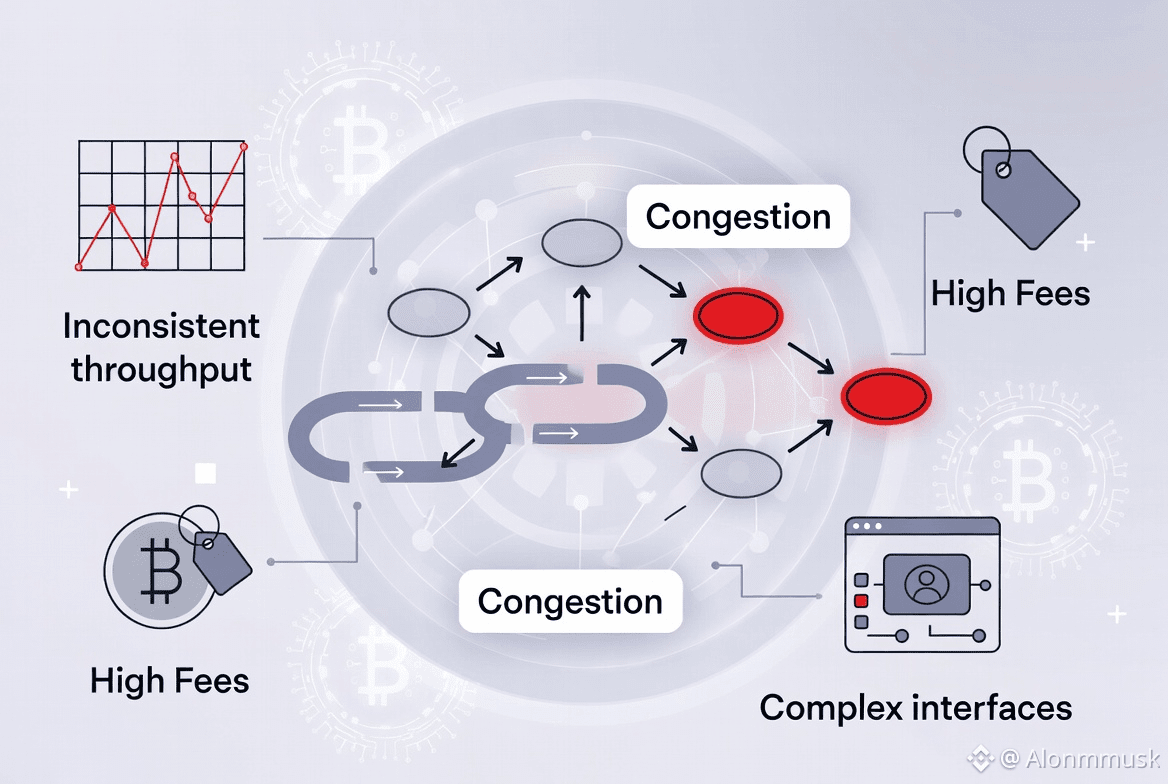
It feels like driving on an old highway system designed for every kind of vehicle, now overwhelmed by nonstop delivery traffic. No dedicated lanes, constant slowdowns, and tolls that quietly price out everyday drivers during rush hour.
Plasma is clearly trying to solve for that. It approaches the problem as a stablecoin-first Layer 1, closer to payment infrastructure than a general blockchain. Sub-second block times and high throughput aren’t marketing points here — they’re requirements. Just as important is what Plasma doesn’t prioritize. There’s no push to host every category of application, no competition with NFT drops or compute-heavy experiments. That restraint matters. If you’re sending stablecoins daily, you don’t want your transaction competing with whatever happens to be popular that day. Features like the USDT paymaster, which removes gas costs entirely for transfers, change behavior. When fees disappear, friction turns into flow.
XPL fits into this design without trying to do too much. It’s used for standard fees when gasless paths aren’t in play, staked by validators to secure the network, and tied into settlement through paymaster backing. Governance also runs through it, with holders voting on upgrades, including the on-chain approval of the Aave v3.6-related proposal in mid-January. Validator incentives come from fees and early inflation, keeping participation aligned without adding complexity for its own sake.
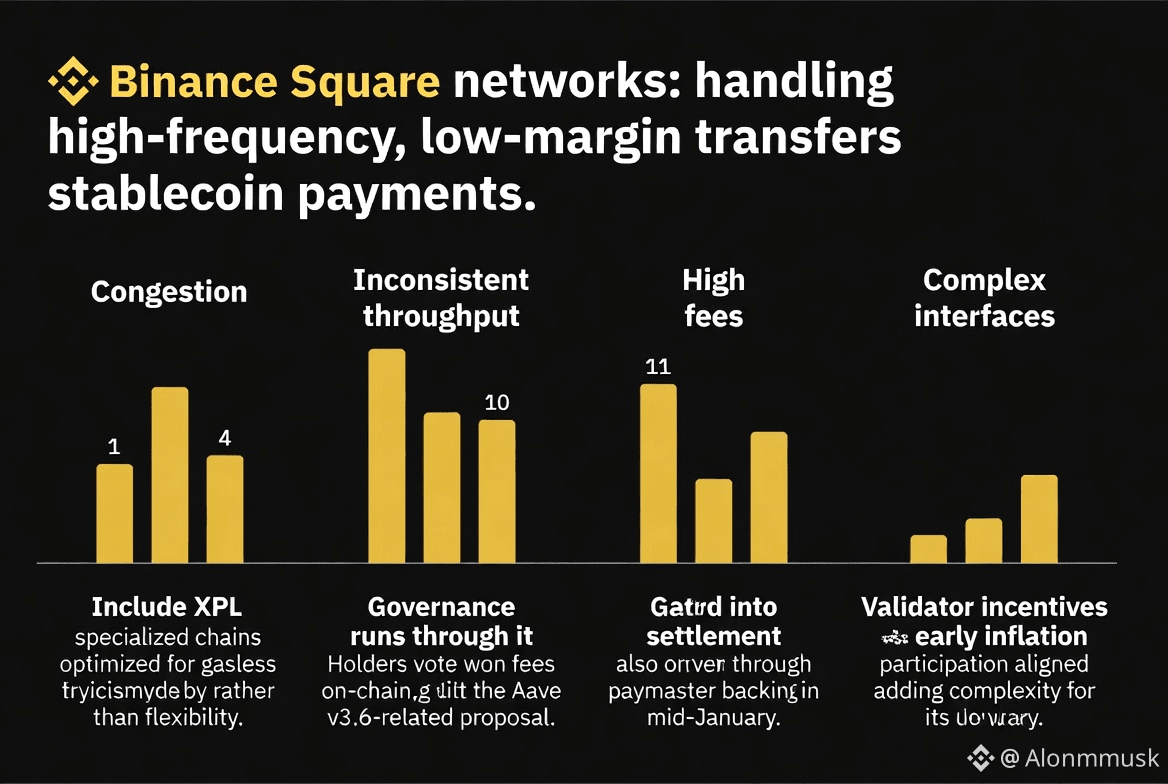
On-chain data gives some grounding. Stablecoin balances on Plasma sit around $1.78 billion, lower than earlier peaks but still meaningful. Daily volumes remain in the tens of millions. Active addresses hover in the low six figures. It’s steady usage — not explosive, not collapsing.
All of this naturally pulls the conversation toward short-term trading versus long-term infrastructure exposure. Short term, narratives are easy to chase. Token unlocks, news cycles, volatility. The January 25 unlock of roughly 88.9 million XPL — about 4% of circulating supply — created predictable price movement. News like the NEAR integration announced January 23 briefly lifted liquidity signals. Traders can play those moments. Long term, though, the bet is different. If fast finality and zero-fee stablecoin transfers become routine, value compounds through usage, not attention. Infrastructure wins when people stop thinking about it.
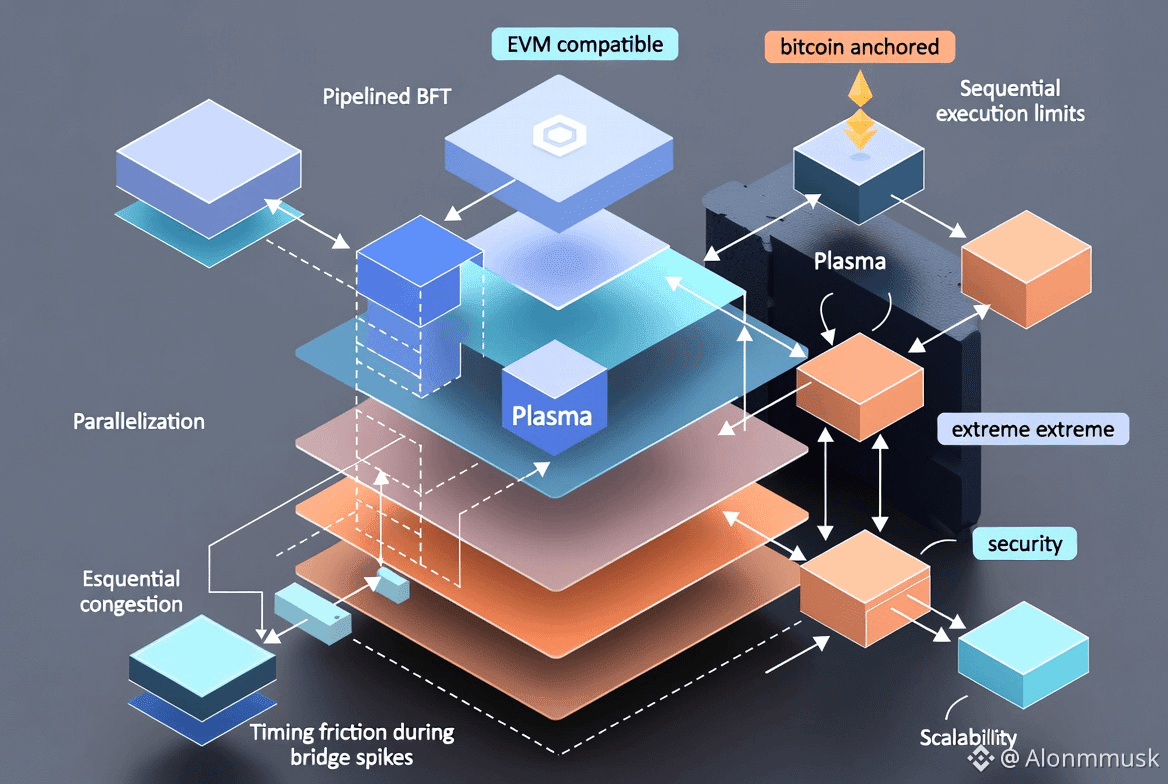
That doesn’t mean risks disappear. Extreme congestion after a major external shock could stress Plasma’s pipelined BFT design. Structurally, overlapping stages improve speed, but uneven load can expose propagation issues. EVM compatibility lowers barriers for deployment — seen with launches like CoW Swap on January 12 — yet it enforces sequential execution, which limits parallel scaling. The pattern is consistent. From a systems perspective, bitcoin-anchored security adds neutrality, but also introduces reliance on Bitcoin’s slower cadence, which can create timing friction during bridge spikes.
Competition remains real. Tron still dominates stablecoin volume, and adoption could stall if issuers don’t migrate meaningfully. Even with ecosystem pushes like StableFlow’s January 27 rollout for large Tron-to-Plasma settlements, there’s a risk Plasma remains a specialized rail. Roadmap moves toward broader cross-chain tooling — including early January wallet integrations — expand reach, but also test governance as participation grows.
In the end, it comes down to behavior over time. Do users come back after that first gasless transfer and build routines, or do they drift back to familiar rails once novelty fades? Infrastructure sticks when it quietly removes friction again and again. Whether Plasma gets there will show up in usage, not headlines.
@Plasma #Plasma $XPL