


When people talk about DeFi, they often talk in abstractions. Liquidity, composability, yield, efficiency. These words sound impressive, yet they hide something simpler underneath. DeFi only works when capital feels comfortable staying put. Capital moves fast when it is nervous and slows down when the environment makes sense. @Plasma is being shaped as one of those environments where money does not feel rushed.
This is why not every DeFi primitive belongs everywhere. Some chains reward experimentation and chaos. Others quietly reward consistency. Plasma falls into the second category. Its design choices do not scream for attention, however over time they begin to favor a very specific type of financial behavior. Lending, stable AMMs, yield vaults and collateral routing are not chosen because they are fashionable. They fit because they match how capital naturally wants to behave when friction is low and rules are clear.
To understand this, it helps to look at how capital actually moves in DeFi today. On most chains, more than 65 percent of total value locked tends to sit in lending markets and stablecoin pools during neutral market conditions. Even during high volatility, stable assets often remain above 50 percent of onchain liquidity. This is not an accident. It reflects how users manage risk when they are not chasing headlines. Plasma quietly aligns itself with this reality.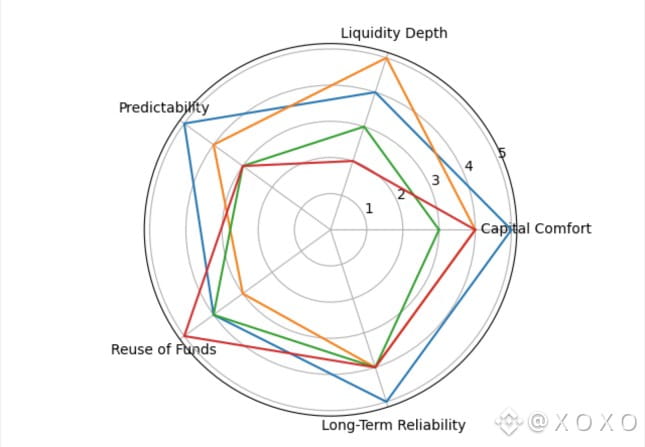
Lending becomes the first anchor. Lending is not exciting in the way trading is exciting, yet it is where capital rests when users want optionality. On Plasma, lending benefits from predictable execution and controlled risk surfaces. When users supply stablecoins into lending markets, they are not just earning yield. They are placing capital into a system where liquidation mechanics behave consistently, interest rates do not swing wildly, and collateral valuation follows expected rules. Even a one to two percent reduction in unexpected liquidation events can dramatically change lender confidence over time.
Moreover, lending on Plasma does not exist in isolation. A lending pool holding 500 million dollars in stable assets does not sit idle. It becomes the source liquidity for other primitives. This is where stable AMMs naturally follow. Stable AMMs thrive when volume is steady rather than explosive. On chains optimized for speed above all else, stable pools often suffer from liquidity fragmentation. Plasma’s environment encourages fewer pools with deeper liquidity. A stable AMM with 200 million dollars in liquidity and daily volume of 50 million dollars produces tighter spreads and lower slippage than ten fragmented pools doing the same volume. That difference compounds daily for traders and liquidity providers.
As a result, stable AMMs on Plasma begin to feel less like trading venues and more like settlement rails. Users are not swapping for excitement. They are swapping because they need to move balances efficiently. This utility-driven flow stabilizes fees and smooths yield. Liquidity providers begin to see returns that look boring in a good way. Five to eight percent annualised yield may not trend on social media, yet it attracts long-term capital that does not flee at the first sign of volatility.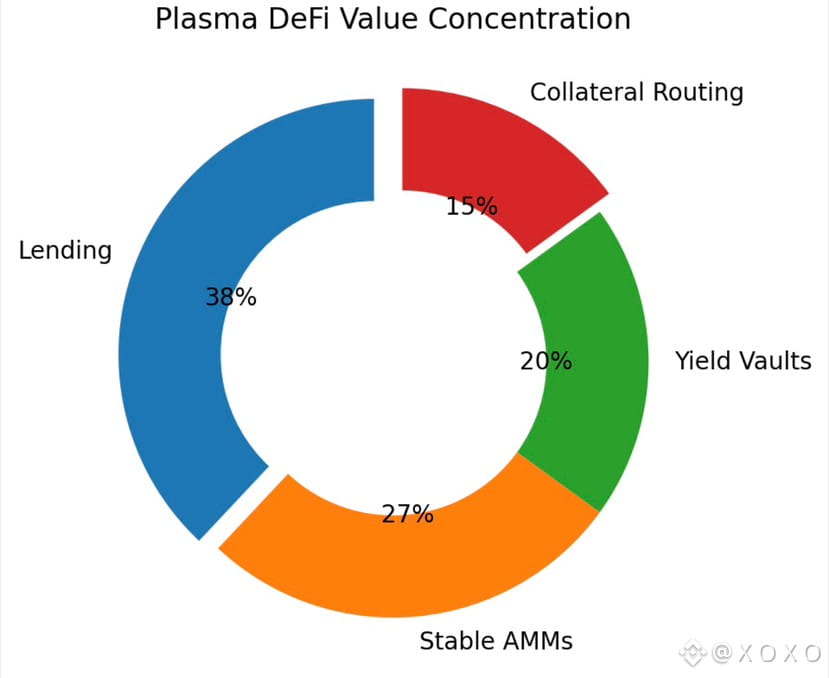
Once lending and stable AMMs are in place, yield vaults naturally emerge as organizers rather than yield chasers. On Plasma, yield vaults are not pressured to invent complexity to stay relevant. Their job becomes simpler. They route capital between lending pools and stable AMMs, adjusting exposure based on utilization and demand. A vault managing 100 million dollars can allocate 60 percent to lending during high borrow demand, then rebalance toward AMMs when swap volume increases. This flexibility allows users to remain passive while capital remains productive.
What makes this sustainable is not clever strategy but reduced uncertainty. Vault users care less about peak APY and more about drawdown control. A vault that delivers a steady seven percent with minimal variance often retains capital longer than one advertising twenty percent that fluctuates wildly. Plasma’s predictability supports this mindset.
Collateral routing then quietly ties everything together. On many chains, collateral is trapped. Assets sit locked in one protocol while another protocol struggles for liquidity. Plasma encourages collateral to move without breaking trust assumptions. A stablecoin used as lending collateral can simultaneously support AMM liquidity or vault strategies under controlled parameters. Even a 10 percent improvement in capital reuse across protocols can significantly increase effective liquidity without attracting new deposits.
This interconnected flow changes how growth happens. Instead of chasing new users to increase TVL, Plasma allows existing capital to do more work. A system with one billion dollars in TVL but high reuse efficiency can outperform a system with two billion dollars fragmented across isolated pools. Over time, this efficiency becomes visible in metrics that matter, such as lower slippage, more stable yields, and fewer stress events.
What stands out is how quiet this all feels. There are no sharp spikes, no dramatic incentives, no constant resets. Plasma does not attempt to redefine DeFi. It simply aligns itself with how financial systems behave when they mature. Lending anchors capital. Stable AMMs move it efficiently. Yield vaults manage it patiently. Collateral routing ensures nothing sits idle for too long.
Plasma is not designed for moments. It is designed for habits. The DeFi primitives that fit best are the ones people return to without thinking. When DeFi stops feeling like an experiment and starts feeling like infrastructure, these are the building blocks that remain. Plasma understands this quietly, and that may be its strongest advantage.