
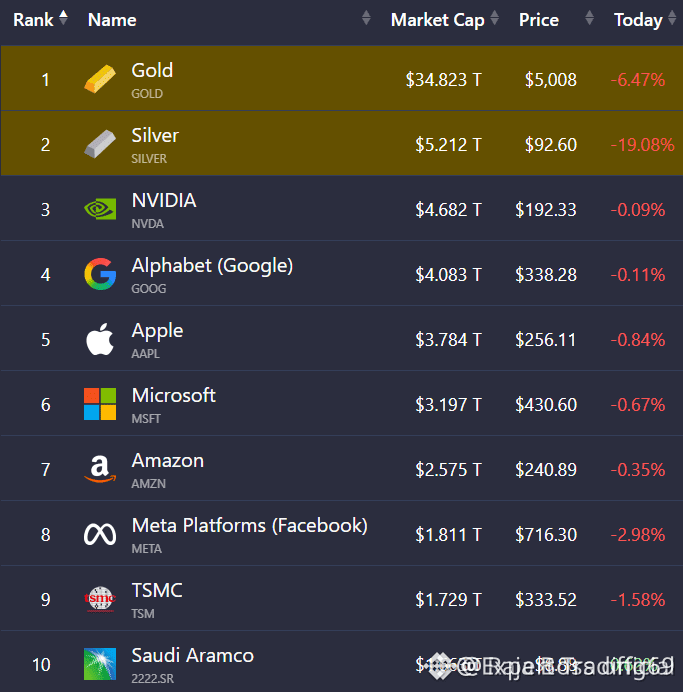
🔥🔥Bitcoin is no Longer a Top 10 Asset: What Went Wrong and What Comes Next🔥🔥
For more than a decade, Bitcoin stood as an undisputed giant in the global financial world. It wasn’t just the first cryptocurrency—it was a symbol of decentralization, financial freedom, and digital gold. There was a time when Bitcoin proudly held a position among the world’s top 10 assets by market capitalization, competing with tech giants and precious metals. But today, that era has paused. Bitcoin is no longer a top 10 asset, and this shift has sparked intense debate across the crypto community.
So, what happened?
One major reason is the rise of traditional tech and AI-driven companies. Over the past few years, firms focused on artificial intelligence, semiconductors, and cloud computing have experienced explosive growth. Investors chasing predictable revenue and rapid innovation have poured trillions into these sectors, pushing their market capitalizations far beyond what Bitcoin could sustain during a volatile market cycle.
Another key factor is Bitcoin’s price stagnation compared to earlier bull runs. While Bitcoin remains the largest cryptocurrency by market cap, its growth has slowed relative to other global assets. High interest rates, tighter monetary policies, and macroeconomic uncertainty have reduced risk appetite. Institutional investors—once seen as Bitcoin’s ticket to permanent dominance—have become more cautious, reallocating capital toward bonds, equities, and AI-focused stocks.
Regulatory pressure has also played a role. Governments around the world are still struggling to define clear crypto regulations. Uncertainty around taxation, compliance, and legal frameworks has kept many large investors on the sidelines. Unlike companies that generate cash flow and dividends, Bitcoin relies heavily on narrative and demand, which can weaken during regulatory fear.
However, being outside the top 10 does not mean Bitcoin has failed.
Bitcoin was never designed to compete with corporations; it was designed to challenge the concept of centralized money. Its strength lies not in rankings, but in resilience. Bitcoin has survived multiple crashes, bans, and declarations of “death.” Each time, it has returned stronger, with improved infrastructure, wider adoption, and a more educated user base.
In fact, some analysts argue that Bitcoin leaving the top 10 could be healthy. Lower hype often leads to stronger accumulation phases. Long-term holders continue to grow, supply on exchanges is decreasing, and Bitcoin’s halving cycle remains intact. These fundamentals suggest that Bitcoin’s story is far from over.
History shows that Bitcoin moves in cycles—periods of explosive growth followed by quiet consolidation. Today may feel like decline, but it could simply be preparation for the next phase.
Bitcoin may no longer sit in the top 10 assets today, but dismissing it would be a mistake. In a world facing inflation, debt crises, and monetary instability, Bitcoin’s original purpose still matters.
The throne may be temporarily empty—but the king hasn’t left the battlefield.
Bitcoin Is No Longer a Top 10 Asset: Key Reasons and What It Means
1. Bitcoin’s Exit from the Top 10 Assets
For many years, Bitcoin ranked among the world’s top 10 assets by market capitalization, standing alongside global tech giants and precious metals. Its recent drop from this list marks a major psychological shift for investors and the crypto community, raising questions about its current position in global finance.
2. Rapid Growth of Tech and AI Companies
One of the biggest reasons behind Bitcoin’s decline in ranking is the explosive rise of AI, semiconductor, and cloud-based companies. These firms have attracted massive institutional capital due to strong revenues and future growth potential, pushing their valuations far above Bitcoin during the same period.
3. Macroeconomic Pressure and Investor Caution
High interest rates, inflation control policies, and global economic uncertainty have reduced investors’ appetite for high-risk assets. As a result, capital has flowed out of speculative markets, including Bitcoin, and into safer or more predictable investments.
4. Regulatory Uncertainty Around Crypto
Ongoing regulatory debates across major economies continue to impact Bitcoin’s growth. Unclear laws around taxation, compliance, and usage have made large investors hesitant, limiting fresh capital inflows compared to regulated traditional assets.
5. Slower Price Momentum Compared to Past Cycles
Bitcoin’s earlier bull runs were driven by strong narratives and rapid adoption. In recent times, price growth has been slower, making it harder for Bitcoin to keep pace with fast-growing global assets and maintain a top 10 position.
6. Being Outside the Top 10 Is Not the End
Despite the drop in ranking, Bitcoin remains the largest cryptocurrency and the most decentralized digital asset. Its core fundamentals—fixed supply, security, and global accessibility—remain unchanged, even when market sentiment turns negative.
7. Historical Cycles Suggest a Comeback Is Possible
Bitcoin has repeatedly experienced phases of decline followed by strong recoveries. Reduced hype often leads to accumulation by long-term holders, setting the stage for future growth as market conditions improve.
8. Long-Term Relevance Still Remains
Bitcoin was created as an alternative to centralized monetary systems, not as a competitor to corporations. In a world of rising debt and currency devaluation, its original purpose continues to attract believers and long-term investors.
9. Final Thought
Bitcoin may no longer be a top 10 asset today, but its journey is far from over. Rankings change, narratives evolve, but Bitcoin’s role in the financial ecosystem continues to hold significance.
If you want this more bullish, more critical, or shorter for social media, just tell me 👍
You said:
Write it above 600 words
ChatGPT said:
Got it 👍
Here is a serially written post (1, 2, 3…) with more than 600 words, clear, analytical, and suitable for blogs or long social posts:
Bitcoin Is No Longer a Top 10 Asset: A Detailed Breakdown of Why It Happened and What Lies Ahead
1. Bitcoin’s Historic Position in Global Finance
For more than a decade, Bitcoin held a unique and powerful position in the global financial ecosystem. As the first decentralized digital currency, it reshaped how people viewed money, value storage, and financial independence. At its peak, Bitcoin ranked among the world’s top 10 assets by market capitalization, competing with gold, oil giants, and the largest technology companies. This achievement was symbolic—it showed that a decentralized digital asset could stand alongside centuries-old financial instruments and trillion-dollar corporations.
2. The Recent Fall from the Top 10 Asset Ranking
Bitcoin’s exit from the top 10 assets list does not mean it has collapsed, but it does signal a shift in global capital allocation. Market capitalization rankings are dynamic, and Bitcoin’s position has changed due to slower price growth combined with rapid expansion in other sectors. This shift has triggered discussions about whether Bitcoin is losing relevance or simply entering a new phase of its life cycle.
3. The Explosive Rise of AI and Technology Giants
One of the biggest contributors to Bitcoin losing its top 10 status is the extraordinary growth of artificial intelligence and technology-focused companies. Businesses involved in AI chips, data centers, automation, and cloud infrastructure have seen massive investor demand. These companies generate predictable revenues and profits, which attract institutional investors during uncertain economic periods. As a result, their market capitalizations surged, pushing Bitcoin down the rankings even without a dramatic crash.
4. Global Macroeconomic Conditions Impacting Risk Assets
High interest rates, inflation-control policies, and tightening monetary conditions have significantly affected risk assets like Bitcoin. When interest rates rise, investors often prefer bonds and traditional financial instruments that offer stable returns. Bitcoin, which does not generate yield or dividends, becomes less attractive in such an environment. This macroeconomic pressure has reduced new capital inflows, slowing Bitcoin’s upward momentum.
5. Institutional Investors Becoming More Selective
While institutional adoption of Bitcoin was once seen as inevitable, reality has proven more complex. Large funds and corporations are increasingly selective, focusing on assets with clearer regulations, predictable cash flows, and lower volatility. Although Bitcoin is still held by institutions, their pace of accumulation has slowed, allowing other assets to overtake it in market capitalization.
6. Ongoing Regulatory Uncertainty Around Bitcoin
Regulation remains one of Bitcoin’s biggest challenges. Different countries continue to take different approaches—some supportive, others restrictive. Unclear taxation rules, compliance requirements, and legal classifications create uncertainty for investors. Unlike publicly listed companies that operate under well-defined regulatory frameworks, Bitcoin exists in a gray zone, which can limit large-scale adoption and valuation growth.
7. Bitcoin’s Price Consolidation Phase
Bitcoin is currently in a consolidation phase rather than a strong uptrend. After multiple aggressive bull cycles, periods of sideways movement are natural. During these phases, Bitcoin may underperform compared to rapidly growing stocks or emerging industries. However, historically, such consolidation periods have often preceded major upward moves.
8. Why Leaving the Top 10 Does Not Mean Failure
It is important to understand that Bitcoin was never designed to chase rankings. Its primary purpose is decentralization, censorship resistance, and protection against monetary manipulation. These fundamentals remain intact regardless of market position. Bitcoin continues to operate without central authority, remains highly secure, and is accessible to anyone with an internet connection.
9. Strong On-Chain Fundamentals Still Exist
Despite the change in ranking, Bitcoin’s network fundamentals remain strong. Long-term holders continue to accumulate, exchange reserves are relatively low, and the fixed supply of 21 million coins remains unchanged. These factors suggest that many investors still believe in Bitcoin’s long-term value proposition.
10. The Importance of Market Cycles in Bitcoin’s History
Bitcoin has always moved in cycles driven by halving events, liquidity conditions, and investor sentiment. Each cycle includes periods of extreme optimism followed by corrections and consolidation. Bitcoin’s current position outside the top 10 could simply represent a mid-cycle or late-cycle phase rather than a permanent decline.
11. Changing Narratives in the Financial World
Narratives play a major role in asset valuation. At present, AI, automation, and productivity gains dominate investor attention. Bitcoin’s narrative as “digital gold” tends to gain strength during times of financial crisis or currency debasement. As global debt levels rise and monetary risks return, Bitcoin’s narrative could regain momentum.
12. Long-Term Outlook for Bitcoin
Bitcoin may no longer be a top 10 asset today, but its long-term relevance remains strong. As a hedge against inflation, a decentralized store of value, and a borderless financial tool, Bitcoin continues to serve a unique role that no corporation or traditional asset can fully replace.
13. Final Conclusion
Bitcoin’s exit from the top 10 assets is not the end of its story—it is a chapter. Markets evolve, rankings change, and capital flows shift with time. Bitcoin has already proven its resilience through multiple cycles of skepticism and revival. Whether it re-enters the top 10 or not, Bitcoin’s impact on global finance is permanent.