
A couple months ago I was testing some on-chain transfers for a small portfolio setup. Nothing big. Just seeing how tokenized assets behave when you actually move them around. What stood out right away was that uncomfortable feeling of exposure. You send value and everything is visible. Amounts, addresses, timing. All of it. I ended up checking privacy layers more than once, adding extra steps, even thinking about mixers, and it just felt awkward. Like trying to seal something that was never meant to be sealed in the first place. Fees kept stacking and I still was not fully confident it was private. The thought of audits later made it worse. Speed was fine, but reliability felt thin. One mistake and everything is public. Sitting there waiting for confirmations, wondering if someone could still trace it anyway, made the whole thing feel heavier than it should. Those small frictions pile up fast.
That is kind of the bigger issue with how most blockchains handle privacy. It is usually an add-on. Transparency comes first, privacy comes later. That works until you actually need confidentiality without breaking compliance. Then everything turns into workarounds. Wrapping assets, hopping chains, trusting custodians. Each step adds cost and uncertainty. During busy periods you start questioning whether privacy even holds up. UX does not help either. Multiple wallets, manual proofs, settlement delays. For institutions touching regulated assets, this is where things stall. You cannot expose everything, but you also cannot hide it all. That tension slows adoption where things should be simple.

It feels like sending something sensitive in a clear envelope. Everyone along the way can see it, so you keep adding layers, slowing things down, instead of using something built to be sealed from the start.
This is where Dusk comes in. Not as hype, just as a chain designed around privacy first. It runs as a Layer 1 where transactions are confidential by default, using zero-knowledge proofs, but can still be verified when needed. The idea is auditable privacy. Data stays hidden unless disclosure is required. That logic is built into the protocol rather than layered on top. The focus is clearly regulatory fit. It supports checks and disclosures without putting the entire ledger in the open. That is different from most public chains and makes more sense for institutional use, where leaking data can create real problems. In practice, it removes a lot of operational friction. Fewer extra steps, less uncertainty around compliance, and no need to bolt privacy on later. The modular setup splits execution through the Rusk VM from consensus, so developers can deploy confidential contracts directly. Things like the XSC standard for tokenized securities exist because of that structure, not despite it.
$DUSK as a token is mostly mechanical here. It pays transaction fees, which include the cost of generating zero-knowledge proofs and running the network. Structurally, staking ties into consensus, where users stake DUSK to act as provisioners or block generators and earn rewards. Settlement uses DUSK as the native unit for confidential transfers. From a systems perspective, governance also runs through it, with holders voting on protocol changes like tuning ZK parameters. Security incentives are backed by staking and slashing when nodes misbehave. Nothing flashy, just infrastructure roles.
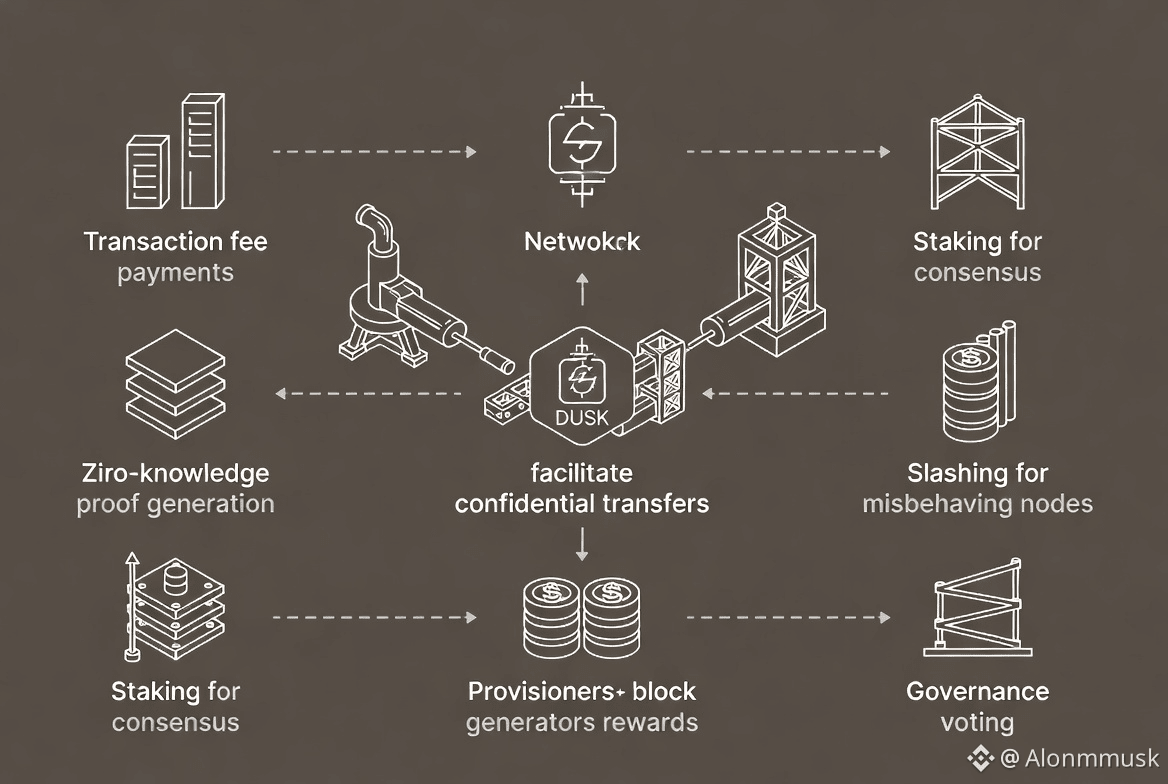
Right now, circulating supply sits around 497 million DUSK, with market cap around 55 million dollars as of late January 2026. That feels reasonable for a niche privacy chain. Activity is not huge. A few thousand transactions per day. The focus seems to be more on financial use cases than pushing raw volume.
Short term, traders jump on headlines. A partnership rumor pops up, price spikes, then cools off. That cycle repeats. Infrastructure value shows up differently. It builds when things just work. When settlements are private and reliable, users come back. The second transaction matters more than the first. That is how habits form.
There are still real risks. If tokenized RWA activity spikes hard, especially after something like the DuskEVM mainnet launch expected in Q1 2026, zero-knowledge proof generation could become a bottleneck. Transactions queue, fees rise, and settlement slows. The modular design helps, but heavy confidential contracts could still stress the Rusk VM. Competition is also there. Other privacy-focused projects exist, and Ethereum ZK rollups could pull institutions away with deeper liquidity. #Dusk compliance angle helps, but adoption tends to be not guaranteed. Consensus tradeoffs matter too. The reason for this tends to be that proof of Blind Bid keeps bids private, but relies on a dual-node setup that could centralize if staking concentrates. Settlement uses Segregated Byzantine Agreement for fast finality, assuming honest majority. If that breaks, forks are possible, even with slashing.
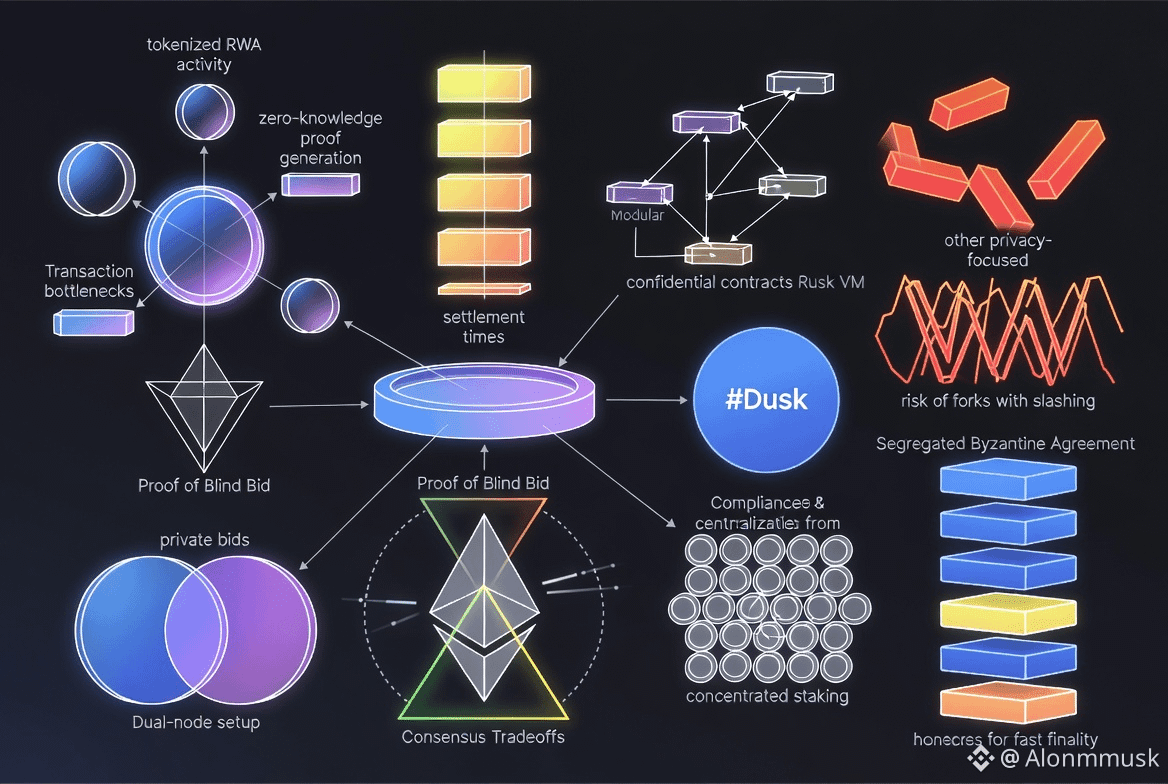
Regulation adds uncertainty. It is not clear how fast different jurisdictions will fully accept ZK-based compliance. Integrations like Chainlink standards and partnerships like NPEX help, but broader uptake depends on regulators catching up.
In the end, this kind of infrastructure proves itself slowly. If people come back because the second transaction feels as solid as the first, it sticks. If friction creeps back in, it does not. That is really the part worth watching.
@Dusk #Dusk $DUSK