

In most blockchains, the relationship between users and validators is more fragile than it appears. On the surface, both groups seem aligned. Users want transactions processed quickly and cheaply. Validators want fees and rewards. However, once real economic activity enters the picture, cracks begin to show. Validators often benefit from higher fees, congestion, or complex extraction mechanisms, while users want predictability, privacy, and fairness. When these incentives drift apart, trust slowly erodes.
This is where @Dusk takes a noticeably different path. DUSK is not designed around maximizing raw throughput or fee spikes. Instead, it is built around sustained, repeatable economic activity where both users and validators benefit from the same outcomes over time. The alignment is subtle, but it is deliberate, and it becomes clearer the closer you look at how the network is meant to be used.
To understand this alignment, it helps to first look at who DUSK is actually built for. The primary users are not speculative traders jumping between chains for short-term yield. They are issuers, traders, funds, and applications operating under real-world constraints. These users care about privacy, compliance, and reliability far more than momentary speed. Their activity tends to be consistent rather than explosive. For validators, this kind of activity creates a very different incentive environment.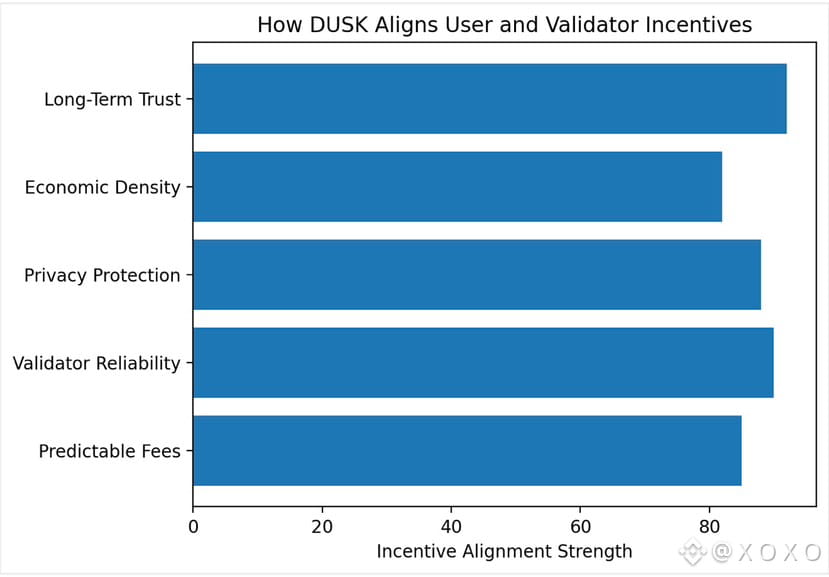
On many chains, validators are incentivized to prioritize high-fee transactions or exploit ordering advantages because transaction flow is unpredictable and often short-lived. In contrast, DUSK’s design encourages validators to value long-term participation over short-term extraction. When transaction volume comes from regulated issuance, private trading, and settlement, the network benefits from stability. Validators earn more by staying honest and reliable than by trying to optimize for edge cases.
One of the most important elements here is privacy by default. On DUSK, transaction details are not openly exposed to the network. This immediately removes an entire class of incentive misalignment that exists elsewhere. Validators cannot front-run what they cannot see. They cannot selectively reorder transactions based on hidden information. As a result, users are protected from behaviors that are common in transparent execution environments, and validators are relieved from the temptation to engage in them.
This changes the validator role from opportunistic executor to trusted infrastructure provider. Their incentive shifts toward uptime, correctness, and reputation. Over time, validators who behave reliably attract more delegated stake and remain active participants in the network. Those who attempt to deviate gain little, because the system does not reward adversarial behavior.
Another layer of alignment comes from the nature of fees themselves. DUSK is designed around economic density rather than transaction count. A single transaction representing the settlement of tokenized securities or fund shares carries far more economic significance than hundreds of speculative swaps. Validators benefit from processing these high-value actions consistently. Users benefit because fees remain predictable and proportional to real usage, not inflated by congestion games.
This predictability matters deeply to users operating under compliance requirements. When costs are stable, they can plan operations confidently. When settlement behavior is consistent, they can integrate blockchain processes into existing financial workflows. Every time this happens, the network becomes more valuable to both sides. Validators see recurring activity rather than spikes. Users see infrastructure they can depend on.
Staking mechanics further reinforce this alignment. Validators are required to commit capital to the network, which ties their financial outcomes directly to the health of the ecosystem. If the network attracts serious economic activity, validator rewards become more sustainable. If trust is broken and users leave, validators feel the impact directly. This creates a feedback loop where validator incentives mirror user interests rather than oppose them.
Delegators play a role here as well. Because DUSK is positioned around institutional-grade use cases, delegation decisions are more likely to consider validator reliability, governance participation, and long-term behavior rather than short-term yield alone. Validators who invest in proper infrastructure, compliance readiness, and network participation are rewarded with more stake. This further discourages reckless behaviour.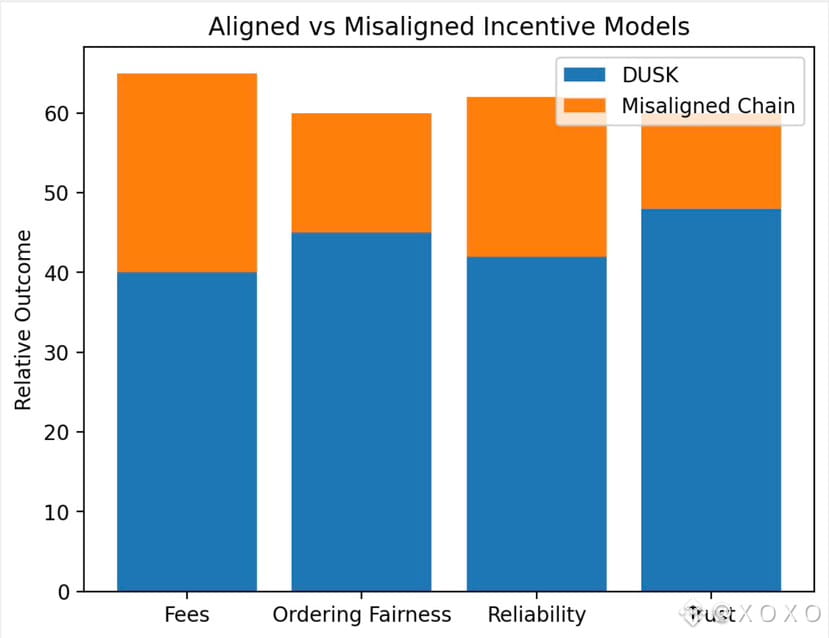
Governance also contributes to incentive alignment. Changes to the protocol are not framed around maximizing speculative excitement, but around maintaining regulatory compatibility and operational stability. Users benefit because the rules of the system do not shift unpredictably. Validators benefit because they can invest in infrastructure with confidence that the network’s direction will not abruptly undermine their role. Over time, this creates a shared interest in cautious, deliberate evolution.
Another important aspect is how DUSK treats failure and accountability. In environments where validators can extract value without consequence, trust decays quickly. On DUSK, the emphasis on verifiable correctness and auditability ensures that misbehavior is detectable even when transactions are private. This balance between privacy and accountability is critical. Users can trust that their data is protected, while validators remain accountable to the network’s rules.
This dynamic becomes especially important as real economic activity scales. Institutions do not tolerate environments where incentives are misaligned. They expect infrastructure providers to behave predictably and transparently within defined boundaries. By designing validator incentives around these expectations, DUSK makes itself compatible with the way real markets operate.
There is also a cultural element to this alignment. DUSK does not market itself as a playground for experimentation. It presents itself as financial infrastructure. This framing attracts validators and users who share similar priorities. Participants enter the ecosystem with an understanding that long-term reliability matters more than short-term advantage. Culture, while intangible, plays a powerful role in reinforcing incentive alignment.
Over time, this alignment compounds. As more real-world assets and applications are deployed on DUSK, the cost of misalignment increases. Validators have more to lose by acting against user interests. Users have more reason to stay because the network becomes embedded in their operations. This mutual dependence creates resilience that is difficult to replicate in more speculative environments.
In my view, DUSK’s approach to incentives is not flashy, but it is realistic. It assumes that users and validators will act in their own interest, and then designs the system so those interests point in the same direction. Instead of trying to eliminate incentives, it channels them toward outcomes that support trust, privacy, and long-term economic activity. In a space where misaligned incentives have caused repeated failures, this quiet alignment may prove to be one of DUSK’s most important strengths.