
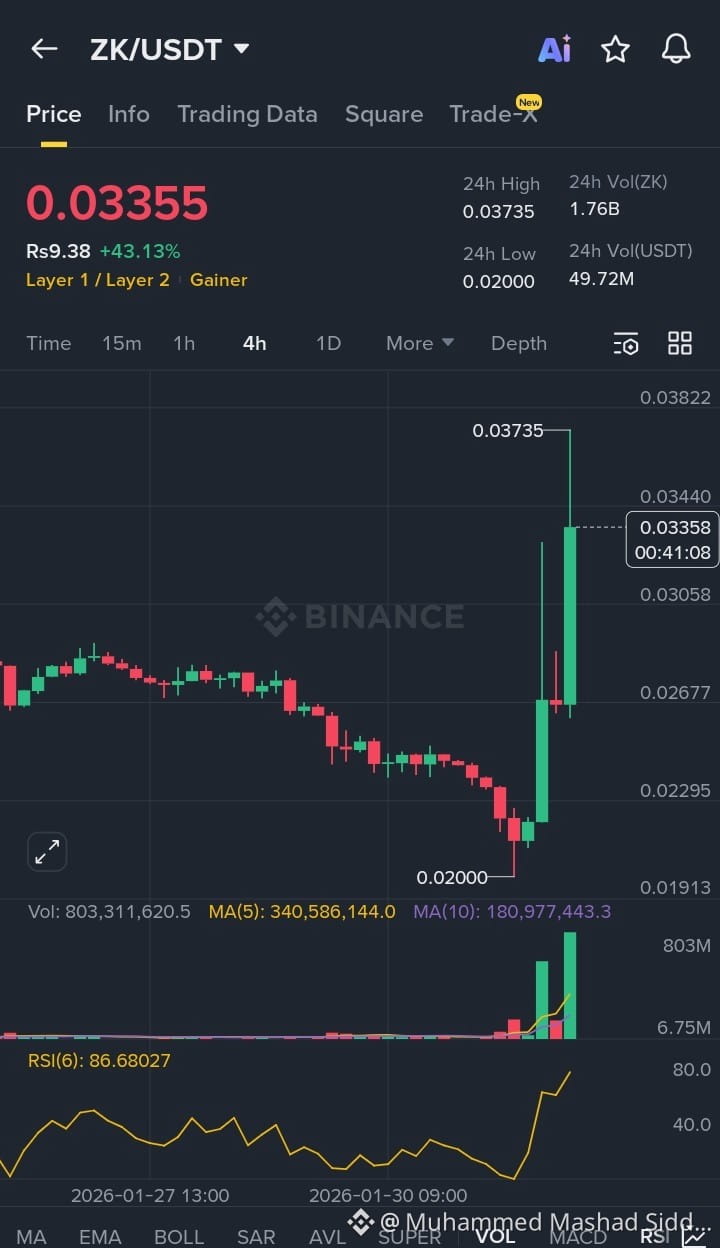
The pump isn't just random volatility; it is driven by four primary catalysts:
Ethereum Foundation Funding: On January 27, 2026, the Ethereum Foundation announced a massive $7.38 million allocation for Q4 2025, specifically targeting Zero-Knowledge (ZK) technology. As a leading ZK-rollup, ZKsync is the primary beneficiary of this institutional validation.
The $ZK " Overhaul: Matter Labs (the team behind ZKsync) proposed a shift from a simple governance token to a utility-driven model. This includes using network fees for token buybacks and burns, which creates a deflationary "flywheel" effect that investors find highly attractive.#WhenWillBTCRebound
2026 Roadmap (Enterprise Focus): The new roadmap introduces Prividium (bank-grade privacy) and Airbender (the world's fastest RISC-V zkVM). By pivoting toward institutional adoption and real-world assets (RWA), ZKsync is positioning itself as more than just a retail trading layer.
Technical Rebound: Before this pump, ZK was trading in an "oversold" zone (RSI below 30). This created a "spring" effect where even small positive news caused a disproportionate price bounce as shorts were liquidated.
2. Similar Coins (Same Use Case)
ZKsync belongs to the Layer-2 (L2) Scaling and Zero-Knowledge Proof (ZKP) categories. These projects aim to make Ethereum faster and cheaper without compromising security.
Coin Name Symbol Primary Similarity
Starknet $STRK Also uses ZK-rollups; direct rival in technology and developer activity.
Polygon $POL (MATIC) Uses ZK technology for its "AggLayer" and CDK to scale Ethereum.
Arbitrum ARB The current leader in L2 TVL (Total Value Locked); competitor for dApp dominance.
Optimism OP Competitor using "Optimistic Rollups" but moving toward ZK integration.
Manta Network MANTA A modular L2 focusing specifically on ZK-enabled privacy applications.