

If you’ve ever worked in the back office of a financial institution, you know the "quiet nightmare" of reconciliation. It’s that invisible friction where systems don’t talk to each other, data gets lost in translation, and millions are spent every year just to prove that "Money A" actually reached "Destination B." When I look at Dusk, I don't see another blockchain trying to be a faster version of Ethereum. I see a specialized machine designed to kill the reconciliation crisis.
In traditional markets, a trade is just the beginning. The real work—clearing and settlement—happens in the shadows, often taking days (T+2) and involving multiple intermediaries. Why? Because no one trusts the "finality" of a digital entry until several hands have shaken on it. This delay is not just a nuisance; it’s a massive capital inefficiency.
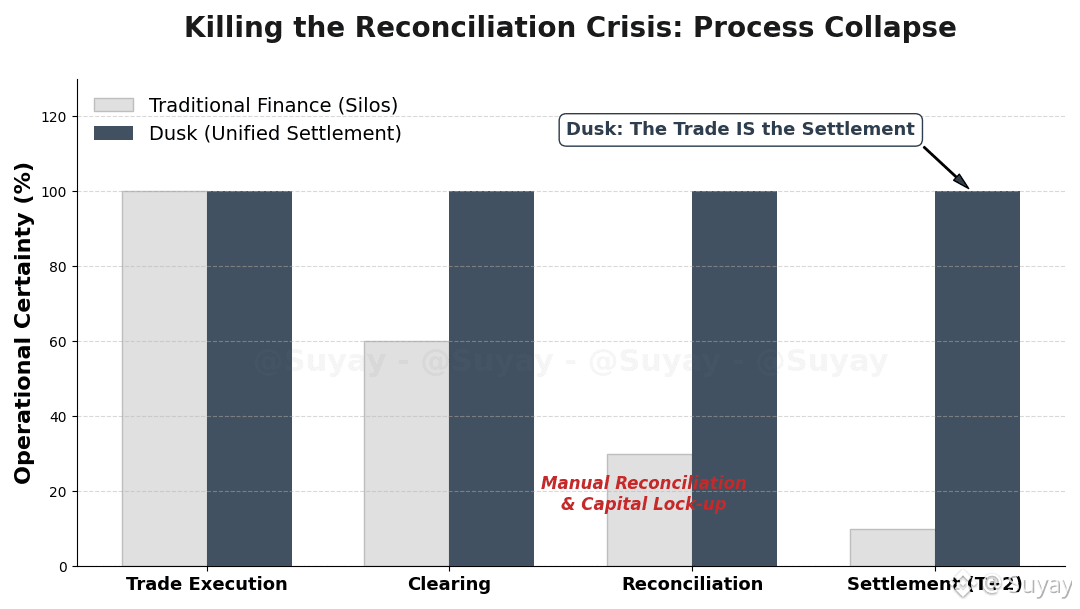
Dusk’s SBA (Segregated Byzantine Agreement) consensus changes the fundamental unit of trust. By providing instant, deterministic finality, the trade is the settlement. There is no "waiting period" because there is no possibility of a fork. For a platform like DuskTrade, moving €300M in tokenized securities isn't about speed; it's about the fact that once a block is confirmed, the legal ownership has moved irreversibly.
I’ve heard critics say that the 1,000 $DUSK stake for Provisioners is just a technical detail. I disagree. It’s an economic guarantee. In the Dusk ecosystem, validators aren't just "mining" coins; they are acting as the decentralized clearing houses of the future. They are the guardians of a ledger that obeys MiCA regulations and respects GDPR through Zero-Knowledge Proofs (ZKP). This "Regulatory Edge" is what sets Dusk apart from the chaotic experimentation we see in other Layer 1s.
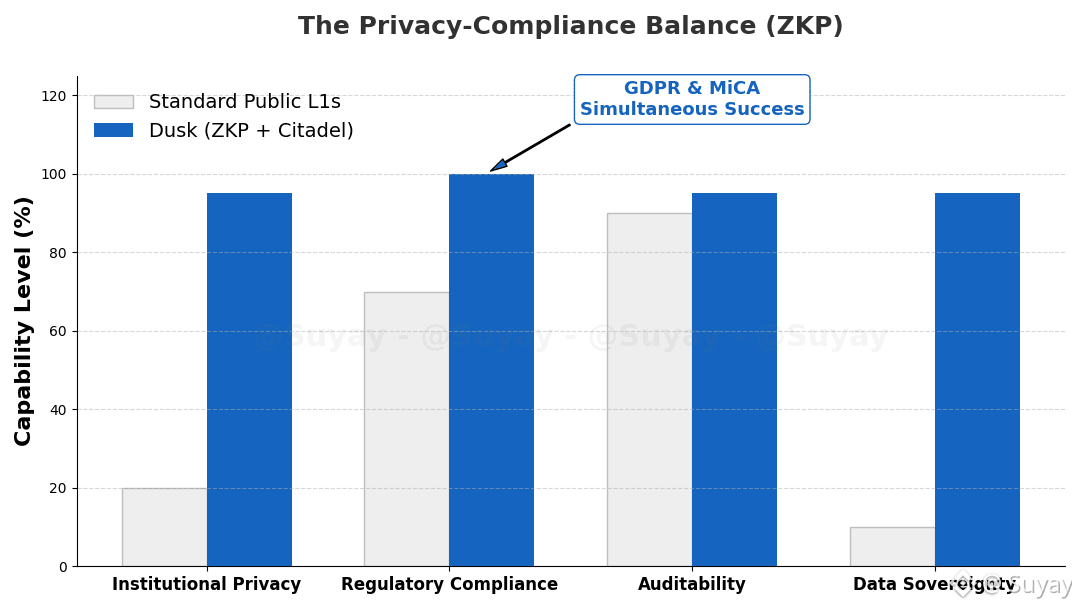
The market is currently obsessed with "mass adoption" of retail apps. But the real money—the trillion-dollar capital markets—is waiting for an infrastructure that doesn't break when things get complicated. They need a network that handles privacy as a right and compliance as a requirement. Institutions don't move to a chain because it's "cool"; they move because it reduces their operational risk.
Dusk is building the "boring" parts of finance: the settlement rails, the auditable privacy, and the legal finality. And in a world of chaotic volatility, "boring" but reliable infrastructure is the only thing that will survive the next decade of institutional migration. As we look towards the Mainnet launch, the question isn't how many transactions we can fit in a second, but how much certainty we can provide to the world's most demanding investors.
Would you rather bet on the next hype cycle or on the rails that will carry the global bond market? I know where I’m placing my stake.
